Santa Teresa in October: Rain, Crowds, and Rooms
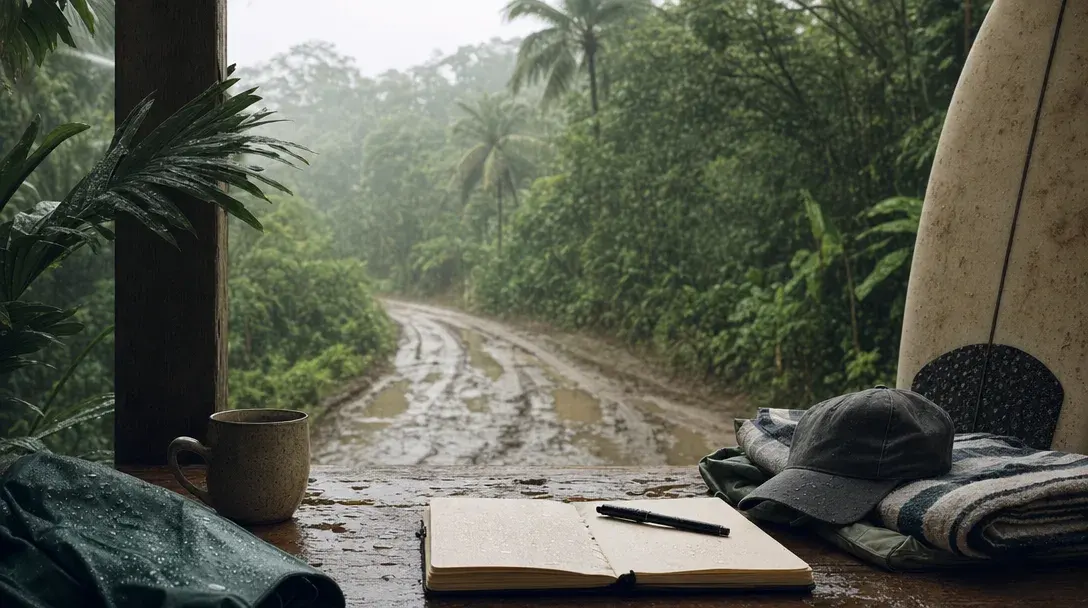
October is Santa Teresa’s wettest stretch, but it also brings quieter beaches, lower rates, and fewer crowds. The tradeoff is rain, mud, and a trip that rewards flexibility.
Key takeaways
- Santa Teresa in October is one of the peninsula's cheapest and quietest months, and also one of its wettest: weather-and-climate.com's long-run average puts rainfall at **432 mm (17 in)** across 21 rainy days.
- October is one of Santa Teresa's wettest months by the numbers, not a vague in-between stretch.
- Full-day rain is more common in October than earlier in the season, and it's the main reason locals treat late green season differently from the May-through-August stretch.
- October closures in Santa Teresa are selective, not townwide, and that distinction matters more than most trip-planning advice suggests.
Is Santa Teresa Worth Visiting in October?
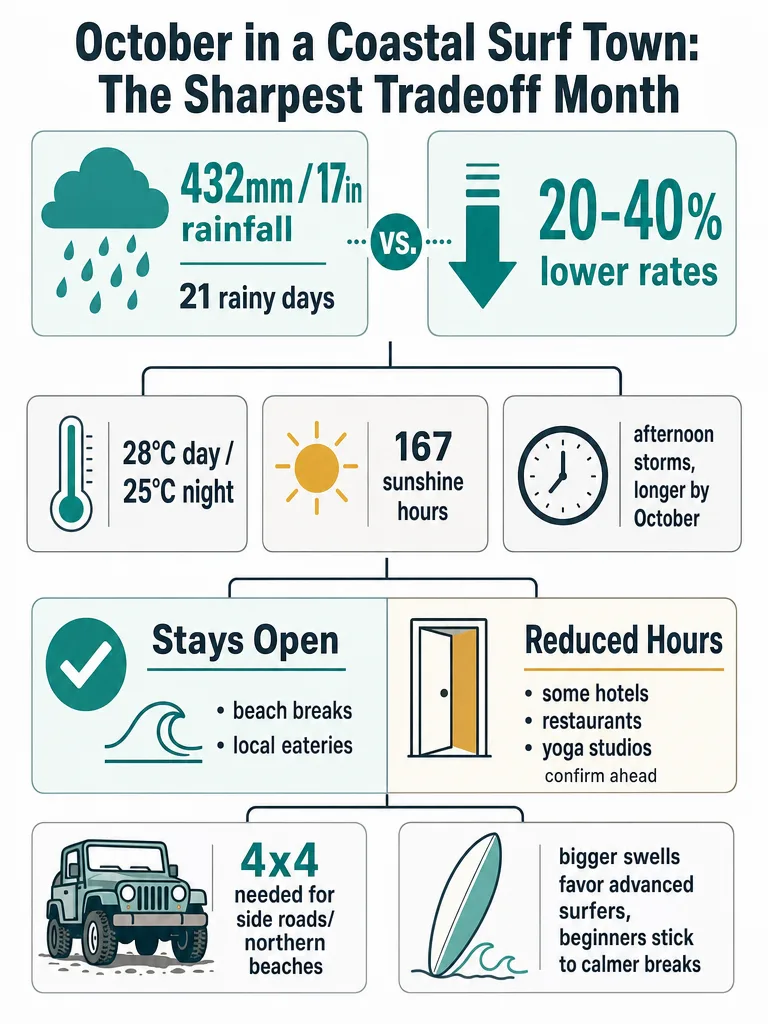
Santa Teresa in October is one of the peninsula's cheapest and quietest months, and also one of its wettest: weather-and-climate.com's long-run average puts rainfall at 432 mm (17 in) across 21 rainy days. The combination rewards travelers who can flex around storms more than those needing a guaranteed dry afternoon.
This is the deep end of what locals call invierno, or green season. YokoVillage, which tracks the May-through-November wet stretch for the town, notes that locals and many expats actually prefer it, and October sits near the far edge of that stretch: empty beaches, quiet breaks, and rooms nobody else is bidding on. The rain isn't a footnote here. It's the main variable that decides whether your trip feels relaxed or frustrating.
The honest split is by traveler type. If your plans center on surfing, slow mornings, long lunches, and evenings that start once the storm passes, October works fine and typically costs less than the December-to-April dry season. If you need three or four locked-in dry days for a short trip, a wedding, or a tour you can't reschedule, October is a riskier bet than dry season or the gentler early green-season months of May and June.
October is the tail end of Santa Teresa's wet season, not a mild "transition" month the way some generic travel sites describe it. Treat it as one of the heaviest-rain windows of the year, not a coin flip.
How Much Does It Actually Rain in Santa Teresa in October?
October is one of Santa Teresa's wettest months by the numbers, not a vague in-between stretch. Weather-and-climate.com's 36-year average shows about 432 mm (17 in) of rain falling across 21 days, alongside daytime highs of 28°C (82°F) and warm overnight lows of 25°C (77°F).
| Metric | October average |
|---|---|
| Rainfall | 432 mm (17 in) |
| Rainy days | 21 |
| Daytime high | 28°C (82°F) |
| Overnight low | 25°C (77°F) |
| Sunshine hours | 167 |
Some generic destination pages describe October as a "transition month" with rainfall that "can vary." The local data doesn't support that framing. A separate breakdown of Santa Teresa's 2026 weather patterns puts September and October at roughly 380 mm (15 in) of rain, landing on a similar conclusion to the weather-and-climate.com figures: this is the peak of the wet season, not its midpoint. Some local rankings, including malpais.net's month-by-month guide, go further and call October the single wettest month of the year on the peninsula. October sits at or near the peak of Santa Teresa's rainy season, whichever specific ranking you use. The 167 sunshine hours in the same dataset still matter: even in the wettest month, storms leave real breaks of usable sun, which is the detail the "transition month" framing tends to leave out entirely.
Does It Rain All Day in Santa Teresa in October, or Just in the Afternoon?
Full-day rain is more common in October than earlier in the season, and it's the main reason locals treat late green season differently from the May-through-August stretch. Santa Teresa's classic wet-season pattern is a clear, sunny morning followed by a hard afternoon storm between roughly 2 and 5 PM that clears by evening. That rhythm holds reliably from May through July.
Field reporting on the rainy season draws a clean line here: early green season, from May through August, is the most manageable stretch, while September through November is when rain intensifies and roads suffer most. October sits squarely in that later window, which is why storms are more likely to run longer or arrive outside the usual afternoon slot.
Lapoint, a surf school based in Santa Teresa, frames the wet season in three phases rather than one continuous slog, starting with a manageable onset in May and June. By the time October arrives, the town has moved well past that early phase and into the period when a full afternoon plan, not just a morning one, needs a rain contingency.
Are Hotels, Restaurants, and Surf Schools Still Open in Santa Teresa in October?
October closures in Santa Teresa are selective, not townwide, and that distinction matters more than most trip-planning advice suggests. Some hotels, restaurants, and yoga studios reduce hours or shut down temporarily in September and October, when demand is lowest, but plenty of businesses run a full schedule right through the month.
The mistake is assuming the whole town scales back uniformly. It doesn't. A surf school might run every session as usual while the restaurant two doors down closes for a staff break. The only reliable move is to confirm hours directly with the specific hotel, restaurant, or studio you're planning around before you book, rather than assuming based on the season.
If a spot you're counting on turns out closed for October maintenance, Montezuma is close enough for a same-day swap.
This is also where a short trip gets riskier than a flexible one. Two or three nights built around one specific hotel or dinner reservation leave less room to adjust if that place happens to be on reduced hours the week you're there.
Do You Need a 4x4 in Santa Teresa in October?
A 4x4 becomes genuinely necessary in October for specific trips, not for simply staying near the center of town. Central Playa Carmen, where most restaurants, surf shops, and lodging cluster, is easier to manage without one if you stick to the main roads and skip side streets, though conditions vary after a heavy storm.
The calculus changes the moment you leave that core. Puravida Traveling highly recommends a 4x4 for rainy-season driving in Santa Teresa, and that recommendation applies most directly to side roads and trips toward Manzanillo, Majagua, or Cabo Blanco, where unpaved sections turn to mud and ruts once October's daily rain sets in.
What you're driving to decides whether you need a 4x4, not a blanket rule about the town. A trip that stays within walking distance of Playa Carmen doesn't need one. A trip that includes the northern beaches or the Cabo Blanco reserve access road does. A closer look at whether you need a car in Santa Teresa walks through the lodging-location tradeoffs in more detail if you're still deciding.
Keep reading
- Santa Teresa Rainy Season: What Still Works, What Doesn't
- What to Pack for Santa Teresa: Dust, Rain, and Roads
- Santa Teresa Weather in 2026: Rain, Heat, and Dust
- What to Do in Santa Teresa When the Surf Is Bad: 11 Solid
- Santa Teresa With Kids: What Actually Works
- Santa Teresa Yoga Retreats vs Drop-In Classes: Who Each Fits
Is October Good for Surfing, or Should Beginners Wait?
October surf in Santa Teresa runs bigger and more powerful than the dry-season version, which makes it a better month for advanced surfers than first-timers. Rainy-season surf reporting notes that the Pacific gets stronger south and southwest swells during green season, and breaks at Playa Hermosa and Mal Pais get more powerful and better defined as a result.
| Surf level | Where to go in October | Why |
|---|---|---|
| Advanced | Playa Hermosa, Mal Pais | Bigger, more defined swells from south/southwest green-season energy |
| Beginner | Playa Carmen, low tide | Softer, more forgiving conditions even during bigger-swell months |
| Undecided / mixed group | Playa Carmen morning session | Glassy mornings before afternoon storms build |
Beginners aren't shut out of October, but the smart move is picking the tide, not the break, with the same care. Playa Carmen at low tide stays workable for first-timers even when Hermosa and Mal Pais are running well above beginner comfort. For a fuller month-by-month sense of which spot fits which skill level, a beginner surf guide breaks down conditions break by break. The same rainy-season surf reporting frames it plainly: October rewards surfers chasing size and can humble beginners who show up expecting the same forgiving water they'd find in December.
How Much Cheaper Is Santa Teresa in October, and Is the Discount Worth the Rain?
October rooms in Santa Teresa run meaningfully below peak-season rates, and the discount is real enough to change how a lot of travelers plan their trip. Hotel Tropico Latino reports green-season hotel rates running 20-40% below peak, and separate rainy-season reporting adds a concrete range: mid-range hotels that charge $50-100 per night in dry season often drop by that same 20-40% once green season sets in.
For a longer trip, that math tends to favor October. A week at a discounted rate absorbs a few rained-out afternoons without much cost, and there's more time to route around any business that happens to be closed that week. For a short trip, the tradeoff gets sharper: a two- or three-night stay has less room to recover if a storm eats a planned surf day or a favorite restaurant turns out to be on reduced hours. A guide on how many days in Santa Teresa is actually enough is worth checking before locking in October dates, since the discount matters less on a trip too short to absorb a bad-weather day.
What Should You Pack for Santa Teresa in October?
Packing for Santa Teresa in October means packing for regular afternoon storms, not a light drizzle: weather-and-climate.com's average puts the month at 21 rainy days.
- Rain layer. A lightweight rain jacket holds up better than an umbrella once wind picks up ahead of a storm.
- Quick-dry clothing. With rain most days, clothes that dry between wearings beat anything heavy or cotton-based.
- Closed-toe shoes for mud. Side roads and trail sections turn to real mud in October; sandals won't cut it for anything off the main strip.
- A dry bag for phones and cameras. Afternoon storms arrive fast enough to catch tours and beach days off guard.
- Sandals for everything else. For walking around town and the beach itself, sandals you don't mind getting wet are more practical than trying to keep shoes dry all month.
None of this is exotic gear. It's the same kit that works for any green-season trip here, just leaned on harder in October because the rain shows up more often and stays longer once it does.
FAQ
Will the rainy season in Santa Teresa be lighter than usual in 2026?
Possibly. Costa Rica's Instituto Meteorológico Nacional is forecasting a drier-than-average rainy season for 2026, potentially 10 to 30% below normal rainfall totals, with longer gaps between storms. santateresadirtroad.com, which has tracked local rain gauge data for nearly two decades, flags the shift as worth watching. That could mean more usable beach days than a typical October, though it also brings hotter temperatures and less predictable timing between storms.
Do surf lessons and tours cost less in Santa Teresa during October?
No, surf lesson and tour pricing stays flat year-round even as hotel rates drop. Hotel rates fall 20 to 40% in green season, but lessons, boat trips, and guided tours are priced the same in October as in December. The savings in October come from lodging and food, not from the surf school or tour operator side of a trip.
What can you do in Santa Teresa when it's raining in the afternoon?
Rainy afternoons in Santa Teresa are built around yoga, long lunches, and a massage rather than beach time. Local studios run drop-in yoga classes for roughly $15 to $25 while storms pass, and restaurants along the south end of town are often at their best once the rain sets in. Treat the 2 to 5 PM window as downtime, not dead time, and plan the beach for morning instead.
Is October a good month for bioluminescence tours in Santa Teresa?
Yes, October is one of the better months for a bioluminescence tour in Santa Teresa. Rainy-season runoff carries more nutrients into the water, which increases the plankton responsible for the glow, according to local rainy-season reporting. Pair it with a sunset paddle or snorkel after the afternoon storm clears, since the bay is usually calm again by early evening.
Is Montezuma a good backup if plans in Santa Teresa get rained out?
Yes, Montezuma works as a same-day backup if a Santa Teresa hotel, restaurant, or tour is closed for October maintenance. It sits close enough for a short drive or taxi, and it runs on a different closure schedule than Santa Teresa, so a shutdown in one town doesn't usually mean a shutdown in both. Keep it in mind on short trips with tight reservations.
How does October compare to May or June in Santa Teresa's rainy season?
October sits at the harder end of the rainy season, while May and June mark its gentler opening phase. Lapoint, a local surf school, breaks the wet season into three phases, and field reporting on rainy-season conditions notes that rain intensifies and roads worsen from September through November. Storms in October run longer and fall outside the typical 2 to 5 PM window more often than they do in May or June.
Dogs in Santa Teresa: Beaches, Rentals, and Rules
Dogs in Santa Teresa are common in town, but beach access and rental rules are not the same thing. This guide separates booking tags from real policy so you can book with fewer surprises.
Read →Best Coffee in Santa Teresa That Isn't a Scene
The smartest coffee move in Santa Teresa is usually the closest good café, not the one across town. This guide separates coffee-first stops from breakfast and laptop spots.
Read →Santa Teresa Power and Water Outages: How Locals Cope
Short outages in Santa Teresa usually clear fast, but longer planned shutdowns are part of life on the peninsula. This guide shows the backup stack locals rely on for power and water.
Read →