Santa Teresa or Montezuma? Pick the Right Base Fast
A fast, practical comparison of Santa Teresa and Montezuma for Nicoya Peninsula trips. Use it to choose the base that fits your surf, pace, and logistics.
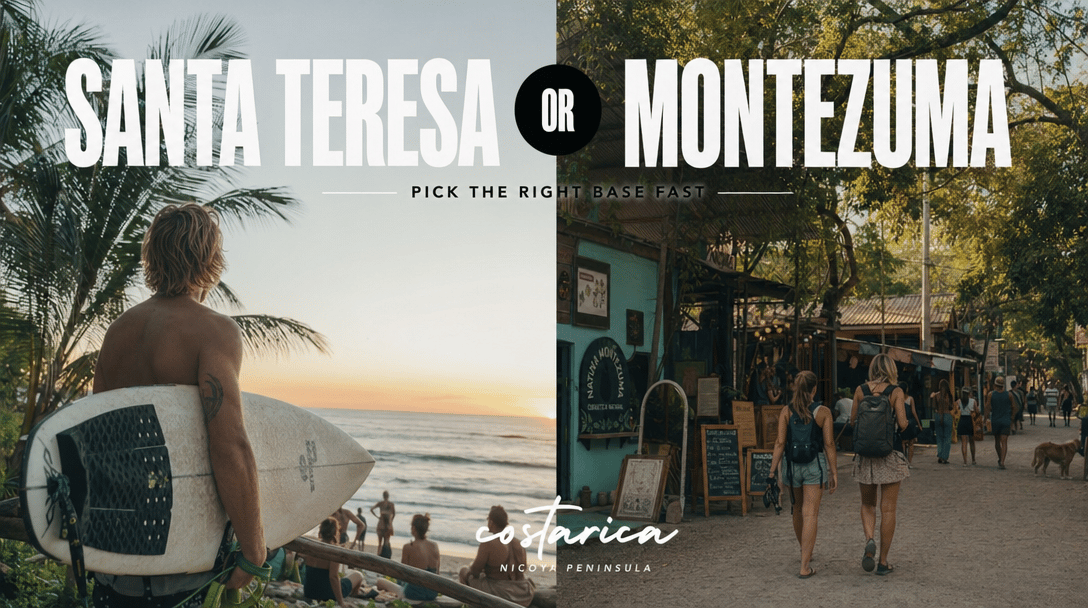
Key takeaways
- If you're choosing a base on the Nicoya Peninsula and don't want to read ten posts to figure it out, here's the short version: **Santa Teresa** is the busier, longer beach town with a strong surf scene, more restaurants, a visible yoga-and-wellness crowd, and enough nightlife to fill a few evenings.
- Santa Teresa is the right base for most travelers on the Nicoya Peninsula — not because it's universally superior, but because it serves a wider range of needs.
- Montezuma suits a specific traveler, and that traveler should know who they are before booking.
- Most people asking this question fall into a handful of recognizable trip types.
Santa Teresa vs Montezuma: the fast decision
If you're choosing a base on the Nicoya Peninsula and don't want to read ten posts to figure it out, here's the short version:
Santa Teresa is the busier, longer beach town with a strong surf scene, more restaurants, a visible yoga-and-wellness crowd, and enough nightlife to fill a few evenings. The beach stretches wide and sandy, the sunsets are genuinely excellent, and there's more logistical infrastructure — food options, transport connections, services — for visitors who want things within reach.
Montezuma is smaller, quieter, and more compact. It has its own character — waterfalls nearby, a slower pace, a more bohemian holdout feel — but fewer restaurants, a rockier beach, and notably less surf access than Santa Teresa's stretch of coast.
| Factor | Santa Teresa | Montezuma |
|---|---|---|
| Beach type | Long, sandy, open | Smaller, rockier |
| Surf quality | Consistent breaks along the coast | Limited surf, not a surf town |
| Restaurant / bar density | High | Low–moderate |
| Town size and bustle | Bigger, busier | Small, quieter |
| Yoga / wellness options | Widespread | Present but fewer |
| Vibe | Active, social | Laid-back, slower |
| Good for first-timers | Yes, easier logistics | Yes, if quieter is the goal |
The decision resolves itself quickly once you know what you're actually optimizing for. If surf access matters at all, Santa Teresa wins outright. If you want somewhere smaller and less trafficked where evenings end early and the pace is genuinely slow, Montezuma makes more sense.
What this guide won't do is pretend both towns suit all travelers equally. They don't. The sections below run through the specific profiles where each base works — and where it doesn't.
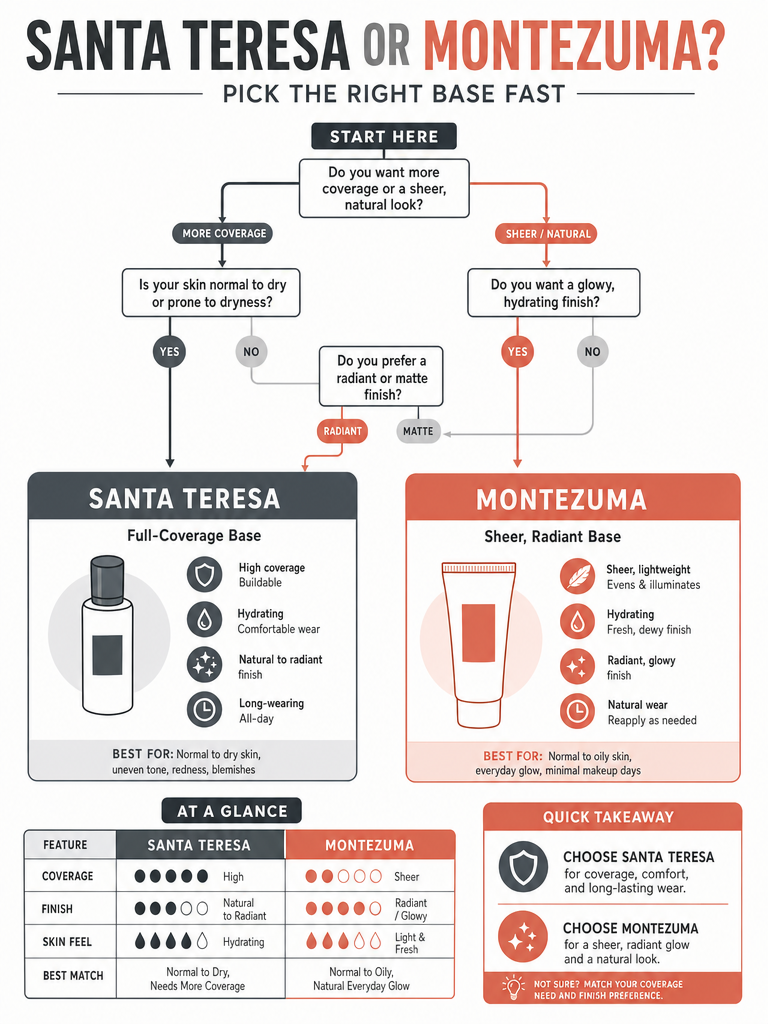
Pick Santa Teresa if you want surf access, more restaurant choice, and a busier social scene
Santa Teresa is the right base for most travelers on the Nicoya Peninsula — not because it's universally superior, but because it serves a wider range of needs.
The beach is long and sandy with consistent surf, which makes it functional for beginners taking lessons and intermediate surfers looking for reliable waves without committing to a remote camp. The town is bigger and busier than Montezuma, though it still retains a relatively laid-back feel compared to Pacific beach towns elsewhere in Costa Rica. If you've heard it's gotten crowded in recent years, that's accurate — but the tradeoff is density of good options.
Who fits Santa Teresa best:
- Surfers at any level who want breaks accessible from their accommodation
- Travelers who want real restaurant variety — multiple cuisines, different price points, places to eat well every night of the week
- Yoga practitioners or anyone looking for retreat-style wellness programming; Santa Teresa has a concentration of yoga studios and retreat operators
- Couples where one person surfs and the other doesn't — there's enough to fill non-surf hours without effort
- Digital nomads who need reliable cafes, co-working options, and enough infrastructure to stay longer than a week
- Anyone arriving via Tambor airport or the Paquera ferry who wants a straightforward onward journey
Santa Teresa, Mal Pais, and Carmen are technically distinct neighborhoods along the same road — locals use the names loosely. When you're comparing accommodation options, note which stretch you're booking in, since the southern end near Mal Pais is quieter than central Santa Teresa.
The sunsets on Santa Teresa's west-facing beach are a consistent payoff regardless of your travel style — that part of the reputation is earned.
Pick Montezuma if you want a smaller, quieter, more laid-back base
Montezuma suits a specific traveler, and that traveler should know who they are before booking.
The town is compact and genuinely slower-paced. It has character that Santa Teresa's more developed strip has partially traded away — less commercial density, a smaller footprint, a community feel that comes with a small-town scale. For travelers who find Santa Teresa's busyness off-putting, or who want evenings that end at the beach rather than at a bar, Montezuma is a legitimate alternative.
For a more laid-back vibe, Montezuma is a great option. (Source: Reddit/CostaRicaTravel)
What Montezuma is not: a surf destination. The beach is rockier and smaller, the surf is limited, and travelers who expect to surf daily from a Montezuma base will be disappointed or spending significant time in transit.
Where Montezuma outperforms Santa Teresa:
- Travelers who actively want fewer people and less noise
- Visitors focused on hiking and waterfalls rather than beach activity
- Anyone who's already done Santa Teresa and wants a contrast
- Budget-conscious travelers who may find slightly fewer options but also slightly less price inflation
The honest constraint is infrastructure. Fewer restaurants means less flexibility if you have dietary needs or simply want variety across a week-long stay. Montezuma works better for shorter visits or for travelers who plan itineraries around specific activities rather than wandering.
Santa Teresa or Montezuma for your trip style
Most people asking this question fall into a handful of recognizable trip types. Here's where each base lands:
| Trip style | Better base | Reason |
|---|---|---|
| Dedicated surfer, 5–10 days | Santa Teresa | Consistent beach breaks, board rentals, lessons, surf community |
| Couple, mixed interests | Santa Teresa | One person surfs, other has restaurants, yoga, beach options |
| Solo first-time visitor | Santa Teresa | More social, easier logistics, more dining choice |
| Traveler seeking quiet and slow pace | Montezuma | Fewer crowds, smaller scale, less commercial noise |
| Hiker / waterfall-focused | Montezuma | Proximity to Montezuma Falls and forest trails |
| Short stay (2–3 nights) | Either, depending on priority | Santa Teresa for surf/food density; Montezuma for contrast |
| Long-stay digital nomad | Santa Teresa | Infrastructure, co-working, consistent services |
| Already visited Santa Teresa | Montezuma | Useful as a contrast, not a like-for-like substitution |
One scenario worth naming: the first-time Nicoya Peninsula visitor who has read that Montezuma is "more authentic" and books there expecting the best of both worlds. Montezuma is not a quieter version of Santa Teresa — it's a different kind of town with different tradeoffs. Treating it as a compromise base often leads to logistical frustration rather than a better trip.
Should you split your stay between Montezuma and Santa Teresa?
Splitting a stay is more common than the logistics suggest it should be. The towns are roughly 1.5–2 hours apart by road, and the route between them is not trivial — it requires a vehicle or a transfer, and the road quality on parts of the Nicoya Peninsula means travel times are real, not approximate.
That said, splitting works in specific scenarios:
- Your trip is 7 days or longer and you genuinely want different experiences rather than depth at one spot
- You're arriving at Tambor airport and routing toward Santa Teresa anyway — Montezuma sits on a different branch of that journey, so combining both in a loop is geographically logical
- You've done one of these towns before and want to add the other without repeating yourself
Where splitting doesn't work: - Trips under 5 days, where transit between towns eats a meaningful percentage of your time - Surfers who want to maximize water time — the transit day to Montezuma is a surf day lost - Travelers who underestimate packing, loading, and finding new accommodation repeatedly
Some travelers add Montezuma to a Santa Teresa trip assuming it's a short day trip. It's not — it's a committed half-day of travel each way. Either stay overnight or skip the diversion.
The honest guidance: most travelers benefit from committing to one base and exploring from it, rather than treating the peninsula like a multi-stop itinerary. Both towns have enough within reach for a full week if you're not trying to replicate the other.
The buyer checklist: choose your base by asking these 6 questions
Run through these before you book. Most itineraries resolve by question three or four.
- Do I plan to surf? If yes, Santa Teresa. If surfing isn't a priority, both towns are eligible.
- How important is restaurant variety? If you want real options every night, Santa Teresa. If you're happy with a small rotation, Montezuma works.
- What's my tolerance for busier, more social environments? Santa Teresa is more energetic. If that's a drawback, Montezuma.
- How long is my stay? Under five days: pick one and go deep. Over seven: a split stay becomes more defensible.
- Do I need reliable services — cafes, ATMs, transport connections? Santa Teresa has more infrastructure density.
- Am I looking for contrast with somewhere I've already been? If you've done Santa Teresa, Montezuma gives you that. Not the other way around — Montezuma doesn't prime you well for Santa Teresa's pace.
If you answered "surf" or "more options" to any of the first two questions, the decision is made. Don't second-guess it.
Use Onda Teresa to pressure-test your base before you book
Once you've landed on a base, the next problem is verifying that the specific accommodation, surf window, or restaurants you're planning around actually hold up.
Onda Teresa is built for exactly this step. The directory covers vetted places to eat, stay, and surf across Santa Teresa, Mal Pais, Montezuma, and nearby towns — without pay-to-play listings or sponsored placements. The surf report updates every 30 minutes with physics-based conditions across multiple breaks, not a single vague forecast. The events calendar and community guides cover practical logistics that most travel content doesn't touch: transport, services, what's actually open.
Use it to cross-check your base choice, find specific places rather than category generalities, and arrive with enough local context that the first two days aren't spent re-researching everything from scratch. For independent travelers who've wasted time on outdated or sponsored content before, that's the actual value — fast access to reliable, locally grounded information about one of Costa Rica's most misrepresented coastlines.
FAQ
How far apart are Santa Teresa and Montezuma, and is a day trip between them realistic?
The two towns sit roughly 1.5–2 hours apart by road, and the route is not a casual drive — road quality on parts of the Nicoya Peninsula means travel times are genuine, not approximate. A day trip is technically possible but eats most of the usable day; if you want to see both properly, plan an overnight rather than a return transfer.
Is Montezuma good for surfing?
No — Montezuma is not a surf town. The beach is smaller and rockier, consistent breaks are limited, and surfers who base there will either be disappointed or spending significant transit time reaching better waves. If surfing is any part of your plan, Santa Teresa is the clear choice.
Which town is better for digital nomads who need to work reliably?
Santa Teresa has meaningfully more infrastructure for longer stays — cafes with usable wifi, co-working options, ATMs, and regular transport connections. Montezuma's smaller footprint means fewer fallback options if your primary workspace or service fails.
What's the difference between Santa Teresa, Mal Pais, and Carmen — are they the same place?
They're distinct neighborhoods strung along the same coastal road, and locals use the names interchangeably, which creates real confusion when booking accommodation. The southern end near Mal Pais is noticeably quieter than central Santa Teresa, so the stretch you land in affects your experience more than the town name alone suggests.
Which town is cheaper to stay in, Santa Teresa or Montezuma?
Montezuma's smaller scale means fewer options overall, but budget travelers sometimes find less price inflation there than in Santa Teresa, where demand from surfers, wellness tourists, and nomads has pushed costs up in recent years. That said, fewer restaurants and services in Montezuma can limit your ability to trade down when you want to.
LaPoint Santa Teresa: Is the Surf Camp Worth It?
Lapoint Santa Teresa is strongest for structured surf weeks and solo travelers who want coaching and a social camp. The tradeoff is rigid scheduling, Monday-only transfers, and limited flexibility.
Read →Is Santa Teresa Safe in 2026? What Changes at Night
Santa Teresa is safe for most visitors in 2026, but the real risks are roads after dark, petty theft, and rip currents. This guide separates crime from the practical hazards that catch travelers off guard in Santa Teresa and Mal Pais.
Read →Do Flights From Liberia to Santa Teresa Exist?
There’s no scheduled direct flight from Liberia to Santa Teresa in 2026. The practical options are a San Jose connection, shuttle, drive, or charter.
Read →