Surfboards on Flights to Santa Teresa: What to Check Before You Book
If you’re flying to Santa Teresa with a board, the key is SANSA’s 6.7-foot cutoff and eight-board cap. This guide also flags the Tambor-to-Cobano airport shift so you book the right route.
Key takeaways
- Yes, surfboards travel on flights to Santa Teresa as checked baggage on the San José to Cobano route, but SANSA caps board length at 6.7 feet (2.04 meters) and carries a maximum of eight surfboards per flight, according to SANSA's published baggage policy.
- SANSA's surfboard limit on flights to Cobano is 6.7 feet (2.04 meters) per board, with a maximum of eight boards carried on any single flight, according to the airline's published baggage rules.
- The sources available here document scheduled San José to Cobano service on SANSA and Costa Rica Green Airways; they don't cover a current scheduled flight between Liberia and Cobano.
Can You Bring a Surfboard on a Flight to Santa Teresa?
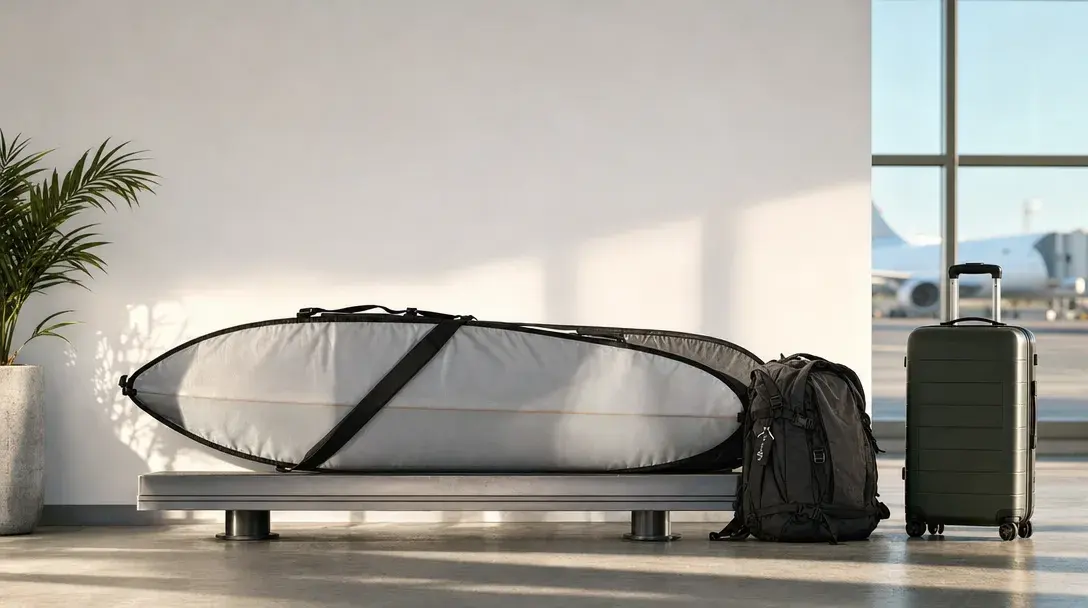
Yes, surfboards travel on flights to Santa Teresa as checked baggage on the San José to Cobano route, but SANSA caps board length at 6.7 feet (2.04 meters) and carries a maximum of eight surfboards per flight, according to SANSA's published baggage policy. For most surfers checking surfboards on flights to Santa Teresa, the real question is whether your board clears that cutoff and whether the flight has board space left that day.
This guide covers the domestic hop between San José and Cobano, the airport serving Santa Teresa. It doesn't cover international airlines' surfboard policies for getting a board into Costa Rica in the first place; that's a separate check with whatever carrier flies you into San José or Liberia.
SANSA, the domestic carrier connecting Juan Santamaría airport in San José to the Cobano airstrip near Santa Teresa, treats a surfboard like any other oversized checked item: it rides in the hold, not the cabin, and costs extra per board. A surfboard limit, in airline terms, is simply the maximum length and headcount a carrier accepts as checked baggage, and SANSA sets that limit at 6.7 feet and eight boards per flight. A standard shortboard or fun-shape clears it without trouble. A longer step-up board, a longboard, or a quiver of several boards can hit either the length ceiling or the per-flight cap, a limit shared across every passenger on that departure, not reserved seat by seat.
A board longer than 6.7 feet rules SANSA out for that departure entirely. A flight already close to its eight-board cap doesn't rule anything out on its own, but it does mean you need to confirm remaining board space with the airline before you book, since that cap is shared across everyone on the flight, not assigned seat by seat.
What Is the Surfboard Size Limit on SANSA Flights to Cobano?
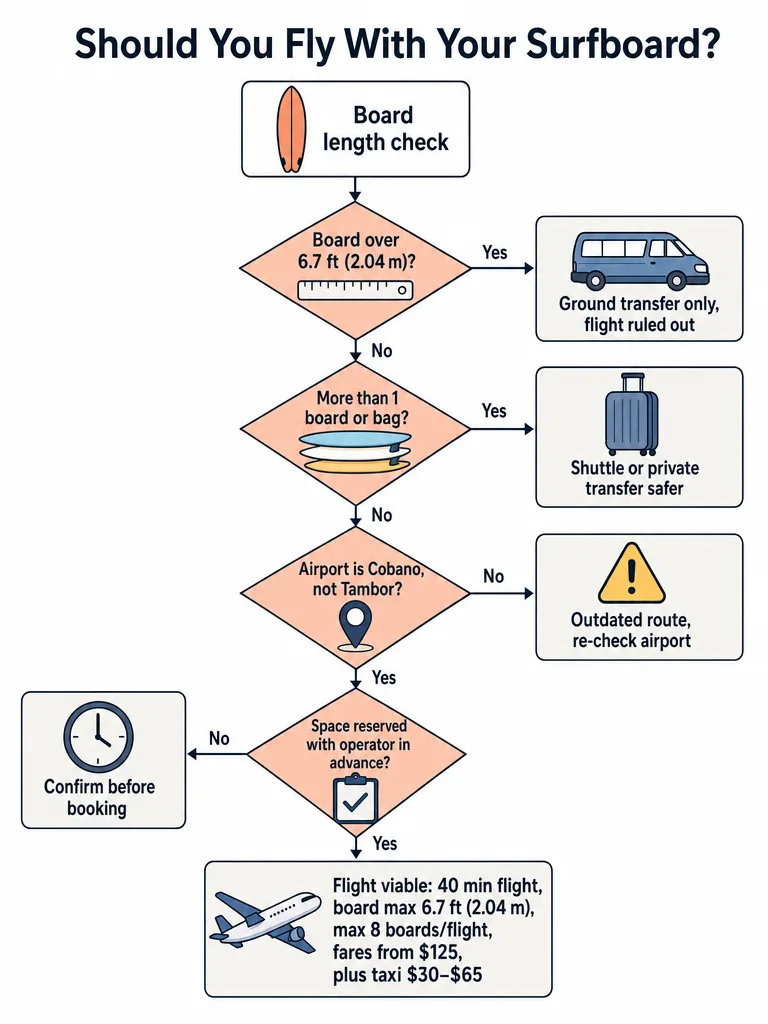
SANSA's surfboard limit on flights to Cobano is 6.7 feet (2.04 meters) per board, with a maximum of eight boards carried on any single flight, according to the airline's published baggage rules. The available sources do not show a published board-length cap for Costa Rica Green Airways, the other carrier flying San José to Cobano, but its checked-weight allowance shifts by fare class, which changes the math for a board bag plus the rest of your luggage.
| Airline | Max board length | Max boards per flight | Checked baggage allowance | Overage fee |
|---|---|---|---|---|
| SANSA | 6.7 ft (2.04 m) | 8 per flight | Not published in SANSA's current baggage terms | Not published; confirm the per-board fee directly with SANSA |
| Costa Rica Green Airways | Not shown in available sources | Not shown in available sources | 50 lb, 40 lb, 35 lb, or 25 lb, depending on fare class | $1-$2 per lb over the allowance, 60 lb cap per passenger |
Surf Vista Villas, a Santa Teresa property that publishes its own travel-logistics page, still warns that smaller planes serving the peninsula carry luggage weight limits and restrictions on surfboards. That's a fair general warning about small aircraft, but the specific numbers on that page, a 25-pound luggage limit and $60-$90 fares, describe the old Tambor route, which no longer runs scheduled service. Read it as a reason small planes are strict about weight, not as a current price sheet for booking a flight with a board today.
Can You Still Fly to Tambor for Santa Teresa?
No. Tambor airport stopped scheduled service in November 2023, and Cobano airport (ACO) replaced it as the airstrip serving Santa Teresa, according to Onda Teresa's 2026 flight-route reporting. Any surfboard-and-flight advice that still points travelers to Tambor, including older guides built around a roughly 30-minute hop and $60-$90 fares, describes a route that no longer operates.
Tambor and Cobano sit close enough together on the peninsula map that outdated listings and old forum threads keep recommending the former. SANSA and Costa Rica Green Airways now fly the San José to Cobano leg instead, and that's the flight to check for surfboard rules, baggage weight, and board-space availability. If a quote, a travel forum, or an older guide still routes you through Tambor, treat it as stale and confirm with the airline that your ticket reads Cobano before you pack the board bag. A related breakdown of why the old Liberia-to-Tambor advice no longer works covers the same airport swap from the Liberia side of the map.
What If You're Flying Into Liberia Instead of San José?
The sources available here document scheduled San José to Cobano service on SANSA and Costa Rica Green Airways; they don't cover a current scheduled flight between Liberia and Cobano. A surfboard traveler landing at Liberia's airport (LIR) is choosing between a two-leg connection through San José or ground transport, not a direct hop to the peninsula.
That extra leg adds a full connecting flight before you even reach the SANSA or Costa Rica Green Airways cutoffs covered above, plus a second round of checked-baggage handling for the board itself. For most board travelers, that added connection erases whatever time a flight might save over driving or shuttling straight from Liberia. A full breakdown of the route options between Liberia and Santa Teresa lays out the shuttle, drive, and connecting-flight math without the board math layered on top.
Should You Fly or Take a Shuttle to Santa Teresa With a Surfboard?
Flying San José to Cobano starts around $125 one way before board fees, according to the same 2026 flight-route guide to Santa Teresa. For a ground comparison, Tropical Tours publishes a $60 per-person fare plus a board fee on its shared shuttle from Santa Teresa to San José Airport, the outbound direction; treat that fare as a benchmark for the return trip rather than a confirmed inbound price, since the available sources don't document the San José-to-Santa-Teresa fare separately.
| Mode | Base fare | Board fee | Transfer add-on | Door-to-door time |
|---|---|---|---|---|
| San José to Cobano flight | From $125 one way | Not published per board on SANSA; budget for baggage overage if it applies | $30-$65 taxi from Cobano to Santa Teresa | About 2.5-3 hours |
| Tropical Tours shared shuttle (Santa Teresa to San José, published outbound fare) | $60 per person | $15 under 6 ft, $20 at 6 ft or longer | Included in the door-to-door service | About 5.5 hours |
Run the numbers on a single shortboard and a flight day: a $125 fare plus a taxi at the midpoint of that range, around $45, lands near $170 before any per-board fee SANSA applies. The shuttle's published outbound fare, board fee included, runs about $75 to $80 and takes roughly two and a half hours longer door to door. Flying buys time. The shuttle buys a published board fee and one fewer connection, at a price confirmed for the outbound leg and worth double-checking for your actual direction before you book.
Keep reading
- Santa Teresa Surf Lessons: When to Book a School vs a Coach
- Surf Camps in Santa Teresa: Which Ones Fit
- Best Time to Surf Santa Teresa by Swell, Wind, and Tide
- What to Pack for Santa Teresa: Dust, Rain, and Roads
- What to Do in Santa Teresa When the Surf Is Bad: 11 Solid
- Where to Stay in Santa Teresa for Surf Access, Not Vibes
Do Shared Shuttles in Costa Rica Allow Surfboards?
Most shared shuttles in Costa Rica don't take surfboards, because luggage space on a shared van is already allocated across every passenger's bags before a board is even considered, according to Travesía's transport guide. Tropical Tours is a working exception on its Santa Teresa to San José Airport route, publishing a fee of $15 per board under 6 feet and $20 per board 6 feet or longer directly on its shuttle page.
The distinction matters because "shared shuttle" isn't one product. A van with four other bookings has no spare space once everyone's bags are loaded, which is why Travesía reports that most shared operators cap passengers at one carry-on and one suitcase and decline boards, bicycles, and kayaks outright. Tropical Tours publishes its board fee upfront on that route rather than leaving it unstated.
Showing up at a shared shuttle pickup with an unbooked surfboard risks getting turned away on transfer day in Costa Rica, because most shared vans have no space held for it.
A broader comparison of ferry, drive, and shuttle options into Santa Teresa covers the rest of that route's logistics without the board constraint layered in.
How to Choose Between a Flight, Shared Shuttle, or Private Transfer With a Board
Four variables decide this choice: board length against SANSA's 6.7-foot cutoff, how many boards you're carrying, how many people are in your group, and how much slack sits in your budget. Running these checks before booking avoids the two failure modes that strand board travelers: an oversize board refused at the gate, or an unbooked board turned away at a shuttle pickup.
- Measure your longest board. Anything at or under SANSA's published 6.7-foot limit clears that flight; anything longer rules it out entirely, regardless of fare or date.
- Count your boards against the cap. SANSA's published cap is eight boards per flight, shared across all passengers; a group with several boards should confirm space before ticketing, not assume it.
- Match the mode to your group size. A shortboard traveler who confirms airline or shuttle policy in advance typically has the most options open; a group with multiple boards and bags often fits a private transfer or a rental car better than a shared shuttle with limited board slots.
- Compare the full door-to-door cost, not just the fare. Add the taxi or transfer fee and the board fee to the base price before deciding the flight is cheaper than the shuttle.
- Decide on time versus certainty. The flight saves roughly two and a half hours; the shuttle trades that time for a published board fee and one fewer connection to manage.
If a rental car is also in the mix, the honest tradeoffs of renting in Santa Teresa breaks down when a 4x4 beats a shuttle or flight once you're carrying board bags and luggage together.
What Should You Check Before Booking a Flight With a Surfboard?
Before booking a flight with a surfboard to Santa Teresa, confirm four things directly with the airline: your exact board length against SANSA's published 6.7-foot cutoff, the per-board fee for your date, that your ticket routes to Cobano rather than Tambor, and what happens if the board gets bumped. The first three sit inside published airline policy. The fourth doesn't appear anywhere in current public sources.
- Disclose your board count and length when you book, not at check-in. Airlines manage the eight-board cap per flight, and a surprise board at the counter is the easiest way to get bumped to the next departure.
- Get the per-board fee and space confirmation in writing. SANSA's length and count limits are published, but the exact fee for your date is not, so ask directly before you count on a number.
- Double-check the airport on your ticket. It should read Cobano. If it reads Tambor, you're looking at a route that stopped scheduled service in November 2023.
- Ask what happens if your board doesn't fit that flight. Rebooking options, storage, and timing vary by operator and aren't standardized across SANSA and Costa Rica Green Airways.
Use a padded board bag, remove the fins, and confirm acceptance with the airline in advance; Travesía's transport guide notes a padded bag also protects the board during loading and transfer.
Public information on insurance or compensation if an operator delays or refuses a surfboard in Costa Rica is limited as of this writing. Treat any verbal assurance from an airline or agent as unverified until you have it in writing.
Before You Book for 2027
SANSA's board-size cutoff, per-flight cap, and the San José-Cobano route reflect 2026 reporting; airlines and shuttle operators can adjust baggage rules and fares between seasons.
- Confirm SANSA's current surfboard length limit and per-flight board cap directly with the airline
- Verify the San José-Cobano route is still operating and check current one-way fares
- Check whether board fees have changed from the figures cited here
- Reconfirm Tropical Tours' shuttle board-fee policy before using it as a price benchmark
FAQ
How much does SANSA charge to check a surfboard on the San José to Cobano flight?
SANSA has not published a specific per-board fee for the San José to Cobano route, according to the airline's current baggage terms. The carrier does publish hard limits, a 6.7-foot length cap and eight boards per flight, so you know whether your board qualifies even without a confirmed price. Ask SANSA directly for the exact charge on your travel date before you book, since quoted fees can vary.
What happens if my surfboard is longer than SANSA allows?
A board over 6.7 feet (2.04 meters) rules out that SANSA departure entirely; there's no oversize fee that gets a longer board on board. Costa Rica Green Airways doesn't publish a board-length limit in available sources, so it's worth a direct check with that carrier. Otherwise, a private transfer or rental car from San José or Liberia becomes the realistic option for step-up boards and longboards.
Does Costa Rica Green Airways have different surfboard rules than SANSA?
Available sources don't show a published board-length cap for Costa Rica Green Airways, unlike SANSA's stated 6.7-foot limit. What is published is a checked-baggage allowance that shifts by fare class, 50, 40, 35, or 25 pounds, with overage fees of $1 to $2 per pound up to a 60-pound cap per passenger. That weight math matters as much as length once a board bag and regular luggage are combined.
Can a private shuttle carry more surfboards than a shared van in Costa Rica?
Yes, a private shuttle can transport surfboards where most shared vans cannot, according to Travesía's transport guide, because there's no competing luggage from other passengers. The operator still needs advance notice of board count and size, and usually swaps in a larger vehicle at an added cost once a board is in the mix. Confirm the vehicle and price before booking rather than assuming standard shuttle capacity applies.
Should I remove the fins from my surfboard before a flight to Santa Teresa?
Yes, removing fins and using a padded board bag is standard practice before checking a board on any flight or transfer into Santa Teresa, according to Travesía's transport guide. A padded bag protects the board during loading and handling, not just in the air but also during ground transfers. Confirm acceptance with the airline or shuttle operator in advance rather than assuming the bag alone solves space or weight limits.
Is there insurance if an airline damages or bumps my surfboard in Costa Rica?
Public information on compensation or insurance for a delayed, bumped, or damaged surfboard in Costa Rica is limited as of this writing. Neither SANSA nor Costa Rica Green Airways publishes a standard policy covering this scenario in available sources. Treat any verbal assurance from an airline representative or booking agent as unverified until you have it in writing, and ask specifically what happens if your board doesn't fit that flight.
Flights from San Jose to Santa Teresa: Sansa and Green Airways to Cobano
Flying from San Jose (SJO) to Cobano (ACO) for Santa Teresa in 2026: Sansa and Costa Rica Green Airways, the Green Airways schedule, baggage and surfboard rules, the taxi from the airstrip, and what the total costs against the shuttle.
Getting HereFlights from Liberia to Santa Teresa: What Actually Exists
How flying from Liberia (LIR) to Santa Teresa actually works in 2026: the Cobano airstrip that replaced Tambor, the Sansa connection through San Jose, fares, surfboard fees, the taxi leg, and when the shuttle or a rental car is the smarter call.
Getting HereLiberia to Santa Teresa: Shuttle, Drive, Private Transfer and Flights
Every way to get from Liberia airport (LIR) to Santa Teresa in 2026: Tropical Tours and Interbus shared shuttles with times and prices, private transfer costs, the 4 to 5 hour Ruta 21 drive step by step, the flight connection through San Jose, and when SJO is the better airport.
Getting HereSan José to Santa Teresa: Every Route Compared
How to get from San José airport (SJO) to Santa Teresa in 2026, shuttle, private transfer, rental car, and public bus with the Paquera ferry. Real times, costs, and honest advice.