What to Do in Santa Teresa When the Surf Is Bad: 11 Solid Options
Rainy days in Santa Teresa are still workable if you sort them by shower, swell, and travel time. Use the right fallback, from yoga to reserve hikes to Montezuma.
Key takeaways
- A rainy day in Santa Teresa is rarely a lost day.
- Santa Teresa's rainy season runs from May to November, called the green season locally, while the dry season covers December through April (Source: Coldwell Banker Sunset Reef Realty).
- Yes, if you plan around timing instead of expecting guaranteed dry afternoons.
- Plenty runs without a drive.
What to do in Santa Teresa when it rains: choose by shower, swell, and travel time
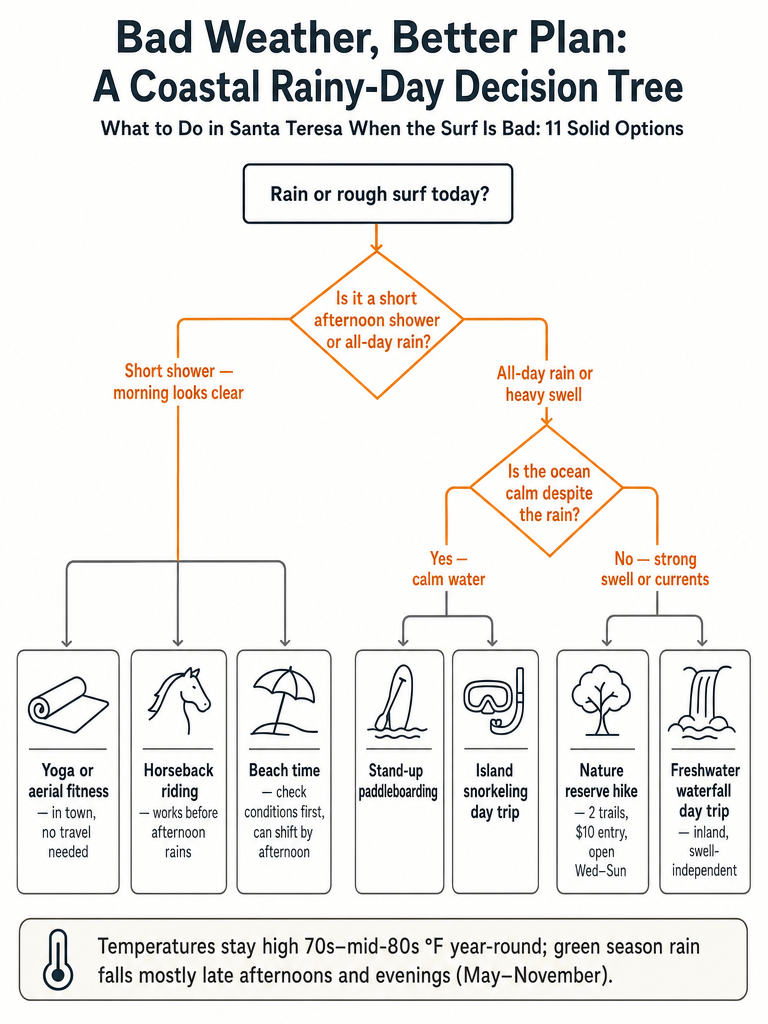
A rainy day in Santa Teresa is rarely a lost day. Green-season showers tend to land in the late afternoons and evenings (Source: Coldwell Banker Sunset Reef Realty), and temperatures stay in the high 70s to mid-80s Fahrenheit most of the year. So the useful question isn't "what's the one indoor thing to do." It's which of three days you're having.
Sort your day before you book anything:
- Short green-season shower. The morning is fine, rain lands later. Surf, walk the beach, or run a nearby outing early, and keep the afternoon flexible.
- Rough-sea day. Waves are bad but the sky isn't the problem. This is a land day: yoga, a zip line, a reserve hike, or horseback riding.
- Full pivot day. Rain and swell are both ugly. Don't force the beach. Reschedule surf, or run a freshwater or reserve trip that doesn't depend on clean surf.
Match the plan to the condition instead of copying a generic attraction list. In Santa Teresa the timing of the rain often matters more than the rain itself.
Most ranking pages hand you a flat list of activities. That's useless when the beach is fine at 8 a.m. and closed out by 2 p.m. The rest of this guide sorts each source-backed option by which of those three days it actually fits.
What is the rainy season in Santa Teresa?
Santa Teresa's rainy season runs from May to November, called the green season locally, while the dry season covers December through April (Source: Coldwell Banker Sunset Reef Realty). That's the calendar most travelers plan around. The green season doesn't mean constant rain. Sources describe showers as more frequent in the late afternoons and evenings, with the landscape turning lusher and more vibrant.
The temperature stays warm across both seasons, generally in the high 70s to mid-80s Fahrenheit for most of the year. That's why a wet day here still supports outdoor plans that a colder climate wouldn't.
For surf timing, it's worth being blunt: rain and swell are separate variables. A green-season afternoon shower doesn't tell you whether the waves are good. Check conditions before you commit either way, and read our take on Santa Teresa rainy season, what still works and what doesn't if you're deciding when to come at all.
Is Santa Teresa worth visiting in rainy season?
Yes, if you plan around timing instead of expecting guaranteed dry afternoons. The green season, May to November, brings more frequent showers, mostly late in the day, but the town stays warm and the landscape turns lusher (Source: Coldwell Banker Sunset Reef Realty). You trade dry certainty for fewer crowds and greener surroundings, not a ruined trip.
The practical adjustment is structural. Front-load outdoor plans into the morning, keep afternoons flexible, and accept that some outings need a break in the weather. Warm temperatures in the high 70s to mid-80s Fahrenheit mean a rain jacket and a backup plan cover most of it.
Green-season roads matter more than green-season rain. Some routes into and around Santa Teresa are unpaved and can turn muddy, which is why many travelers rent a 4x4 in the wet months (Source: Coldwell Banker Sunset Reef Realty).
If you want the honest tradeoffs before booking, how many days in Santa Teresa is actually enough helps you build slack into the itinerary.
What can you do in Santa Teresa besides surfing without leaving town?
Plenty runs without a drive. Source-backed in-town and nearby options include yoga, aerial yoga, aerial silks, stand-up paddleboarding, and zip line tours (Source: Suitcase and Heels). These are your first calls on a rough-sea day when the surf is off but you don't want to burn an hour on the road.
Yoga is the obvious low-travel default. Beach and studio classes, including drop-in options, are common, and one source describes sunrise and sunset beach yoga classes offered through Selina. Aerial yoga (anti-gravity yoga in a fabric hammock) and a beginner aerial silks class are also cited through Selina.
For the adrenaline version, Santa Teresa has its own zip line and canopy tour. One source singles out Canopy Mal Pais for a surfboard zip line, which isn't standard elsewhere.
If you came to surf and the day fell apart, don't waste the slot. Surf shops and instructors operate throughout town for lessons and board rentals (Source: Coldwell Banker Sunset Reef Realty), so rescheduling a session for a better window is usually easy.
| Option | Depends on surf/sea? | Best for |
|---|---|---|
| Yoga / aerial yoga | No | Any rough or wet day |
| Aerial silks | No | Full pivot day |
| Zip line / canopy tour | No | Rough-sea day (pause in rain) |
| Surf lesson reschedule | Yes | Salvaging a bad-wave slot |
Compare formats first in Santa Teresa yoga retreats vs drop-in classes and when to book a surf school vs a coach.
What to do in Santa Teresa when the surf is bad but the sea is still calm?
Bad waves and unsafe water are not the same thing. When the swell is disorganized but the sea is manageable, the ocean-dependent options still work: stand-up paddleboarding, Isla Tortuga snorkeling trips, horseback riding along the beach, and simple beach time (Source: Suitcase and Heels; Coldwell Banker Sunset Reef Realty). These are exactly the plans that fail on a big-swell day but shine when the surf is just flat or messy.
Stand-up paddleboarding is the clearest fit. Rentals, lessons, and tours are widely available in town, and a mellow sea is better for it than good surf. An Isla Tortuga snorkeling trip is a boat-based outing that trades the beach break for calmer water elsewhere. Horseback riding along the beach is cited as a land-adjacent option that doesn't need clean waves at all.
A weak-surf day is often the best day for SUP, snorkeling trips, and beach riding, because those activities want calm water, not good waves.
The rule that saves the day: check same-day conditions before you commit to anything on the water. A calm-looking morning is not a guarantee. The next section covers when to override the plan entirely.
When rain and swell are both ugly, which Santa Teresa plans should you not force?
Don't treat a bad surf day as an automatic swim day. One source is explicit that a beautiful beach is not always a calm swimming beach, and that a calm morning can shift by afternoon. When rain and swell stack up, the water is exactly where a "might as well" decision goes wrong.
Skip or delay the ocean plans first. Strong swell, visible currents, and afternoon changes should override an open-water swim, a snorkeling trip, or a long paddle, even if the beach looked fine at breakfast. The safer move is to check current conditions, then default to land: yoga, a zip line under a break in the rain, or a reserve trip.
Conditions here move within a single day. Base the call on what the sea is doing when you go out, not on how the morning looked or what the forecast said yesterday.
This is the gap most travel content skips. Pages list activities but rarely flag which ones depend on cooperative water. If you're weighing where to base yourself for surf access on days like this, where to stay in Santa Teresa for surf access, not vibes is more useful than a photo tour.
Keep reading
- Santa Teresa Rainy Season: What Still Works, What Doesn't
- What to Pack for Santa Teresa: Dust, Rain, and Roads
- Best Time to Surf Santa Teresa by Swell, Wind, and Tide
- Where to Stay in Santa Teresa for Surf Access, Not Vibes
- Santa Teresa Surf Lessons: When to Book a School vs a Coach
- Beginner Surf in Santa Teresa: Best Breaks by Conditions
Is Playa Hermosa worth the drive when Santa Teresa beach looks rough?
Often, yes, for beach time specifically. Playa Hermosa, north of the main strip, is a wider, more relaxed beach than central Playa Santa Teresa, which makes it a better fallback when you want space to sit and walk rather than clean surf. The catch is that it still depends on the same-day swell, so it's a "check first" option, not a guaranteed calm alternative.
Both beaches show up as headline sights on general destination pages, which tells you they're the default stops, not insider picks. The real distinction on a rough day is comfort and elbow room, and Playa Hermosa tends to win there.
| Playa Santa Teresa (main) | Playa Hermosa (north) | |
|---|---|---|
| Feel | Central, busier, surf-focused | Wider, more relaxed |
| Best rough-day use | Quick beach walk if calm | Space to spread out |
| Depends on swell? | Yes | Yes |
| Travel from town | Minimal | Short drive north |
Playa Hermosa is also the quieter beginner backup when conditions are forgiving. See beginner surf in Santa Teresa: best breaks by conditions before you decide the drive is worth it.
Cabo Blanco Nature Reserve vs Montezuma waterfalls: which bad-weather day trip fits better?
Pick Cabo Blanco for a structured hike and Montezuma waterfalls for a freshwater swim. Cabo Blanco Nature Reserve is open Wednesday through Sunday, with entry cited at $10 for access to two hiking trails (Source: Suitcase and Heels). The Montezuma waterfalls are a freshwater outing near Santa Teresa built around a swim and a short scramble rather than a groomed trail.
The choice comes down to what a wet day rewards. A reserve hike works on a rough-sea day and can absorb light rain under canopy, but heavy rain and slick trails argue for waiting. Waterfalls are freshwater, so bad ocean surf is irrelevant, but heavy rain changes flow and footing on the rock.
| Cabo Blanco Nature Reserve | Montezuma waterfalls | |
|---|---|---|
| Type | Guided-style hiking, two trails | Freshwater swim + scramble |
| Cited cost | $10 entry (Source: Suitcase and Heels) | Not sourced here |
| Days open | Wednesday–Sunday | Verify locally |
| Rough surf matters? | No | No |
| Heavy-rain risk | Slick trails | Slick rock, changed flow |
Cabo Blanco's Wednesday-to-Sunday schedule means a Monday or Tuesday rainy day rules it out entirely. Check the day of the week before you build the plan around it.
For the honest verdict on the falls, read Montezuma waterfall from Santa Teresa: go or skip it, and to weigh the trip end to end, Santa Teresa to Montezuma: taxi, ATV, shuttle, or car.
What surf report is most accurate for Santa Teresa right now?
Base the call on live swell, wind, and tide, not on how the sky looks or a single star rating. Santa Teresa has beach breaks that work year-round, but "works" depends on conditions on the day, so a report that shows swell height and direction, wind speed and direction, and the tide window tells you far more than a vibe or a five-star icon.
Rain and surf quality are independent. A gray, drizzly morning can have clean, light offshore wind and a workable swell, and a bright afternoon can be blown out. The variables that decide a session are the same ones a proper report lists: swell components with period and direction, wind that's ideally offshore, and where the tide sits.
A surf report is only useful if it gives you live swell, wind, and tide, because in Santa Teresa the weather and the wave quality change on different clocks.
Don't read a rainy forecast as a bad-surf forecast. Check the numbers, then decide. For how to interpret them without getting fooled, how to read the Santa Teresa surf report like a local and best time to surf Santa Teresa by swell, wind, and tide do the work.
How do you avoid wasting the day between Santa Teresa, Mal País, Montezuma, and Tambor Airport?
The fastest way to lose a rainy day is guessing at hours, roads, and bookings. The peninsula is small (Tambor Airport is about a 45-minute drive from Santa Teresa, per Coldwell Banker Sunset Reef Realty), but green-season roads can be unpaved and muddy, which is why many visitors rent a 4x4. Verify the movable parts before you set out.
Run this checklist first:
- Confirm hours and bookings. Cabo Blanco Nature Reserve is Wednesday–Sunday (Source: Suitcase and Heels); other operators change with season, so verify current opening hours and booking directly before you commit. Named options such as Canopy Mal Pais appear in the sources for zip lines, while venues like Blue Surf Sanctuary, Cocozuma Tours, and Ollie's Adventures should be checked for current hours and availability.
- Match the vehicle to the outing. In green season, plan for a 4x4 on unpaved routes rather than assuming a standard car copes.
- Front-load outdoor plans. Showers skew to late afternoon and evening, so schedule the reserve, waterfall, or beach block in the morning.
- Keep an indoor or in-town fallback. Yoga, a surf-lesson reschedule, or a town meal covers a washout.
For the logistics, lean on do you need a car in Santa Teresa, how to get around Santa Teresa without wasting half a day, Santa Teresa airport transfers: what actually works, and what to pack for Santa Teresa: dust, rain, and roads.
Sources
- Santa Teresa (Costa Rica) || What's it Actually Like?www.youtube.com
- 10 Things to Do in Santa Teresa, Costa Rica...That Aren't Surfingsuitcaseandheels.com
- How to Plan Santa Teresa Surf Vacation in 2026 | Complete Guidewww.bluemysticsurf.com
- Dreamsea Santa Teresa vs Avellanas— We have only two locations in ...cbsunsetreefrealty.com
- 10 Things to Do in Santa Teresa, Costa Rica That Aren’t Surfingvillaspuravida.com
FAQ
What is the best surf report for Santa Teresa, Costa Rica right now?
A useful report shows live swell height, period, direction, wind speed and direction, and the current tide — not just a star rating. At time of scan, one report showed 3–4+ ft surf with a 2.9 ft SSW swell at 15 seconds and NW offshore wind at 3 mph. Rain and wave quality run on separate clocks in Santa Teresa, so a gray morning can still produce clean offshore conditions. Check swell, wind, and tide together before deciding whether to paddle out or pivot to a land day.
When is the best time to visit Santa Teresa, Costa Rica?
December through April is dry season: consistent morning offshore winds, smaller cleaner waves, and predictable weather — also the busiest and most expensive window. May through November brings bigger swells, lusher scenery, and fewer crowds, with showers skewing to late afternoon rather than all day. Temperatures stay in the high 70s to mid-80s Fahrenheit year-round, so the real tradeoff is crowd and price versus swell size, not warmth.
What to do in Santa Teresa when it rains?
Green-season showers typically arrive late afternoon, so front-load outdoor plans. If rain and rough surf stack up together, the best land-based fallbacks are yoga or aerial yoga (available as drop-in classes through studios in town), the Canopy Mal Pais zip line — which includes a surfboard zip line — or aerial silks classes. Cabo Blanco Nature Reserve works on a rainy day under canopy but is only open Wednesday through Sunday and charges $10 entry.
What are the best beginner surf spots near Santa Teresa?
Playa Carmen is the go-to for beginners: it breaks slowly over sand rather than reef, the takeoff zone is wide, and warm water is consistent year-round. The main Santa Teresa beach break is more powerful — sets pitch properly at 4 feet and become a serious paddle at 5–6 feet, which rules it out for beginners on active swell. During peak season, the main peaks can hold 30–50 surfers between 8 a.m. and 1 p.m., so an early start at Carmen is the practical move.
Is Cabo Blanco Nature Reserve worth it on a bad-weather day?
Worth it on a rough-sea day with light rain — the canopy absorbs drizzle and the two hiking trails don't depend on ocean conditions. Entry is $10. The hard constraint: Cabo Blanco is only open Wednesday through Sunday, so a Monday or Tuesday washout rules it out entirely. Heavy rain makes trails slick, so a full-downpour day argues for waiting. Verify current hours before building the day around it.
Do I need a 4x4 to get around Santa Teresa during rainy season?
For most routes, yes. Tambor Airport is about a 45-minute drive from Santa Teresa, and several roads in and around the area are unpaved and turn muddy in the green season (May–November). A standard car can manage central town, but day trips to Cabo Blanco, Montezuma, or outlying beaches carry real risk of getting stuck. Most travelers who arrive in the wet months rent a 4x4 specifically because of this.
Santa Teresa eSIM and SIM Cards on Arrival
For most Santa Teresa trips, an eSIM is the cleanest answer: install it before you fly, keep your home number active, and arrive already connected. Buy a physical Costa Rican SIM only when you need a local number for calls, drivers, or a longer stay.
Read →Santa Teresa Pharmacies and Clinics: Where to Go
Public, verifiable pharmacy and clinic details for Santa Teresa are thin, and search results often mix in Wichita listings. This guide shows what to ignore and how to confirm care locally on the day.
Read →Santa Teresa Grocery Stores and Markets: What to Expect
Santa Teresa works best for daily top-ups, while Cóbano is the smarter larger shop. Mini markets cover water, eggs, bread, coffee, beer, and fruit.
Read →