Best Time to Surf Santa Teresa by Swell, Wind, and Tide
Santa Teresa has surf year-round, but the best window depends on swell, wind, and tide. This field guide breaks down when to go and which break fits your level.

Key takeaways
- The best time to surf Santa Teresa is **April through October**, with the **May–October green-season window** delivering the most consistent swell and the largest south pulses.
- **Green season is better for swell consistency and size; dry season is better for clean mornings, smaller waves, and easier logistics.** Neither is universally superior — they suit different surfers.
- Santa Teresa essentially does not go flat.
- **Paddle out at first light.
When Is the Best Time to Surf Santa Teresa?
The best time to surf Santa Teresa is April through October, with the May–October green-season window delivering the most consistent swell and the largest south pulses. If you want cleaner mornings, smaller faces, and easier sessions, December through April is the better window — but it is not universally "better," it is just different.
Playa Santa Teresa sits on the southwestern tip of Costa Rica's Nicoya Peninsula, exposed to the open Pacific. That exposure is why the published season advice contradicts itself depending on what each guide is optimizing for. Surf Atlas calls May–August the best window because that is peak south-swell season. Real Surf Travel widens it to April–October for the same reason. Blue Mystic Surf stretches green season to May–November. Surf-Forecast, meanwhile, calls "Winter" the cleanest window — which in the northern-hemisphere sense means December–March, and which is really a comment on lighter offshore mornings and less rain, not wave size.
The honest answer: Santa Teresa is a year-round break where the "best" month depends on whether you weight swell size, cleanliness, or crowd and weather comfort. This guide reconciles those variables into a swell-wind-tide-skill matrix instead of crowning a single month.
Decide what you want before you book. "Bigger and more powerful" points you to June–September. "Cleaner, smaller, sunnier" points you to January–March. Trying to optimize for both will frustrate you.
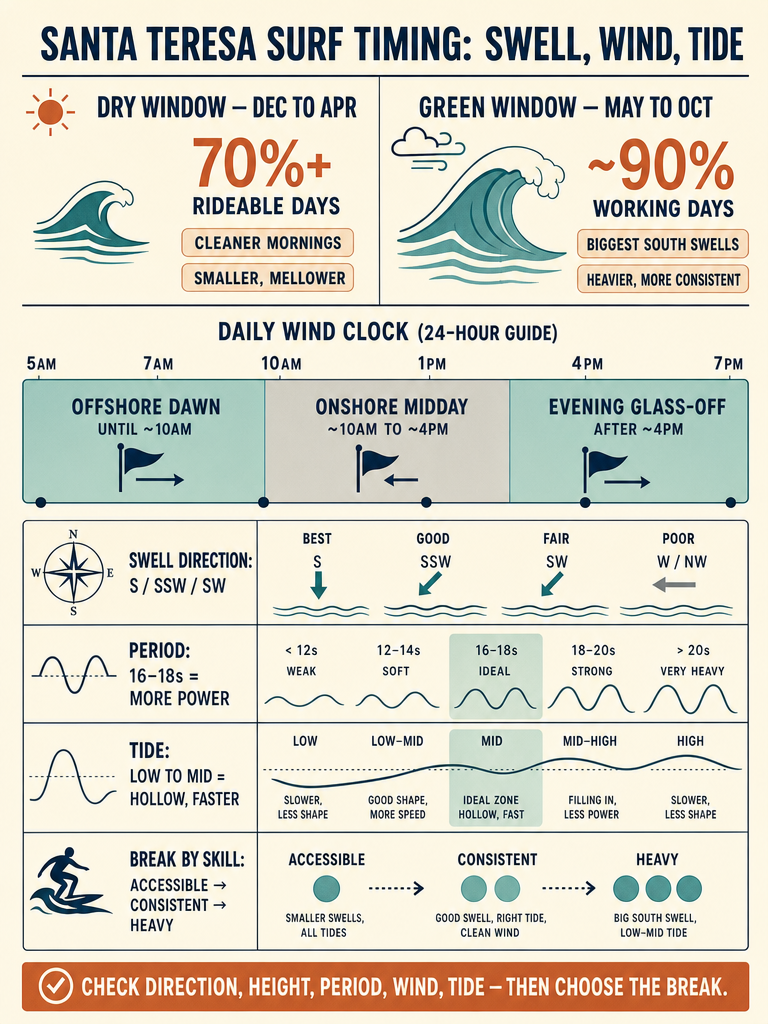
Is Dry Season or Green Season Better for Santa Teresa Surfing?
Green season is better for swell consistency and size; dry season is better for clean mornings, smaller waves, and easier logistics. Neither is universally superior — they suit different surfers.
Dry season runs December to April. According to Surf Atlas, Santa Teresa and Mal Pais have something rideable more than 70% of the time during this window. Blue Mystic Surf frames the same period as the more beginner-friendly window, with smaller, cleaner mornings and more manageable conditions. Wind tends to be lighter, rainfall is minimal, and Playa Carmen gets glassy small days that progressing surfers can actually use.
Green season runs roughly May to October (Surf Atlas, Real Surf Travel) or May to November (Blue Mystic Surf, Dreamsea Costa Rica). According to Surf Atlas, Santa Teresa works almost 90% of days in this window. The largest south swells of the year — the ones that light up Playa Santa Teresa, La Lora, and Suck Rock — arrive in this stretch. Rain comes in afternoon bursts, not all-day washouts, and mornings are often still surfable before the squalls.
| Variable | Dry Season (Dec–Apr) | Green Season (May–Oct/Nov) |
|---|---|---|
| Swell consistency | 70%+ rideable days (Surf Atlas) | ~90% working days (Surf Atlas) |
| Wave size | Smaller, more manageable | Larger, heavier, more powerful |
| Best for | Beginners, intermediates, cleaner sessions | Intermediate to advanced, south-swell hunters |
| Wind | Lighter, more reliable offshore mornings | More variable; mornings still often offshore |
| Weather | Sunny, dry | Sun + afternoon rain |
| Crowds | Higher (peak tourist season) | Lower outside school holidays |
The Bodhi Surf + Yoga and Dreamsea Costa Rica framings of Costa Rica's broader seasons (December–April dry, May–November rainy) match this, but those are country-wide labels. Santa Teresa's south-facing exposure means green season here is genuinely the bigger-wave season, not just the wetter one. Surf-Forecast's "Winter cleanliness" claim is accurate as a wind/rain comment but should not be read as "winter is when the waves are best." The waves are biggest when the south swells are running, and the south swells run April through October (Real Surf Travel).
Does Santa Teresa Have Surf Year-Round, or Can It Go Flat?
Santa Teresa essentially does not go flat. According to Surf Atlas, something is rideable more than 70% of dry-season days and nearly 90% of green-season days — figures that put it among the most consistent stretches on Costa Rica's Pacific Coast. Real Surf Travel describes a January visit with 2–3 ft waves every day, which is the dry-season reality: smaller, but still surfable.
That said, "year-round surf" does not mean every day suits every surfer. Real Surf Travel describes November–March as the off-season for waves — drier and sunnier, but less consistent for strong swell. You'll still find fun waist-to-shoulder days at Playa Carmen and clean small peaks at Playa Hermosa, but advanced surfers chasing overhead, hollow lefts at La Lora or Suck Rock will find the ratio of strong days much lower outside the April–October window. Don't cancel a January trip because forums say it's "off-season" — and don't expect green-season power in February.
What Time of Day Is Usually Best Before the Wind Turns Onshore?
Paddle out at first light. Mornings are almost always your best window in Santa Teresa. According to Real Surf Travel, mornings here are typically offshore or light until around 10 am, afternoons frequently turn onshore and choppy, and evenings sometimes glass off again into a usable sunset session.
DeepSwell lists NE and E as the best wind directions for Santa Teresa — those are the directions that come off the land in the early hours. Surfnerd's example forecast even pinpointed a 5:01 am–9:00 am window as the cleanest, with calm cross-offshore conditions. The pattern is reliable enough that locals plan their day around it.
A practical daily plan:
- Check the Onda Teresa surf report before sunrise — not the night before.
- Be in the water by 6:00–7:00 am if conditions are on.
- Reassess around 9:30–10:00 am; if wind is already turning, get your second wave and get out.
- Skip midday unless the forecast shows an unusual offshore hold.
- Check again around 4:30 pm for a possible evening glass-off, especially in dry season.
A noon star rating on Surfline or Surf-Forecast can hide the fact that the morning was clean and the afternoon turned junk. Don't trust a single daily score — read wind direction by the hour.
For a deeper read on translating those forecast inputs into actual paddle-out decisions, see How to Read the Santa Teresa Surf Report Like a Local. For weekly Nicoya Peninsula surf intel and editorial guides delivered to your inbox, Get the Nicoya dispatch from Onda Teresa.
What Swell Direction Works Best in Santa Teresa?
Santa Teresa lights up on S, SSW, and SW swell. According to DeepSwell, the best swell directions for the break are SW and S. Surfnerd confirms the same range, listing South, South-Southwest, and Southwest as the directions Playa Santa Teresa handles best. This is why the April–October south-swell season (Real Surf Travel) is the high season — it is the season that aligns with the coast's exposure.
West and northwest energy can sneak in but is not the core setup for this stretch. When the buoys show a pure W or NW pulse with no southern component, expect smaller, less organized waves at Playa Carmen and Playa Santa Teresa.
Period matters as much as direction. World Beach Guide's example forecast for a typical south-swell day showed a 3.5–4 ft wave size with a primary swell of 4.5–4.6 ft at a 16–18 second period. A 3 ft reading at 17 seconds will throw a substantially heavier wave than a 4 ft reading at 8 seconds — long-period south swell is what makes La Lora and Suck Rock fire. If the forecast shows long period and a south component, treat the height number as a floor, not a ceiling.
A 3.5 ft wave at 17s period (World Beach Guide) carries roughly the energy of a much larger short-period swell — read period before height.
Keep reading
- Santa Teresa or Montezuma? Pick the Right Base Fast
- How to Read the Santa Teresa Surf Report Like a Local
What Tide Is Best for Santa Teresa: Low, Mid, or High?
Low to mid tide is the performance window. Higher tide softens the wave and is more forgiving but rarely produces the cleanest shape. DeepSwell explicitly lists low-to-mid as the best tide window and describes Santa Teresa as a hollow beach break that is fastest during lower tides.
Santa Teresa is a sandy-bottom beach break with both lefts and rights (Surfnerd). At low tide it gets faster, hollower, and shallower — which is why it produces those crisp, pitching sections that show up in clips, but also why it punishes mistimed takeoffs. Mid tide is the sweet spot for most surfers: enough water to be safe, enough drop to keep the wave defined.
| Tide | Wave character | Best for | Risk |
|---|---|---|---|
| Low | Fast, hollow, shallow | Advanced surfers, performance sessions | Closeouts, sandbar contact, hollow takeoffs |
| Mid | Balanced shape, workable face | All levels with appropriate wave size | Moderate; depends on swell size |
| High | Softer, fuller, slower | Beginners on small days, longboarders | Mushy, fat sections; less reward |
The risk profile shifts dramatically with swell size. On a 1–2 ft dry-season morning, low tide is fine for a confident intermediate. On a solid south-swell day with 2.5 m faces (Surfnerd's upper range), low tide at Playa Santa Teresa or La Lora is genuinely consequential — Rinsed flags La Lora's range as 1.0–3.0 m for a reason. Beginners should default to mid-to-high tide on smaller days at Playa Hermosa or Playa Carmen, full stop.
Which Santa Teresa-Area Break Should You Choose by Skill Level?
Stop treating Santa Teresa as one break. It is a chain of beaches stretched along the Mal Pais–Santa Teresa coast, each with its own exposure, consequence, and wave size range. Rinsed's framing — think in zones, not in single perfect spots — is the right starting point.
| Break | Approx. wave size | Character | Best for |
|---|---|---|---|
| Playa Hermosa | Smaller, gentler | Mellower beach break, fewer crowds north | Beginners, learners, longboarders |
| Playa Carmen | 0.5–2.0 m (Rinsed) | Accessible beach break, central, easier paddle | Beginners to intermediates |
| Playa Santa Teresa | 0.8–3.0 m (Rinsed) | More exposed, faster, hollower than Carmen | Intermediate to advanced |
| La Lora | 1.0–3.0 m (Rinsed) | Consistent upgrade, holds size well | Strong intermediates, advanced |
| Suck Rock | Variable, can be heavy | Reef-influenced, technical, consequence | Advanced, locals |
| Mal Pais / Mal País | Variable, more technical | Rockier, point-style on swell | Advanced |
Rinsed's read — that Playa Carmen and Playa Hermosa are the accessible options, Playa Santa Teresa and La Lora are the consistent upgrades, and Suck Rock plus Mal País are the heavier, more technical end — matches what locals actually do. On a small clean morning, a beginner should be at Playa Hermosa or the north end of Playa Carmen. An intermediate looking for a faster wall should walk south to Playa Santa Teresa. An advanced surfer chasing a long-period south swell should be at La Lora or Suck Rock at low tide and ready for the consequences.
When in doubt, watch a full set from the beach before paddling out. Five minutes of observation at Santa Teresa beats any star rating — you will see the rip lines, the takeoff zone, and how locals are positioning.
Picking the right beach inside the zone matters more than picking the right day. If you are still deciding whether to base in Santa Teresa or split your trip with Montezuma, the Santa Teresa or Montezuma trip-base guide lays out the trade-offs without the lodging fluff.
How Should You Read a Santa Teresa Surf Forecast Step by Step?
Forecast numbers are useless until you translate them into a manageability call for the surfer you actually are. The Reddit r/surfing thread asking whether a dropping Surfline reading would be "more manageable for an intermediate" is the universal problem: the forecast tells you what the ocean is doing, not whether you should paddle out.
Use this order every time:
- Check swell direction first. If it's S, SSW, or SW (DeepSwell, Surfnerd), Santa Teresa is on. If it's pure W or NW with no southern component, expect a weaker, less organized day.
- Check swell height and period together. A long period (14–18s, like World Beach Guide's example) makes a 3 ft reading feel like 5 ft. Don't read height in isolation.
- Match wind direction and timing. NE or E offshore is your friend (DeepSwell). Use Real Surf Travel's offshore-until-10 am pattern: dawn is almost always cleaner than midday.
- Overlay tide. Low-to-mid for performance and hollow shape; mid-to-high for forgiveness and learners (DeepSwell). Cross-reference with the swell size — bigger swell + low tide = bigger consequence.
- Choose the right break for skill level. A solid south swell at La Lora is a different sport than the same swell at Playa Hermosa. Use the zone table above.
- Make a final beach-read call before paddling out. Watch one full set. Identify the rip. Find the takeoff zone. If anything is unclear, sit five more minutes.
Use Surfline's 16-day forecast, Surf-Forecast, DeepSwell, Surfnerd, and World Beach Guide as your raw inputs — but don't outsource the final call. The Onda Teresa live surf report is updated locally every 30 minutes, and the companion guide How to Read the Santa Teresa Surf Report Like a Local walks through the same logic with live examples.
Is Santa Teresa Good for Beginners?
Santa Teresa can work for beginners on small, clean dry-season mornings — but it is not a soft beginner beach town by default, and treating it like one will get you hurt or humbled. Surfnerd flags strong rips. Real Surf Travel notes the crowds and the offshore-morning, onshore-afternoon pattern that means timing matters as much as skill. Rinsed's zone framing — that Playa Carmen and Playa Hermosa are the more accessible options — is the right read for learners.
If you are a beginner, default to Playa Hermosa or the northern end of Playa Carmen on a small dry-season morning at mid-to-high tide. Avoid Playa Santa Teresa, La Lora, and Suck Rock until you can confidently read a peak, identify a rip, and paddle in a crowd. Take a lesson with a vetted local school for your first sessions — it is the fastest way to learn the channels and the etiquette.
Sit out when:
- A strong south swell is running and faces are overhead.
- It's dead low tide and the beach break is closing out hollow.
- The lineup is crowded with locals on a peak day.
- You can't clearly identify a channel or a rip from the beach.
- Wind has turned onshore and the water is bumpy and disorganized.
The surfers who get the most out of Santa Teresa as beginners are the ones who treat it as a multi-week progression project, not a one-week bucket list — and who pick the right beach inside the zone instead of paddling out wherever looks closest to their hostel.
For weekly Nicoya Peninsula surf intel, vetted local schools, and editorial guides written by people who actually live here, Get the Nicoya dispatch from Onda Teresa.
Sources
- Surfing Santa Teresa - Full Guidethesurfatlas.com
- Playa Santa Teresa Surf Forecast and Surf Reportswww.surf-forecast.com
- Costa Rica Surf Guide: When and Where to Gowww.bodhisurfyoga.com
- Santa Teresa CR forecast : r/surfing - Redditwww.reddit.com
- Costa Rica Surf Seasons Explained: When to Catch the Perfect Wavedreamseacostarica.com
- Santa Teresa Surf Report & Forecast - Surflinewww.surfline.com
FAQ
What months are too crowded to surf Santa Teresa comfortably?
December through March is peak tourist season on the Nicoya Peninsula, so Playa Carmen and Playa Santa Teresa lineups get noticeably more crowded even though the waves are smaller and cleaner. If crowd tolerance is low, aim for May or October — green-season swell is running but school-holiday crowds haven't arrived.
How big do waves actually get at Santa Teresa during big south swells?
Playa Santa Teresa handles faces in the 0.8–3.0 m range, while La Lora runs 1.0–3.0 m on strong south pulses. On a long-period south swell — think 16–18 seconds — even a 3 ft buoy reading can produce genuinely heavy, hollow waves well overhead for most surfers.
Is Santa Teresa worth visiting for surfing in November?
November sits at the tail end of green season and is often underrated: south swells are tapering off but still arrive in pulses, crowds are thin, and accommodation prices drop. The main trade-off is that November can deliver flat stretches more often than June or July, so checking the 10-day forecast before booking is worth doing.
Do I need a wetsuit to surf Santa Teresa?
No wetsuit needed — water temperatures along the southwestern Nicoya Peninsula stay warm year-round, typically in the 27–29 °C range. A rashguard for sun protection is more practical than neoprene for the vast majority of visitors.
Can I surf Santa Teresa without a lesson if I'm a beginner?
Technically yes, but Playa Santa Teresa has strong rip currents, variable sandbars, and a crowded lineup on good days — conditions that punish surfers who can't yet read a peak or paddle out of a rip. A session or two with a vetted local school at Playa Hermosa or Playa Carmen will get you oriented faster and more safely than going it alone.
Santa Teresa eSIM and SIM Cards on Arrival
For most Santa Teresa trips, an eSIM is the cleanest answer: install it before you fly, keep your home number active, and arrive already connected. Buy a physical Costa Rican SIM only when you need a local number for calls, drivers, or a longer stay.
Read →Santa Teresa Pharmacies and Clinics: Where to Go
Public, verifiable pharmacy and clinic details for Santa Teresa are thin, and search results often mix in Wichita listings. This guide shows what to ignore and how to confirm care locally on the day.
Read →Santa Teresa Grocery Stores and Markets: What to Expect
Santa Teresa works best for daily top-ups, while Cóbano is the smarter larger shop. Mini markets cover water, eggs, bread, coffee, beer, and fruit.
Read →