How Many Days in Santa Teresa Is Actually Enough?
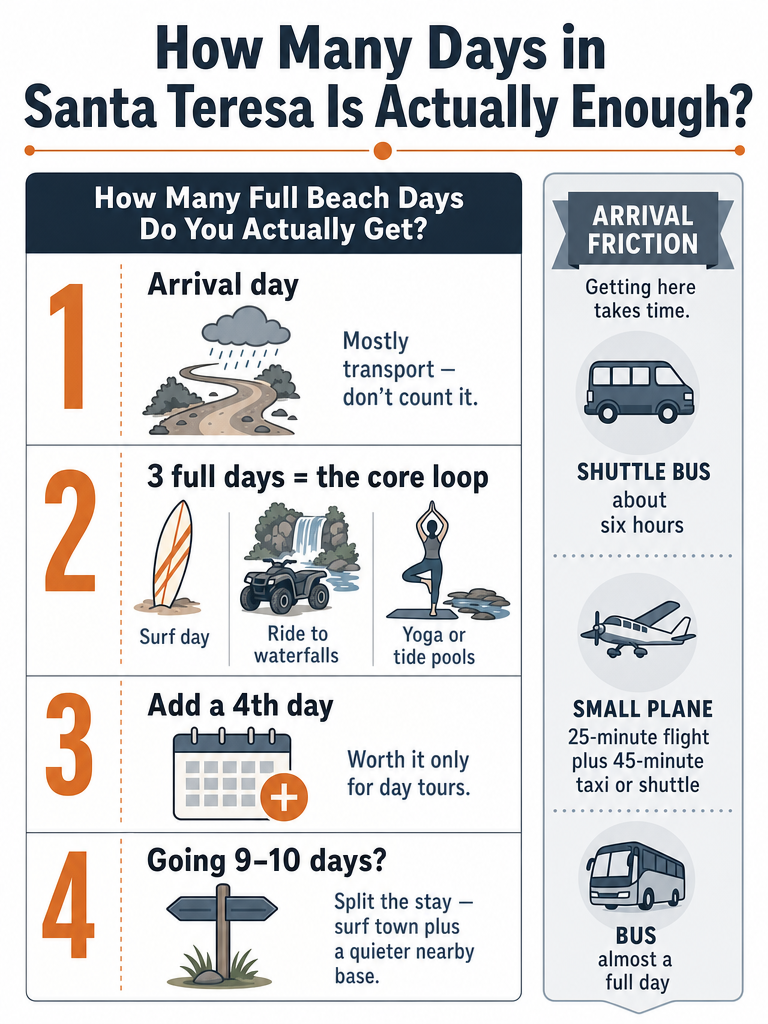
Three full beach days cover Santa Teresa for most visitors, but arrival and departure days rarely count. Add a fourth night only if you want room for day tours.

Key takeaways
- Three full beach days cover Santa Teresa, Costa Rica well for most visitors, with a fourth added only when day tours matter.
- Three full days fit the core of Santa Teresa without a packed schedule.
- A fourth day in Santa Teresa earns its place when you want guided day tours instead of a compressed checklist.
- Arrival and departure days rarely count as full Santa Teresa days because of how remote the town is.
How many days in Santa Teresa is actually enough?
Three full beach days cover Santa Teresa, Costa Rica well for most visitors, with a fourth added only when day tours matter. A 3-day itinerary source describes three days as a good amount of time: one day for surfing, one for an ATV ride to Montezuma and the waterfalls, and one for yoga or tide pools (Source: costaricatripitinerary.com). The catch is what "days" means.
First, the disambiguation, because search engines blur it: this is Santa Teresa on the Nicoya Peninsula in Puntarenas Province, Costa Rica — not the towns of the same name in Brazil, New Mexico, or the San Jose, California park. Onda Teresa covers this one.
The honest version of the answer counts full usable beach days, not nights. The peninsula is remote enough that your arrival day is often half transport. So a "3-night stay" can deliver two real days on the sand.
Count full usable beach days, not nights, and Santa Teresa's right length stops being a guess.
Use this rough frame:
- Surfer: 4+ days, because you want repeat sessions across tides and swells.
- Compact beach trip: 3 full days for the standard surf, Montezuma, and yoga or tide-pool loop.
- Non-surfer staying a week or more: plan to split the stay with a nearby town.
Are 3 days in Santa Teresa enough?
Three full days fit the core of Santa Teresa without a packed schedule. A 3-day itinerary source lays it out cleanly: one day for surfing, one for an ATV ride to Montezuma and the Montezuma Waterfall, and one for a yoga class or the tide pools (Source: costaricatripitinerary.com). That covers what the town is best known for — steady Pacific-coast surf, surf shops, yoga, fresh food, and long sunsets — without overloading.
The condition is that all three days have to be full. If your arrival day is mostly shuttle and ferry, you don't have three days; you have two and a half. Build the loop around days you'll actually wake up in town.
The activities also stack naturally. Surf in the morning when the wind and tide cooperate; if you're new to reading conditions, how to read the Santa Teresa surf report like a local saves a wasted paddle-out. The ATV-to-Montezuma day doubles as transport and sightseeing. The yoga-or-tide-pool day is your low-effort buffer if the road or the swell forces a change.
Three full days is enough for a first Santa Teresa trip — as long as none of them is an arrival day in disguise.
Is a fourth day worth it for Santa Teresa day tours?
A fourth day in Santa Teresa earns its place when you want guided day tours instead of a compressed checklist. The same itinerary source that recommends three days adds plainly that a fourth day helps if you are planning day tours (Source: costaricatripitinerary.com). The logic is simple: the three-day loop already spends one day surfing, one on the Montezuma run, and one on yoga or tide pools. There's no slack left for a separate booked excursion.
So the fourth night is a swap, not a luxury. Add it if you intend to do something like a boat trip or a guided outing that needs its own block of time. Skip it if you're happy with the surf, Montezuma waterfalls, yoga, and tide-pool rhythm — stretching that across four days mostly buys you slower mornings, which is its own argument.
Decide tours before you book nights. A fourth day reserved for a tour you never schedule becomes an extra hotel bill, not a better trip.
For weekly Nicoya Peninsula intel, get the Nicoya dispatch.
Do arrival and departure days count in Santa Teresa?
Arrival and departure days rarely count as full Santa Teresa days because of how remote the town is. The 3-day itinerary source describes Santa Teresa as remote in Puntarenas Province on the Nicoya Peninsula and warns that rough, unpaved roads after rainstorms can affect the trip (Source: costaricatripitinerary.com). Translate nights into usable time before you book.
A shared shuttle from San José runs about six hours, ferry included (Source: costaricatripitinerary.com). Land in the afternoon and your "first day" is dinner and sleep. Departure days work the same in reverse — you're packing and watching ferry timing instead of surfing.
This is why a two-night stay so often feels short. Subtract the arrival half-day and the departure morning, and two nights can leave barely one full beach day. The itinerary source also flags the practical edges: carry cash for sodas and board rentals, book lodging early in high season, and make sure your ride handles rough roads after rain (Source: costaricatripitinerary.com).
Booking "3 nights" and expecting 3 beach days is the most common Santa Teresa planning mistake. Count the usable mornings, not the hotel nights.
For the full route breakdown, see getting to Santa Teresa by ferry, drive, or shuttle.
How to get to Santa Teresa without losing a beach day?
The route you pick decides how many beach days you actually keep. The fastest option in the 3-day itinerary source is a 25-minute domestic flight to Tambor Airport followed by a 45-minute taxi or shuttle (Source: costaricatripitinerary.com). The cheapest-feeling options cost you the most hours.
Here's how the sourced routes compare:
| Route | Approx. time | Source note |
|---|---|---|
| San José shared shuttle (ferry included) | ~6 hours | Common choice from Juan Santamaría |
| Domestic flight to Tambor + taxi/shuttle | 25 min + 45 min | Fastest listed route |
| Bus | Almost a full day | Cramped, per source |
| Monteverde via Puntarenas ferry + road | ~5 to 6 hours | Depends on ferry timing, road conditions |
| Liberia private driver | 4 hours | Trip report example below |
A separate Santa Teresa trip report lists airport transportation from Liberia at $280 one way, and a private driver from Liberia at 4 hours and $640 with tip, round trip (Source: heartbeetkitchen.com). That report also notes Cobano sits within a 40-minute drive of Santa Teresa after a flight (Source: heartbeetkitchen.com).
One traveler reported Sansa Airlines changing a return flight twice within 48 hours of departure (Source: heartbeetkitchen.com). If you fly the last leg, leave buffer on departure day.
Verify current ferry timetables and shuttle prices before you commit — the corpus doesn't cover live schedules, and they shift.
Is nine or ten days too long to stay in Santa Teresa in June?
Nine or ten days in Santa Teresa can run long for non-surfers, and a forum respondent advised splitting that kind of stay — noting Mal Pais and Montezuma are close by (Source: Tripadvisor Santa Teresa forum). The question came from a honeymoon couple who said they weren't surfers but wanted beaches, restaurants, and a few bars, splitting time roughly 60% relaxation and 40% activities.
If you don't surf, the town's core rhythm is what fills repeat days. Without daily sessions, the surf-shop-and-sunset loop can start to feel like the same day twice. Splitting the stay solves that without leaving the peninsula.
On June rain specifically: the corpus doesn't resolve afternoon or evening rain timing for that month, so treat any precise June forecast skeptically. What's sourced is the broader pattern. One Santa Teresa trip report identifies dry season as January to April, wet season as May to December, and the rainfall peak as September and October (Source: heartbeetkitchen.com).
June falls in wet season but before the September–October peak — manageable, but plan around rain rather than ignoring it.
Keep reading
- Where to Stay in Santa Teresa by Beach, Road, and Noise
- Santa Teresa Restaurants Worth It for a Short Trip
- Getting to Santa Teresa: Ferry, Drive, or Shuttle?
- Best Time to Surf Santa Teresa by Swell, Wind, and Tide
- Santa Teresa for Digital Nomads: What Gets Annoying Fast
- Santa Teresa Banking, ATMs, and Cash: What to Expect
Santa Teresa vs Montezuma or Mal Pais: when should you split the stay?
Split your stay once the surf-and-sunset rhythm stops adding new days. A forum respondent recommended exactly this for longer non-surf trips, pointing out that Mal Pais and Montezuma are close by (Source: Tripadvisor Santa Teresa forum). Keep Santa Teresa as your base for steady surf, the restaurant and bar strip along the main road, yoga, and long sunsets (Source: costaricatripitinerary.com).
Use the nearby towns for what Santa Teresa doesn't do as well:
- Montezuma — for waterfall time; it already appears in the standard three-day ATV run.
- Mal Pais — for a quieter, more rustic base with easy Santa Teresa surf access.
The decision is about pace, not distance. If you crave variety after a few days, a night or two elsewhere resets the trip. If you're a surfer chasing tides, staying put usually wins.
For the base comparisons, see Montezuma or Mal Pais: which base fits your trip best and where to stay in Mal Pais if you hate Santa Teresa chaos.
How to spend a week in Santa Teresa without rushing it?
A week in Santa Teresa is a slow-stay choice, not a fixed itinerary. It works cleanly for surfers and beach-focused travelers who want unhurried mornings, repeat sessions across changing tides, and time to learn the breaks rather than cram them. The town's draw — steady Pacific surf, yoga, fresh food, beach bars, long sunsets — rewards repetition for the right traveler (Source: costaricatripitinerary.com).
For non-surfers, a flat week in one town is where the corpus pushes back. The advice to split a nine- or ten-day stay applies here too: build in Montezuma, Mal Pais, or another stop instead of repeating the same daily loop (Source: Tripadvisor Santa Teresa forum).
A workable week, then, isn't seven copies of day three. It's a few surf or beach days, the Montezuma waterfall run, a yoga or tide-pool day, and at least one change of scene if you don't surf.
If you're a surfer, a week is a feature. If you're not, treat the week as a peninsula trip with Santa Teresa as the anchor, not the whole map.
Time your surf days with the best time to surf Santa Teresa by swell, wind, and tide.
How much does a longer Santa Teresa stay actually cost?
Stay length in Santa Teresa is a budget decision, not just a vibe one. A trip report listed hotel rooms at $250 per night and up into the $1,000s, dinner for two around $80, and breakfast or lunch for two around $40 (Source: heartbeetkitchen.com). Every added night stacks lodging plus food on top of fixed transport.
Sourced costs from that same report:
| Item | Cost | Source |
|---|---|---|
| Hotel room | $250/night, up to $1,000s | heartbeetkitchen.com |
| Dinner for two | ~$80 | heartbeetkitchen.com |
| Breakfast/lunch for two | ~$40 | heartbeetkitchen.com |
| ATV rental, 5 days | $400 | heartbeetkitchen.com |
| Liberia transfer, one way | $280 | heartbeetkitchen.com |
| Liberia private driver, round trip | $640 with tip | heartbeetkitchen.com |
| Alcoholic drinks / local beer | $10–$20 / $5 | heartbeetkitchen.com |
| Coffee drinks | $4–$9 | heartbeetkitchen.com |
| Massage | $100/hour | heartbeetkitchen.com |
| Horseback riding | $95/person | heartbeetkitchen.com |
A 5-day ATV rental ran $400 (Source: heartbeetkitchen.com) — the kind of fixed cost that makes a longer stay worth it only if you'll actually use surf, beach, and day-trip time.
The author also called Costa Rica the most expensive Central American country in her experience, citing $22 sunscreen and $8–$12 cereal (Source: heartbeetkitchen.com). Longer stays add up fast.
Where should you base yourself if sleep matters in Santa Teresa?
Pick the north side of Santa Teresa if sleep is a priority. A trip report notes the north side is generally preferred because the middle and south sides are busy and can be loud at night (Source: heartbeetkitchen.com). Santa Teresa isn't one hotel zone, and the difference between a quiet hillside room and a spot above a bar is the difference between resting and not.
This matters more the longer you stay. One noisy night on a short trip is survivable. A week of late-night sound near the busy middle stretch erodes everything you came for, surf included — tired surfers make bad calls in the water.
Decide your base before you add nights. A longer stay on the wrong side of the road is worse than a shorter one in a quiet room.
The single trip report's north-side preference is a useful starting point, not a full map. For the breakdown by beach, road, and noise, see where to stay in Santa Teresa by beach, road, and noise.
Tamarindo vs Santa Teresa: when should this change your trip length?
Public, verifiable detail comparing Tamarindo and Santa Teresa for trip length is limited in the material behind this guide. The comparison is a common search, and both are real Costa Rican beach towns, but the sources here don't carry the Tamarindo-specific evidence — surf, logistics, pace, or cost — needed to make an honest call about how it should change your number of nights.
Rather than fill that gap with guesswork, the responsible move is to flag it. What the corpus does support is the within-peninsula comparison: keep Santa Teresa for steady surf and the dining strip, use Montezuma for waterfalls, and use Mal Pais for a quieter base (Source: costaricatripitinerary.com; Tripadvisor Santa Teresa forum).
If you're weighing Santa Teresa against a different vibe entirely, the closest sourced comparison is Nosara or Santa Teresa: the better fit depends on this.
Sources
- Should I add Santa Teresa to this 10 day itinerary? : r/CostaRicaTravelheartbeetkitchen.com
- The ultimate Santa Teresa travel guide, Costa Ricawww.tripadvisor.com
- 11 Best Tips for Vacationing in Santa Teresa, Costa Ricacostaricatripitinerary.com
- Hello! How long do people recommend staying in Santa Teresa and ...www.gamintraveler.com
FAQ
Are 3 days in Santa Teresa actually enough, or will I feel rushed?
Three full days cover Santa Teresa's core without a packed schedule: one day surfing, one ATV run to Montezuma and the waterfall, one yoga or tide-pool day. The catch is that none of those three can be an arrival day in disguise. A shared shuttle from San José runs roughly six hours, ferry included — land in the afternoon and your 'first day' is dinner and sleep. Count usable mornings, not hotel nights, and three days holds up.
Does a fourth day in Santa Teresa add real value?
A fourth day earns its place only when you want a separate guided excursion — a boat trip or booked outing that needs its own block of time. The standard three-day loop (surf, Montezuma run, yoga or tide pools) leaves no slack for an add-on. If you're not planning a specific tour, the fourth night mostly buys slower mornings, which is its own argument for or against depending on your pace.
How long is too long to stay in Santa Teresa if you don't surf?
Nine or ten days without surfing can feel repetitive in Santa Teresa — a forum respondent specifically advised splitting that kind of stay and pointed to Mal Pais and Montezuma as nearby alternatives. Without daily surf sessions, the town's rhythm (beach bar, sunset, repeat) starts to feel like the same day twice around day four or five. A longer peninsula trip with Santa Teresa as anchor, not the entire map, works better for non-surfers.
What does arrival day actually cost you in Santa Teresa beach time?
A typical arrival from San José eats half a day minimum — the shared shuttle runs about six hours including the ferry. Add an afternoon landing and your first night is functionally just dinner and sleep. The same math applies on departure: you're watching ferry timing, not surfing. Booking three nights and expecting three beach days is the most common Santa Teresa planning mistake.
What's the fastest way to get to Santa Teresa without losing a full beach day?
A 25-minute domestic flight to Tambor Airport followed by a 45-minute taxi or shuttle is the fastest documented route. Compare that to a shared shuttle from San José at roughly six hours or a bus that takes nearly a full day. A private driver from Liberia runs about four hours and $640 round trip with tip — slower than flying but faster than the bus, and door-to-door.
Where should you stay in Santa Teresa to avoid noise problems on a longer trip?
The north side of Santa Teresa is generally quieter — one trip report notes the middle and south sides are busy and can be loud at night. This matters more the longer you stay: a noisy week near a busy bar strip undercuts sleep and surf performance. Decide your base before you book extra nights, because a longer stay on the wrong side of the road is worse than a shorter one in a quiet room.
Santa Teresa eSIM and SIM Cards on Arrival
For most Santa Teresa trips, an eSIM is the cleanest answer: install it before you fly, keep your home number active, and arrive already connected. Buy a physical Costa Rican SIM only when you need a local number for calls, drivers, or a longer stay.
Read →Santa Teresa Pharmacies and Clinics: Where to Go
Public, verifiable pharmacy and clinic details for Santa Teresa are thin, and search results often mix in Wichita listings. This guide shows what to ignore and how to confirm care locally on the day.
Read →Santa Teresa Grocery Stores and Markets: What to Expect
Santa Teresa works best for daily top-ups, while Cóbano is the smarter larger shop. Mini markets cover water, eggs, bread, coffee, beer, and fruit.
Read →