How to Get Around Santa Teresa Without Wasting Half a Day
Santa Teresa transport is mostly a lodging-location decision. Stay near Playa Carmen or central Santa Teresa and you can walk most places; farther out, plan on taxis, an ATV, or a 4x4.

Key takeaways
- The best way to get around Santa Teresa depends almost entirely on where you sleep.
- Santa Teresa is functionally one long street, and that geometry decides your daily friction more than any vehicle does.
- You probably don't need a rental car for a short Santa Teresa trip if you stay near Playa Carmen or central Santa Teresa.
- To skip a rental entirely, base yourself near the Playa Carmen intersection or in central Santa Teresa, where the densest cluster of restaurants, surf access, and groceries sits within walking distance.
What is the best way to get around Santa Teresa?
The best way to get around Santa Teresa depends almost entirely on where you sleep. Santa Teresa is a beach town strung along one coastal road, so a stay near the Playa Carmen intersection or central Santa Teresa puts most beach, food, and grocery runs within walking distance. Push out toward Playa Hermosa or down into Mal País and you'll want wheels of some kind.
Here's the quick match:
- Near Playa Carmen or central Santa Teresa, short stay: walk for most things, grab the occasional taxi. Short rides in town run $5–$10 (Source: Gobimba).
- Spread-out plans along the strip: an ATV or scooter handles the dirt road and short hops.
- Day trips to Mal País, Montezuma, Playa Hermosa, or Cóbano: a 4×4 earns its keep on unpaved, bumpy roads (Source: Gobimba).
- Rainy season or staying off the main road: lean toward a 4×4, since roads turn muddy.
There's no Uber here, no taxi meters, and no central dispatch, and that's why planning ahead matters — there's no app to bail you out when you land. That single fact reshapes the whole decision. Pick your lodging zone first, then choose the vehicle — not the other way around.
Decide your transport mode before you book your room, not after. The right neighborhood can erase the need for a rental entirely.
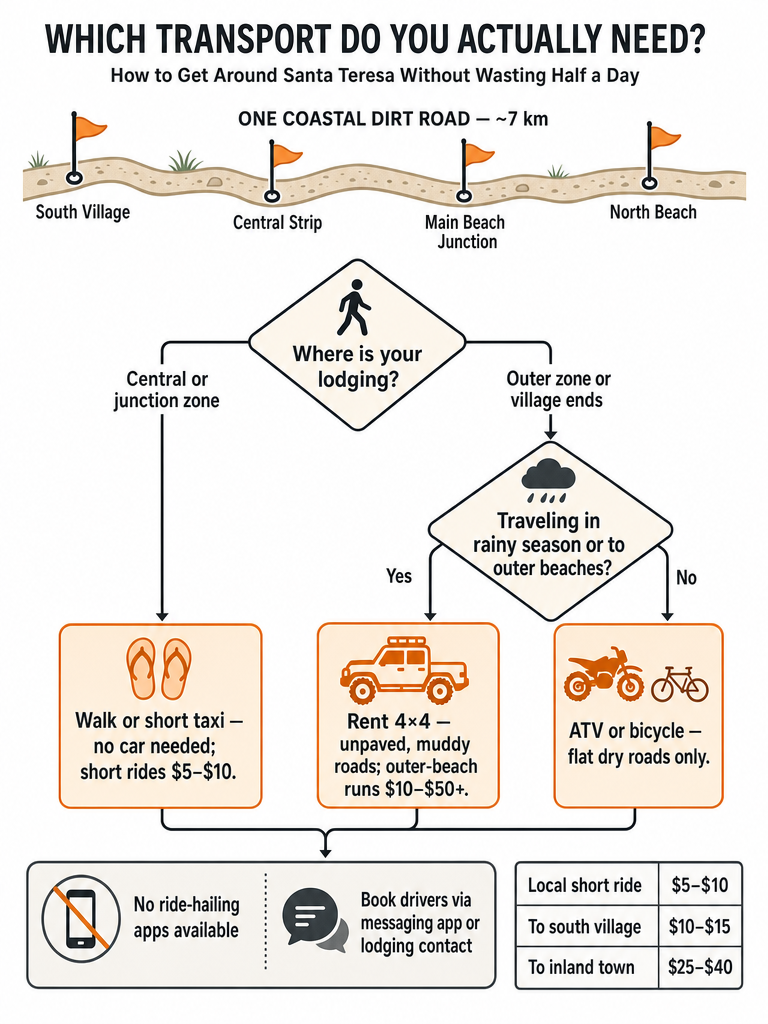
Why Santa Teresa transport is really a one-road decision
Santa Teresa is functionally one long street, and that geometry decides your daily friction more than any vehicle does. The main dirt road runs north from the Playa Carmen intersection for about 7 kilometers through Santa Teresa to Playa Hermosa, with Mal País branching south (Source: Sights and Sounds). Everything — restaurants, surf breaks, markets, hostels — sits along that line.
That's the detail most transport guides miss. You're not navigating a town with neighborhoods and a grid. You're choosing a spot on a 7-kilometer ribbon and deciding how far you're willing to move along it each day.
Stay near the Playa Carmen end and central Santa Teresa, and your trips are short and walkable. Stay at the Playa Hermosa end or down in Mal País, and every coffee run becomes a drive. The road is also unpaved for long stretches, which matters when you weigh an ATV against a bike against your own feet.
In Santa Teresa, lodging location is the transport decision — the vehicle is just how you cope with it.
For a deeper look at how the road itself splits the town, see where to stay in Santa Teresa by beach, road, and noise.
Do you need a car in Santa Teresa?
You probably don't need a rental car for a short Santa Teresa trip if you stay near Playa Carmen or central Santa Teresa. Those zones put beaches, restaurants, and groceries within walking range, and the occasional short taxi covers the rest at $5–$10 a ride (Source: Gobimba). A car becomes worthwhile mainly when you plan repeated trips beyond the main strip.
The honest split looks like this:
| Your situation | Car needed? | Why |
|---|---|---|
| 3–4 nights near Playa Carmen / central Santa Teresa | No | Walk most things, taxi the rest |
| Staying toward Playa Hermosa or in Mal País | Maybe | Distances stretch; daily walks get long |
| Day trips to Montezuma, Cóbano, or Tambor | Lean yes | Taxis add up fast over a week |
| Rainy season, off-strip lodging | Yes (4×4) | Roads turn muddy and rough |
Renting isn't cheap or carefree. A car or 4×4 averages 60 to 90 USD per day (Source: Gobimba), plus the dirt road, scarce parking, and no formal lot infrastructure. For a few days on the main strip, taxis and walking usually win on both cost and hassle.
Where should I stay in Santa Teresa without renting a car?
To skip a rental entirely, base yourself near the Playa Carmen intersection or in central Santa Teresa, where the densest cluster of restaurants, surf access, and groceries sits within walking distance. The farther north toward Playa Hermosa or south into Mal País you stay, the more you'll lean on taxis, an ATV, or a 4×4 for ordinary daily errands.
The logic follows the road. Central Santa Teresa is the busiest stretch, so it concentrates the things you'll actually visit. That density is exactly what makes car-free stays comfortable there and frustrating elsewhere.
Mal País is quieter and more spread out, which is a feature if you want calm and a liability if you want to walk to dinner. Playa Hermosa, north of the strip, trades convenience for space.
Match the zone to your tolerance for moving around:
- Playa Carmen / central Santa Teresa: easiest car-free base.
- Mal País: quieter, but plan on wheels — compare bases in where to stay in Mal Pais if you hate Santa Teresa chaos.
- Playa Hermosa end: more room, more reliance on transport.
If you're still weighing surf access against quiet, Santa Teresa vs Mal Pais for surf stays breaks down what changes day to day.
Is an ATV actually the most practical option in Santa Teresa?
An ATV is the most commonly recommended option in Santa Teresa, not automatically the most practical one. The recommendation comes from real road conditions: there are no sidewalks, the roads and paths are uneven, and there's a lot of traffic, which is why one frequent visitor called an ATV essential for getting around (Source: Heartbeet Kitchen). Whether that applies to you depends on how far you're moving and where you stay.
For trips up and down the strip, an ATV handles the dirt road and squeezes past traffic where a car stalls. It's also fun, which is part of its appeal. But it's overkill for someone parked near Playa Carmen doing short walks plus a couple of $5–$10 taxi rides.
Stack the options honestly:
| Option | Best for | Catch |
|---|---|---|
| Walking | Short stays, central base | No sidewalks; dusty, uneven paths |
| Taxi | Occasional rides, no parking worry | No Uber, negotiated, $5–$10 in town |
| ATV | Moving along the full strip | Exposed to dust, rain, traffic |
| Bike | Short flat hops | Same uneven-road problem |
| Car / 4×4 | Day trips off the strip | 60–90 USD/day, parking |
Public detail on local ATV licensing, helmet rules, and enforcement is limited as of this writing, so confirm requirements with your rental before riding.
When is a 4×4 worth it for Mal País, Montezuma, Playa Hermosa, or rainy season?
A 4×4 is worth it when you plan to leave the main strip. Roads to surrounding beaches like Montezuma, Playa Hermosa, and Mal País are unpaved, bumpy, and turn muddy in the rainy season, which is exactly why a 4×4 is highly recommended for that kind of exploring (Source: Gobimba). For staying put in central Santa Teresa, it's usually more vehicle than you need.
The edge cases where a 4×4 pays off:
- Day trips to Montezuma or Cóbano over rough connecting roads.
- Repeated runs to Playa Hermosa or deeper Mal País, where distances and ruts add up.
- Rainy-season travel, when low-clearance cars and ATVs struggle in mud.
- Off-strip lodging reached by steep or unpaved access roads.
Renting runs 60 to 90 USD per day for a car or 4×4 (Source: Gobimba). Over a week of side trips, that can undercut stacking taxi fares — a single Montezuma taxi run is quoted at $50–$70 one way (Source: Gobimba).
If your trip includes Montezuma, Cóbano, or rainy-season roads, a 4×4 is the difference between a side trip and a stranded afternoon.
For the specific Montezuma run, Santa Teresa to Montezuma: taxi, ATV, shuttle, or car lays out the fares and times. To weigh the base itself, see Montezuma or Mal Pais? Which base fits your trip best.
Is there Uber in Santa Teresa, Costa Rica?
No, Uber does not operate in Santa Teresa, and ride-hailing apps are not available across most of the Nicoya Peninsula (Source: Gobimba). The practical replacement is a network of independent local drivers and private 4×4 vehicles, arranged through your hotel, hostel, or a saved WhatsApp contact rather than an app on your phone.
Don't land expecting to open an app and watch a car icon roll toward you. That muscle memory wastes the most time for new arrivals. Instead, your lodging is the dispatch system — front desks and hosts keep driver numbers and will text one for you.
We can't confirm from current sources that alternatives like Lyft or Bolt operate locally either, so treat all app-based ride-hailing as unavailable until you're told otherwise on the ground. Plan for negotiated rides and saved contacts, and the no-Uber reality stops being a problem.
Arriving with no driver contact and no rental is how people lose their first afternoon. Get a WhatsApp number through your lodging before you travel.
Keep reading
- Where to Stay in Santa Teresa by Beach, Road, and Noise
- Getting to Santa Teresa: Ferry, Drive, or Shuttle?
- Santa Teresa to Montezuma: Taxi, ATV, Shuttle, or Car
- How Many Days in Santa Teresa Is Actually Enough?
- Santa Teresa Banking, ATMs, and Cash: What to Expect
- Santa Teresa Restaurants Worth It for a Short Trip
How do taxis work in Santa Teresa, Costa Rica?
Taxis in Santa Teresa work informally: there's no meter, no official taxi stand, and no central dispatch app. Rides are arranged with independent local drivers or private 4×4 vehicles through WhatsApp, hotels, hostels, or local contacts (Source: Gobimba). You agree on a price before you get in, because nothing is metered.
That makes the system feel opaque at first, then simple once you have a number. The usual flow:
- Ask your lodging for a trusted driver's WhatsApp contact on arrival.
- Message the driver with pickup spot, destination, and time.
- Confirm the fare before the ride, in writing if you can.
- Save the number and reuse the same driver all trip.
Because prices aren't fixed, they shift with time of day, demand, weather, number of passengers, and your willingness to negotiate (Source: Gobimba). Late nights and bad weather push fares up. A driver you've used before tends to quote fairer and show up faster.
In Santa Teresa, a reliable driver's WhatsApp number is worth more than any app. Get one early and you've solved most of your transport problem for the whole stay.
How much do Santa Teresa taxis cost for short rides, Mal País, Cóbano, Montezuma, and Tambor Airport?
Santa Teresa taxi prices are negotiated, not metered, but Gobimba publishes working ranges you can budget against. Short rides within town run $5–$10, while longer runs scale up by distance and road difficulty. These are approximate figures that move with demand, weather, passenger count, and the hour.
| Route | Approximate fare |
|---|---|
| Short ride within Santa Teresa | $5–$10 |
| Santa Teresa to Mal País | $10–$15 |
| Santa Teresa to Cóbano | $25–$40 |
| Santa Teresa to Montezuma | $50–$70 |
| Santa Teresa to Tambor Airport | $40–$60 |
All figures: Gobimba.
Use these as anchors when negotiating. If a quote lands far above the range without a clear reason like rain, midnight, or four passengers and luggage, it's worth asking another driver. The Montezuma and Tambor fares show why a rental can pay off over a week — two round trips to either erases much of the 60 to 90 USD per day rental cost (Source: Gobimba).
A short in-town taxi ride costs $5–$10 in Santa Teresa, while a one-way run to Montezuma runs $50–$70 (Source: Gobimba).
How to get around Santa Teresa, Costa Rica, after arriving from SJO
Your arrival logistics and your in-town movement are two separate problems — solve the first transfer before you land. Santa Teresa sits about 150 kilometers west of San José International Airport, and the overland route runs through Puntarenas, the ferry to Paquera, and a mix of paved and uneven roads (Source: Sights and Sounds).
The mistake is treating the last leg as something to figure out on arrival. By the time you reach Paquera or Cóbano, you want a driver already expecting you, not a scramble for a ride with no app to call.
So split the planning:
- Getting there: drive-plus-ferry, shuttle, or the fast option — flying, which House of Somos describes as a 30 minute flight and a 25 minute drive (Source: House of Somos).
- Getting around once there: the walk-taxi-ATV-4×4 choice tied to your lodging zone.
Arrange that first local transfer through your hotel or a shuttle that drops you at the door. It's the single move that prevents losing your first half-day. For the full route comparison, see getting to Santa Teresa: ferry, drive, or shuttle.
San Jose Costa Rica to Santa Teresa Costa Rica ferry, shuttle, or bus current 2026
The overland route from San José runs in three sourced legs: drive to Puntarenas, ferry to Paquera, then continue by road. The drive from San José International Airport to the Puntarenas ferry terminal takes about 2 hours, and the Puntarenas to Paquera ferry crossing takes about 70 minutes (Source: Sights and Sounds).
What's reliably sourced on the ferry:
- First ferry from Puntarenas to Paquera: about 5:30 AM (Source: Sights and Sounds).
- Last ferry from Puntarenas to Paquera: 8:30 PM (Source: Sights and Sounds).
- Arrival buffer: get there at least an hour early, more in busy seasons and holidays (Source: Sights and Sounds).
Beyond that, be careful. Current 2026 schedules for Transportes Cóbano buses, official Naviera Tambor sailing times, and exact fares need direct verification before you travel — public, current detail is limited as of this writing, and we won't invent times you'd plan around. Check the operator directly close to your travel date and confirm with your lodging, since the ferry is the constraint that decides whether a same-day arrival works.
Miss the 8:30 PM last ferry and your day ends in Puntarenas, not Santa Teresa. Build the schedule around the ferry, not your flight.
What should you arrange before arrival so you do not lose half a day?
The single biggest time-saver is deciding your transport before you arrive, because Santa Teresa has no Uber, no taxi meter, and no app to bail you out on the ground. Lock down lodging zone, a driver contact, and any rental in advance, and you skip the scramble that costs new arrivals their first afternoon.
Run this checklist before you fly:
- Pick lodging by transport need first — central Santa Teresa or Playa Carmen for car-free ease; expect to need wheels in Mal País or toward Playa Hermosa.
- Save a WhatsApp taxi contact through your hotel or hostel before you land.
- Decide on a 4×4 if your plans include Montezuma, Cóbano, or rainy-season roads — rentals run 60 to 90 USD per day (Source: Gobimba).
- Buffer the ferry, which runs roughly 5:30 AM to 8:30 PM from Puntarenas to Paquera; arrive at least an hour early (Source: Sights and Sounds).
- Don't assume app-based rides work — they don't (Source: Gobimba).
Plan transport before you fly and you arrive with a driver waiting; improvise and you lose the day.
For ongoing local intel on transport, surf, and what's actually worth your time on the peninsula, get the Nicoya dispatch.
Sources
- What are the best ways to travel to Santa Teresa, Costa ...www.facebook.com
- 11 Best Tips for Vacationing in Santa Teresa, Costa Ricaheartbeetkitchen.com
- Santa Teresa things to do/safety/tips! : r/costaricawww.reddit.com
- How to get to Santa Teresa, Costa Ricahouseofsomos.com
- Santa Teresa, Costa Rica: Complete Travel Guidewww.puravidatraveling.com
FAQ
How do I get from San Jose to Santa Teresa Costa Rica — ferry, shuttle, or bus in 2026?
Drive to the Puntarenas ferry terminal (about 2 hours from SJO), take the Puntarenas-to-Paquera ferry (about 70 minutes), then continue by road. The first crossing leaves Puntarenas around 5:30 AM; the last at 8:30 PM — miss it and you're sleeping in Puntarenas. Arrive at least an hour early, more during holidays. Verify current Naviera Tambor schedules and Transportes Cóbano bus times directly with the operators before you travel, since 2026 timetables shift.
Where should I stay in Santa Teresa without renting a car?
Base yourself near the Playa Carmen intersection or central Santa Teresa. That stretch concentrates restaurants, surf access, and groceries within walking distance, so short taxi rides at $5–$10 cover anything you can't walk. Stay toward Playa Hermosa or down in Mal País and ordinary errands require wheels — distances stretch quickly along a 7-kilometer unpaved road with no sidewalks and no ride-hailing apps.
Is there Uber in Santa Teresa, Costa Rica?
No — Uber and app-based ride-hailing don't operate in Santa Teresa or across most of the Nicoya Peninsula. Rides are arranged through independent local drivers via WhatsApp, coordinated through your hotel or hostel. Get a driver's WhatsApp number from your lodging on arrival; that contact replaces everything an app would do. Arriving without one and expecting to hail a ride is the most reliable way to lose your first afternoon.
How much do taxis cost in Santa Teresa — short rides, Mal País, Cóbano, Montezuma, Tambor Airport?
Fares are negotiated, not metered. Ballpark figures from Gobimba: short in-town rides run $5–$10; Santa Teresa to Mal País is $10–$15; to Cóbano, $25–$40; to Montezuma, $50–$70; to Tambor Airport, $40–$60. Prices shift with demand, weather, hour, and passenger count. Two round trips to Montezuma can erase much of a weekly car rental cost of $60–$90 per day.
Is an ATV actually necessary in Santa Teresa, or is it overhyped?
Necessary depends entirely on where you're staying. ATVs make sense along the full strip — no sidewalks, uneven roads, and steady traffic make them genuinely practical for daily movement. But if you're based near Playa Carmen, walking plus occasional $5–$10 taxi rides usually beats the cost and exposure of an ATV rental. The recommendation is common because road conditions are real; it's not automatically the right call for every trip.
When is renting a 4×4 worth it versus just taking taxis in Santa Teresa?
A 4×4 pays off when you're leaving the main strip repeatedly — day trips to Montezuma, Cóbano, or Playa Hermosa, off-strip lodging, or rainy-season travel when roads turn muddy. Rentals run $60–$90 per day, but a single one-way taxi to Montezuma costs $50–$70, so the math flips fast over a week of side trips. For a short central stay with no day trips planned, taxis win on both cost and hassle.
Santa Teresa eSIM and SIM Cards on Arrival
For most Santa Teresa trips, an eSIM is the cleanest answer: install it before you fly, keep your home number active, and arrive already connected. Buy a physical Costa Rican SIM only when you need a local number for calls, drivers, or a longer stay.
Read →Santa Teresa Pharmacies and Clinics: Where to Go
Public, verifiable pharmacy and clinic details for Santa Teresa are thin, and search results often mix in Wichita listings. This guide shows what to ignore and how to confirm care locally on the day.
Read →Santa Teresa Grocery Stores and Markets: What to Expect
Santa Teresa works best for daily top-ups, while Cóbano is the smarter larger shop. Mini markets cover water, eggs, bread, coffee, beer, and fruit.
Read →