Montezuma or Mal Pais? Which Base Fits Your Trip Best
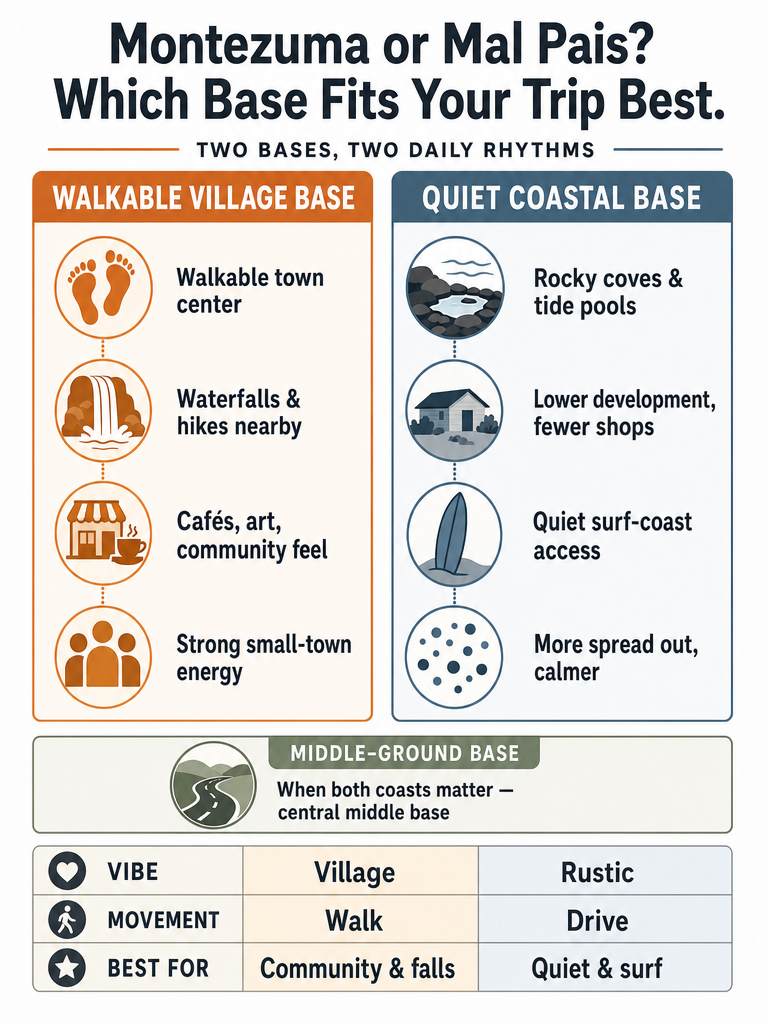
Pick Montezuma for waterfalls, hikes, and a walkable village center. Choose Mal País if you want a quieter, more rustic base with easy Santa Teresa surf access.

Key takeaways
- Pick Montezuma if you want a walkable village, waterfalls, and small-town community; pick Mal País if you want a quieter, more rustic base with easy access to Santa Teresa's surf.
- Mal País in this guide is a small, rustic beach village on the southern tip of Costa Rica's Nicoya Peninsula, just south of Santa Teresa — not a geological landform and not the El Malpais National Monument in New Mexico.
- The real difference between Montezuma and Mal País is how you move once you arrive, not how either looks.
- Montezuma is the better base if you want waterfalls, hikes, a walkable town center, and small-town community over daily surf.
Montezuma or Mal Pais: which base fits your trip best?
Pick Montezuma if you want a walkable village, waterfalls, and small-town community; pick Mal País if you want a quieter, more rustic base with easy access to Santa Teresa's surf. These two towns sit on opposite edges of the southern Nicoya Peninsula and feel almost nothing alike, despite both getting described as "near Santa Teresa." The right answer depends on how you plan to move, not which beach photographs better.
Here's the fast framework:
- Choose Montezuma if waterfalls, hikes, cafés, art, and a compact town center you can walk matter more than daily surf. The Playa Los Vivos comparison guide describes Montezuma as a bohemian community with a distinct identity and walkable center.
- Choose Mal País if you want fewer crowds, lower development, rocky coves and tide pools, and you'll still spend time on the Santa Teresa side. The Costa Rica Surf Company calls it the quieter, more spread-out neighbor.
- Choose Cóbano or Río Negro as a third base when both Montezuma's side and the Santa Teresa/Mal País coast matter equally, per Villas Pura Vida.
If your trip is surf-first, Mal País or the Santa Teresa side wins on access alone — Montezuma's surf is limited and you'll spend hours commuting.
Which Mal Pais are we talking about (Costa Rica, not New Mexico)?
Mal País in this guide is a small, rustic beach village on the southern tip of Costa Rica's Nicoya Peninsula, just south of Santa Teresa — not a geological landform and not the El Malpais National Monument in New Mexico. The Spanish word "malpaís" means rough or jagged volcanic terrain, which is why search results mix it up with US lava fields. That's the wrong page.
The name here translates roughly to "Bad Country," which The Costa Rica Surf Company notes is misleading marketing in reverse — the place is anything but bad. You'll see it spelled both Mal País and Mal Pais. Either way, it refers to the same stretch of coastline below Santa Teresa, sharing the same fork in the road and the same dusty access. This is a base-choice guide, not a hiking-trail or volcano article.
Montezuma vs. Malpais: what daily friction changes after you book?
The real difference between Montezuma and Mal País is how you move once you arrive, not how either looks. Montezuma is a compact village where you can walk to cafés, small shops, and the beach in parts of town. Mal País is more spread out along a road that parallels the coast, with development scattered and fewer places clustered within walking distance.
That distinction matters more than most comparisons admit. "Close to options" and "easy to move around" are not the same thing. The Costa Rica Surf Company describes Mal País as quieter and more spread out, focused on raw natural beauty rather than a social scene. So you may be near Santa Teresa's restaurants and surf, but you'll likely need wheels to reach them comfortably.
Montezuma flips the trade-off. Villas Pura Vida points out that staying in Montezuma means more back-and-forth if Santa Teresa is a major part of your trip — surf lessons, sunset dinners, multiple beach days. Inside the village, though, you can leave the car parked. Decide by movement: Montezuma rewards walkers who stay put, while Mal País rewards drivers who want quiet plus Santa Teresa access.
Should you choose Montezuma for waterfalls, hikes, and a walkable village center?
Montezuma is the better base if you want waterfalls, hikes, a walkable town center, and small-town community over daily surf. The Playa Los Vivos comparison guide describes Montezuma as having a strong community feel, a distinct bohemian identity, art and culture, waterfalls, and a walkable center that draws long-term travelers and creatives. Villas Pura Vida adds that parts of town let you walk to cafés, small shops, and the beach.
This base fits a specific traveler: someone who values village energy and proximity to nature over surf-scene access. If your ideal day is a waterfall hike, a slow café morning, and dinner you can walk to, Montezuma delivers that without a car.
Two honest caveats. First, beaches near Montezuma vary, many are reached by trail, and true seclusion thins out during peak travel months, per the Playa Los Vivos guide. Don't expect an empty beach in high season. Second, Montezuma sits far from Santa Teresa's surf and dining strip, so a surf-heavy itinerary turns into a commute.
| Want this | Montezuma fit |
|---|---|
| Walkable village center | Strong |
| Waterfalls and hikes nearby | Strong |
| Art, culture, community | Strong |
| Daily Santa Teresa surf access | Weak |
| Guaranteed seclusion in peak months | Limited |
If you're weighing the surf-town alternative, our Santa Teresa vs. Montezuma base comparison covers that fork.
Should you choose Mal Pais for quiet near Santa Teresa surf?
Fewer crowds, a rustic feel, and proximity to Santa Teresa's surf without sleeping in its busiest strip — that's the case for Mal País. Sources consistently describe Mal País as calmer than Santa Teresa, with lower development, fewer restaurants and shops, and a rockier coastline mixed with sandy stretches. The Costa Rica Surf Company highlights hidden coves and tide pools and a tranquil, rustic vibe that draws surfers and nature lovers.
The key advantage is connection without immersion. The Playa Los Vivos guide notes Mal País sits just south of Santa Teresa and visitors move between the two easily — so you get quiet evenings but keep the bigger town's surf, dining, and activity within reach.
Be clear about what Mal País is not. It does not offer total isolation. The same guide says Mal País still feels Santa Teresa's growth and doesn't match the seclusion of beaches further south. And with fewer shops and restaurants, you'll either cook, drive, or accept limited options after dark.
"Quieter than Santa Teresa" is not the same as "remote." If silence is your goal, Mal País is a half-measure — you're still tied to the busy town next door.
For lodging micro-areas, our Mal País lodging guide for travelers avoiding Santa Teresa chaos breaks down the Playa Carmen edge versus deeper Mal País.
Mal Pais or Montezuma or both?
Stay in one base and visit the other — the two towns feel different enough that splitting nights often makes more sense than commuting. Travelers on Tripadvisor forums repeatedly say each place is so distinct that they recommend experiencing both, and that people who stay in one frequently visit the other as a day trip.
Whether to split nights comes down to trip length and energy. A short trip rarely justifies packing and re-checking-in twice; pick the base that matches your priority and day-trip the other. A longer trip can absorb a split — a few nights of Montezuma's village and waterfalls, then a few in Mal País's quiet near the surf.
One honest limitation: the provided sources don't include current door-to-door drive times between Montezuma and Mal País, so plan exact transfers with a local driver or your host before you commit to a split itinerary. Public detail on current transfer logistics between these two specific towns is limited as of this writing. The towns reward different moods, so most travelers are better off committing to one base and treating the other as a day trip.
Keep reading
- Where to Stay in Mal Pais If You Hate Santa Teresa Chaos
- Where to Stay in Santa Teresa by Beach, Road, and Noise
- Best Time to Surf Santa Teresa by Swell, Wind, and Tide
- Santa Teresa for Digital Nomads: What Gets Annoying Fast
- Getting to Santa Teresa: Ferry, Drive, or Shuttle?
- Santa Teresa Banking, ATMs, and Cash: What to Expect
Where to stay between Montezuma and Santa Teresa: Cóbano, Río Negro, or the coast?
Cóbano and the nearby countryside, including Río Negro, work as a practical central base when Montezuma, Santa Teresa, and the surrounding beaches all matter equally. Villas Pura Vida identifies this inland area as a functional middle option for travelers who want access to all three without sleeping in the busiest tourist strips. It trades beachfront for balance.
This third-base answer solves a real problem the binary ignores. If you refuse to choose between Montezuma's waterfalls and the Santa Teresa coast — and you have a car — a more central position cuts the worst of the back-and-forth that Villas Pura Vida flags as Montezuma's main downside.
The trade-off is obvious: you won't walk to a beach from Cóbano, and you'll drive more for nightlife and dining. This option suits planners who prioritize logistics over location and don't mind a vehicle anchoring every plan.
| Base | Best for | Main trade-off |
|---|---|---|
| Montezuma | Walkable village, waterfalls | Far from Santa Teresa surf |
| Mal País | Quiet near Santa Teresa | Spread out, fewer shops |
| Cóbano / Río Negro | Central access to all sides | Not beachfront, needs a car |
Cabuya is hard to recommend as a base here — the provided sources don't give enough current detail to put it on the list with confidence.
Stay over in Santa Teresa, Mal Pais or Montezuma?
Santa Teresa itself beats both other bases when dining, social life, and surf access top your list. The Costa Rica Surf Company describes Santa Teresa as the region's vibrant center, packed with cafés, restaurants, boutique hotels, and bars along a busy main road, drawing surfers, yogis, digital nomads, and wellness travelers. If you want options within reach and don't mind the crowds, this is the most convenient base of the three.
The fork in the road tells the geography. Frommer's describes Mal País and Santa Teresa as villages along a beach-parallel road, with Playa Carmen straight ahead at the fork, Mal País to the left, and Santa Teresa to the right. Where you turn decides your trip's pace.
If Santa Teresa is your pick, three Onda guides do the heavy lifting:
- Santa Teresa restaurants worth the trip for short stays
- Where to stay in Santa Teresa by beach, road, and noise to avoid the wrong side of the road
- Best time to surf Santa Teresa by swell, wind, and tide before you book a surf-focused trip
Do you need a car, ATV, or 4x4 for Montezuma, Mal Pais, and Santa Teresa?
A 4x4 is highly recommended for the final leg toward Santa Teresa and Mal País, where roads turn from paved to bumpy dirt. The Costa Rica Surf Company describes the approach as a mix of paved and rough dirt roads and calls a 4x4 the safer choice for the last stretch. That stretch sets the tone for daily driving once you're based on the Santa Teresa side.
For movement between Montezuma, Mal País, and Santa Teresa, wheels matter more the more spread out your base is. Mal País rewards having a vehicle because options are scattered; Montezuma's compact center lets you walk locally but still requires transport to reach Santa Teresa's surf and dining.
The honest gaps: the provided sources don't cover current ATV rental pricing, taxi availability, parking friction, or after-dark driving conditions for each town. The main road through Santa Teresa is described as a chaotic mix of ATVs, motorbikes, pedestrians, and 4x4s kicking up dust, so expect dust and congestion — but confirm current rental and seasonal road details with your host before arrival.
Road conditions shift by season. The sources don't detail rainy-season passability, so check locally before committing to a budget rental car over a 4x4.
Which arrival route fits your base: SJO to Herradura water taxi or LIR to Paquera ferry?
The SJO water-taxi route favors Montezuma; the LIR ferry-and-drive route favors the Santa Teresa and Mal País side. From Juan Santamaría International Airport (SJO), The Costa Rica Surf Company describes about 90 minutes by road to Los Sueños Marina in Herradura, then a one-hour water taxi across the Gulf of Nicoya straight into Montezuma — the cleanest path if Montezuma is your base.
From Daniel Oduber Quirós International Airport (LIR) in Liberia, the same source lays out an overland route: roughly 2–3 hours of driving to the Paquera or Naranjo ferry terminals, a 70-minute ferry crossing to Paquera, then a 60–90 minute drive onward to Santa Teresa on paved and bumpy dirt roads. This route lands you closer to Santa Teresa and Mal País.
| Route | First leg | Crossing | Final leg | Best base |
|---|---|---|---|---|
| SJO → Herradura → water taxi | ~90 min drive | 1-hour water taxi | — | Montezuma |
| LIR → Paquera/Naranjo → ferry | 2–3 hr drive | 70-min ferry | 60–90 min drive | Santa Teresa / Mal País |
Match the route to your base and you skip an unnecessary cross-peninsula transfer. For a fuller breakdown of ferry, drive, shuttle, and bus options, see our guide on getting to Santa Teresa.
The LIR ferry route stacks up to 2–3 hours of driving, a 70-minute crossing, and another 60–90 minutes of dirt road — budget half a day, per The Costa Rica Surf Company.
What town is best to stay for one month? Montezuma or Mal Pais?
For a month, the split holds: Montezuma offers community and walkability, while Mal País offers a quieter, more rustic base with Santa Teresa-side access. The Playa Los Vivos guide reinforces Montezuma's pull for long-term travelers and creatives, with its bohemian atmosphere and walkable center.
For long stays, the practical details matter most — and the provided sources don't cover them. Current differences in banking, ATMs, groceries, pharmacies, coworking, cell service, and Wi-Fi between Montezuma and Mal País need fresh local sourcing. Our Santa Teresa banking and ATM guide and digital-nomad reality check cover the Santa Teresa side, which is the closest service hub for Mal País.
Sources
- What town is best to stay for one month? Montezuma or Mal Pais?www.tripadvisor.com
- HELP! Is it worth going all the way to Mal Pais or Montezuma?playalosvivos.com
- Stay over in Santa Teresa, Mal Pais or Montezuma? What would you ...www.thecostaricasurfcompany.com
- Montezuma vs. Malpais - Fodor's Travel Talk Forumsvillaspuravida.com
FAQ
What's the main difference between Montezuma and Mal Pais for a base?
Movement is the real difference — not scenery. Montezuma is a compact, walkable village where cafés, small shops, and the beach are on foot. Mal País is spread along a coast-parallel road with development scattered across it, so you'll need wheels for most errands. Montezuma rewards travelers who want to stay put; Mal País suits drivers who want quiet nights with Santa Teresa's surf and dining a short drive away.
Is Mal Pais good for surfing, or should I stay in Santa Teresa instead?
Mal País delivers powerful waves with fewer people in the lineup than Santa Teresa, which runs consistent surf but crowded breaks year-round. If uncrowded water matters more than having a restaurant on every corner, Mal País wins. Santa Teresa is still the more convenient surf base — more instructors, more board rental options, and the region's broadest range of dining and nightlife within reach after a session.
Do I need a 4x4 to get to Mal Pais and Santa Teresa?
A 4x4 is the safer choice for the final approach to Santa Teresa and Mal País, where the road transitions from paved to rough dirt. The Costa Rica Surf Company flags this stretch specifically. Once based on the Santa Teresa side, a vehicle matters even more if you're in Mal País, since options are spread out and you'll drive to most meals, surf spots, and shops. Road conditions can shift by season — confirm passability with your host before renting a budget car.
Which airport should I fly into for Montezuma vs. Mal Pais?
SJO (San José) pairs naturally with Montezuma — roughly 90 minutes by road to Los Sueños Marina in Herradura, then a one-hour water taxi directly into town. LIR (Liberia) suits the Santa Teresa and Mal País side better: a 2–3 hour drive to the ferry terminal, a 70-minute crossing to Paquera, then 60–90 more minutes of driving to the coast. Matching your airport to your base avoids a cross-peninsula transfer that can eat most of a travel day.
Is it worth staying in both Montezuma and Mal Pais on the same trip?
On a short trip, pick one base and day-trip the other — packing up twice rarely pays off. Travelers consistently recommend experiencing both because the towns feel genuinely different, not just geographically distant. A longer stay can absorb a split: a few nights of Montezuma's village and waterfall hiking, then a few in Mal País near the surf. Confirm transfer logistics with a local driver before committing, since current door-to-door timing isn't well documented online.
What is Cóbano and why do some people recommend it as a base over Montezuma or Mal Pais?
Cóbano is an inland town that sits roughly between Montezuma and the Santa Teresa coast, making it a functional middle option when both sides of the peninsula matter equally. Villas Pura Vida identifies it as a practical central base for travelers who want access to all three areas without sleeping in the busiest tourist strips. The trade-off is direct: you won't walk to any beach from Cóbano, and every plan anchors to a vehicle.
Santa Teresa eSIM and SIM Cards on Arrival
For most Santa Teresa trips, an eSIM is the cleanest answer: install it before you fly, keep your home number active, and arrive already connected. Buy a physical Costa Rican SIM only when you need a local number for calls, drivers, or a longer stay.
Read →Santa Teresa Pharmacies and Clinics: Where to Go
Public, verifiable pharmacy and clinic details for Santa Teresa are thin, and search results often mix in Wichita listings. This guide shows what to ignore and how to confirm care locally on the day.
Read →Santa Teresa Grocery Stores and Markets: What to Expect
Santa Teresa works best for daily top-ups, while Cóbano is the smarter larger shop. Mini markets cover water, eggs, bread, coffee, beer, and fruit.
Read →