Santa Teresa eSIM and SIM Cards on Arrival
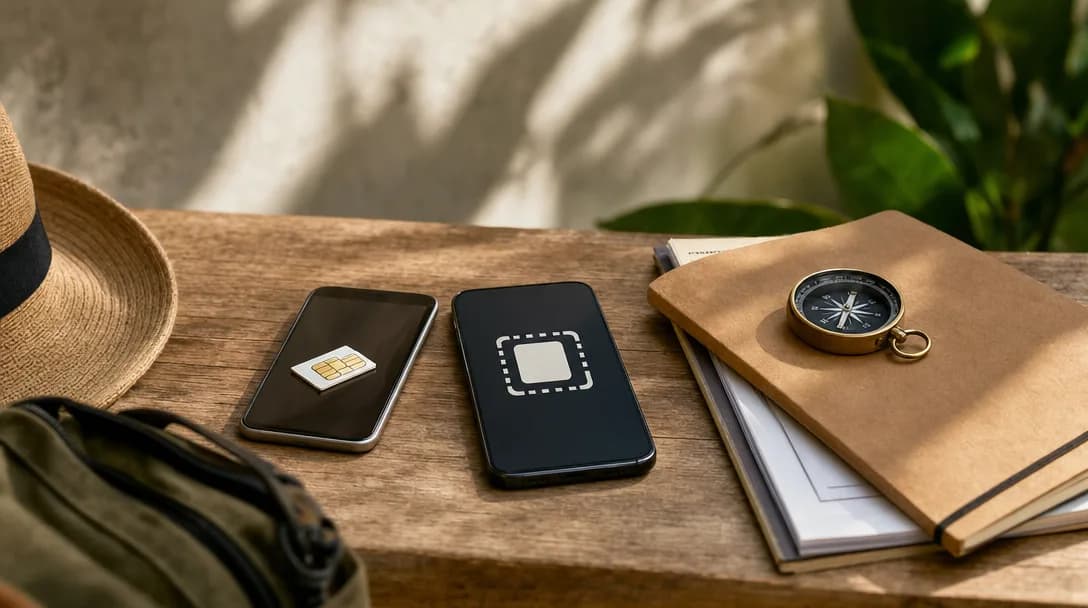
For most Santa Teresa trips, an eSIM is the cleanest answer: install it before you fly, keep your home number active, and arrive already connected. Buy a physical Costa Rican SIM only when you need a local number for calls, drivers, or a longer stay.
Key takeaways
- For most short Santa Teresa trips, set up an eSIM before you fly.
- Yes, a data-only eSIM covers the apps that actually run a Santa Teresa trip.
- A physical Costa Rican SIM earns its place when you need a local number, not just data.
- Buying a prepaid SIM on arrival is straightforward, but you need two things ready first.
Should you set up an eSIM before flying to Santa Teresa or buy a SIM after landing?
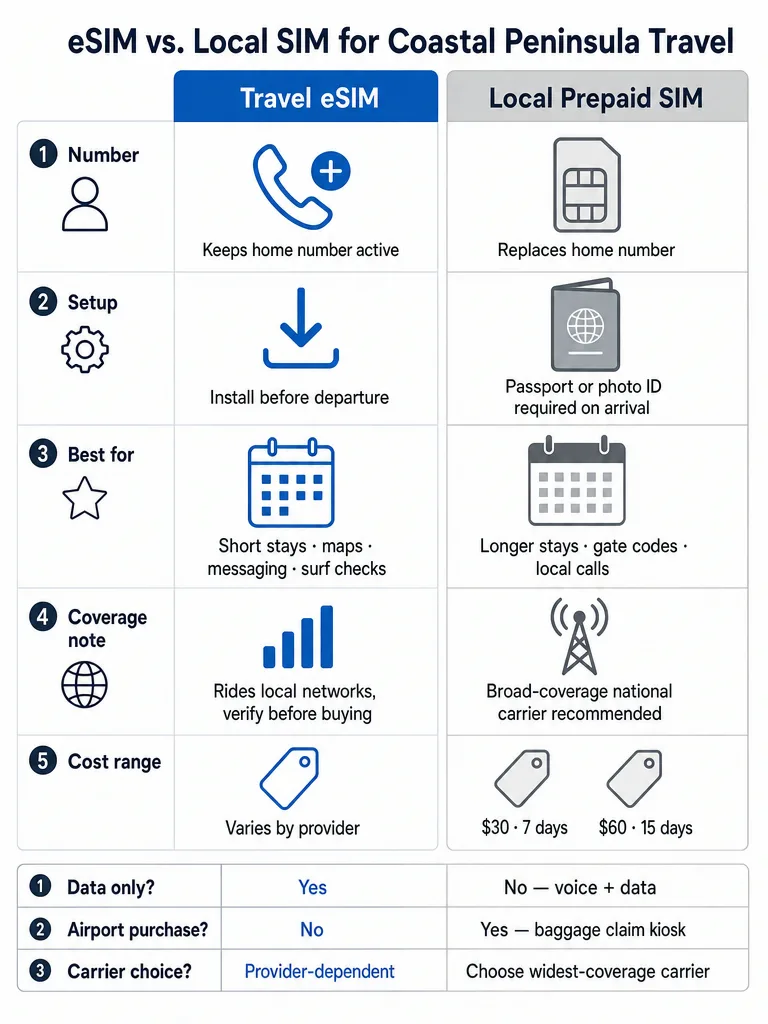
For most short Santa Teresa trips, set up an eSIM before you fly. A travel eSIM is a digital data plan you install ahead of departure and switch on when you land, and it keeps your home number active because these plans are usually data-only. MytanFeet's prepaid SIM guide confirms travel eSIMs add a second line without changing your home phone number.
That matters on the Nicoya Peninsula, where the last stretch of the trip is the part you don't want to spend hunting for a SIM stand. You land tired, you have a shuttle driver to message, a ferry window to watch, and a hotel gate code buried in a WhatsApp thread. Arriving already connected removes the airport queue entirely.
Buy a physical Costa Rican SIM instead when a local number is the actual goal: longer stays, frequent calls to drivers or landlords, or emergency reachability. MytanFeet notes that inserting a local SIM means your home number stops working while it's in the phone. That's a real tradeoff, not a technicality.
The honest catch: eSIM coverage quality depends on which local network your provider partners with, and public sources don't map that cleanly for Santa Teresa. So the safe default is an eSIM for a one-week beach trip, a physical local SIM for anything longer or logistics-heavy.
Is an eSIM enough for WhatsApp, Waze, Google Maps, shuttles, and surf checks in Santa Teresa?
Yes, a data-only eSIM covers the apps that actually run a Santa Teresa trip. WhatsApp, Waze, Google Maps, and tide or surf checks all need data, not a local phone number, so a working data plan handles them fine. Two travelers in the Costa Rica Travel Tips group reported using Airalo in Montezuma specifically for Waze and WhatsApp before heading to Santa Teresa.
Santa Teresa is where this matters more than in a city. The town is spread out and informal, addresses lean on landmarks instead of street numbers, and many plans run on messages rather than fixed schedules. The Kaspersky eSIM guide describes the same reality: mobile data helps you reach the right beach entrance, find a driver, follow a location pin after dark, or shift a dinner plan.
Data handles nearly the full arrival checklist across Santa Teresa, Playa Carmen, Mal Pais, Montezuma, and the transfers between them:
- Navigating between beach areas and Cobano
- Coordinating shared shuttles, taxis, ATVs, and hotel transfers
- Checking ferry plans if you route through Puntarenas and Paquera
- Messaging hosts, surf schools, and coworking spaces
- Checking tide, weather, and surf before a session
If your trip is beach, surf, and shuttle coordination, an eSIM does the whole job. The only things it won't do are voice calls to Costa Rican landlines and being reachable on a local number, which most short-stay visitors never need. For a swell-timing check, our guide on how to read the Santa Teresa surf report works fine off eSIM data.
When is a physical Costa Rican SIM worth the hassle in Santa Teresa?
A physical Costa Rican SIM earns its place when you need a local number, not just data. That means longer stays, frequent calls to drivers, landlords, or tour operators, and situations where someone needs to phone you back. The cost is real: MytanFeet notes that once a Costa Rican SIM is inserted, your home number no longer receives calls or texts.
The peninsula throws up a few cases where a local line genuinely helps. Drivers and gate-code hosts sometimes want to call rather than message. Emergency reachability on a Costa Rican number is cleaner than routing everything through an app. As for topping up, MytanFeet's example is the partner SIM bundled with Adobe Rent a Car, which preloads 1,000 CRC of credit, roughly 30 minutes of local calls. Prepaid SIMs also typically expire after 90 days of no use.
Here's the split that actually decides it:
| Situation | eSIM (data-only) | Physical local SIM |
|---|---|---|
| One-week surf trip | Enough | Overkill |
| Keeping your home number live | Yes | No |
| Calling CR drivers/landlords by phone | No | Yes |
| Long stay or repeat visits | Works, but no local number | Better fit |
| Emergency reachability on a CR line | No | Yes |
A physical SIM means your home number goes dark while the card is in your phone. If people back home need to reach you, use a dual-SIM phone or an eSIM instead.
If you're settling in for weeks rather than days, the local-number case gets stronger. Our brief on Santa Teresa for digital nomads covers the wider setup that goes with a long stay.
How to get prepaid SIM cards in Costa Rica to stay connected
Buying a prepaid SIM on arrival is straightforward, but you need two things ready first. MytanFeet's guide, dated January 1, 2026, says you need an original passport or photo ID, and your phone must be unlocked. Without both, you'll stall at the counter.
The most documented arrival option is the Claro stand at San José International Airport. It sits to the left of baggage claim 5, and staff will help insert the SIM and set up your phone. The stand is open from 6 AM to 9 PM, sometimes to 11 PM on weekends, per MytanFeet, and there's a vending machine if you'd rather buy the card yourself and ask an agent for setup help.
The workflow:
- Confirm your phone is unlocked before you leave home.
- Have your passport or photo ID out at the counter.
- At SJO, find the Claro stand left of baggage claim 5.
- Pick a plan (see pricing below), let staff insert and configure it.
- Test data before you leave the terminal.
Claro's airport plans, per MytanFeet, run $30 for 7 days or $60 for 15 days, both with unlimited internet. Beyond the airport, you can buy prepaid SIMs at phone stores, supermarkets, and computer shops around the country, usually near the cashier.
What the sources don't verify: whether SIMs are sold at Liberia Airport, whether physical SIMs are sold in Santa Teresa town itself, and current Kolbi, Claro, or Liberty prices in Cobano, Montezuma, or Tambor. Public detail on those points is limited as of this writing, so plan to sort connectivity at SJO or before you fly.
What eSIM card has the best network in Santa Teresa and La Fortuna?
Kolbi is the safest carrier bet for broad coverage once you leave airport Wi-Fi and head toward Santa Teresa. MytanFeet names Costa Rica's three major phone companies as Kolbi, Liberty, and Claro, and recommends Kolbi for the widest coverage for tourists heading to popular destinations. That's a verified carrier fact, separate from any eSIM vendor's marketing.
Coverage across the country is decent but not uniform. Two Weeks in Costa Rica describes an extensive network of 3G, 4G, and 4.5G towers reaching most places, with known tourist destinations and major routes generally well covered. Their guide, last updated October 30, 2025, also flags the limit: 5G only began rolling out in mid-2025, via Liberty and Claro, and only in the most populated areas so far. Don't expect 5G in Santa Teresa.
The peninsula's terrain is the real variable. Two Weeks in Costa Rica notes that mountains and trees can partially block towers, so signal that's strong in town can weaken a few miles away. Expect that pattern between Santa Teresa, Mal Pais, Playa Hermosa, Montezuma, and along the road through Cobano.
The catch that vendor pages gloss over: eSIM coverage quality varies depending on which local network the provider partners with. So the decision isn't really "which eSIM brand," it's "which network does that eSIM ride on." Public sources don't map eSIM-to-network cleanly for Santa Teresa, so treat any provider's specific coverage promise as unconfirmed until you test it on the ground.
Keep reading
- Santa Teresa Banking, ATMs, and Cash: What to Expect
- Santa Teresa for Digital Nomads: What Gets Annoying Fast
- Santa Teresa to Montezuma: Taxi, ATV, Shuttle, or Car
- Where to Work in Santa Teresa: Wi-Fi, Noise, and Backup
- Santa Teresa Weather in 2026: Rain, Heat, and Dust
- Do You Need a Car in Santa Teresa? The Honest Tradeoffs
Airalo or Holafly?
Airalo is the eSIM with actual Santa Teresa-area traveler reports behind it; Holafly is thinly documented for this route. In the Costa Rica Travel Tips group, one traveler said Airalo worked across SJO, La Fortuna, Montezuma, Malpais, and Santa Teresa when installed at home and activated on arrival, in a post dated January 4, 2025. A separate March 2024 thread reported Airalo working in Montezuma for Waze and WhatsApp on the way to Santa Teresa.
That's firsthand anecdote, not a coverage guarantee. Both reports come from travelers describing their own trips, which is useful signal and weaker than a carrier map.
MytanFeet confirms eSIMs work in Costa Rica with several options including Holafly and Airalo, but the corpus has no comparable on-the-ground Holafly report for the peninsula. And crucially, none of the sources maps exactly which local network Airalo or Holafly uses in Santa Teresa, Montezuma, Malpais, or La Fortuna. Since coverage quality tracks the underlying network, that gap matters.
Whichever eSIM you pick, install it at home and activate on arrival, the exact setup both Airalo reports used. Buy a plan you can top up rather than a large one upfront, so a weak signal doesn't strand you with prepaid data you can't use.
What should you know before relying on mobile data between SJO, Liberia, Puntarenas, Tambor, Cobano, and Santa Teresa?
Sort your connectivity before the final road segment, because that last stretch is where you'll need data most and can least afford to be hunting for it. Most travelers reach Santa Teresa through San José, Liberia, Tambor, or the Puntarenas-to-Paquera ferry, and the Kaspersky eSIM guide notes each route benefits from having data before the final transfer.
Here's why the timing matters by route:
| Arrival route | Where data earns its keep |
|---|---|
| SJO via Puntarenas and Paquera ferry | Checking ferry plans, coordinating the final ride from Paquera |
| Liberia to Santa Teresa | Messaging the driver, following the route south |
| Domestic flight to Tambor | Contacting the driver at a small airport, confirming pickup |
| Rental car from either airport | Navigation on the rougher final stretch to Cobano and beyond |
The final road segment is the pinch point. Our guide on getting to Santa Teresa by ferry, drive, or shuttle notes there's no expressway, and the last 10 kilometers from Cobano are partly unpaved and seasonally rough. That's also where terrain-related dead zones bite hardest.
Practical sequence: get connected at SJO's Claro stand or via an eSIM you activate on arrival, then confirm data works before you leave the terminal, not after you're on a shuttle. If you're flying into the closer northern airport, our Liberia to Santa Teresa guide covers the 3.5-to-5-hour road transfer where you'll want a live map. For the Tambor option, see Tambor Airport to Santa Teresa.
How much does roaming cost compared with getting connected locally for a Santa Teresa trip?
Home-carrier roaming usually costs more per day than a full week of local data. Two Weeks in Costa Rica reports that major US carriers like AT&T and Verizon offer international travel plans at around $12 per day, which needs to be set up ahead of time and adds up fast on a longer trip.
Compare that to local options. MytanFeet lists Claro's airport plans at $30 for 7 days and $60 for 15 days, both unlimited internet. On a seven-day Santa Teresa trip, roaming at $12 per day runs to roughly $84, while the Claro 7-day SIM is $30.
| Option | Cost | Notes |
|---|---|---|
| AT&T / Verizon international plan | ~$12/day | Set up before you fly; keeps your home number |
| Claro SIM, 7 days (SJO) | $30 | Unlimited internet; local number, home number goes dark |
| Claro SIM, 15 days (SJO) | $60 | Unlimited internet |
| Travel eSIM (Airalo, Holafly, etc.) | Varies by plan | Data-only; keeps home number |
Two exceptions worth checking. Two Weeks in Costa Rica notes T-Mobile's Go5G plans claim to include international coverage with no changes needed, and one reader reported free roaming on a specific AT&T plan. UK travelers on Three UK may be able to use its "go roam" service. Confirm the fine print with your own carrier before assuming it applies.
For a week or two in Santa Teresa, local data or an eSIM almost always beats daily roaming on price, with the T-Mobile and Three UK plans as the plausible exceptions.
How to activate an eSIM on iPhone and Android before Costa Rica
Buy and install the eSIM before you leave home, then switch it on when you land. The install step works on Wi-Fi and takes a few minutes; the activation step happens on arrival at SJO or Liberia. Both Airalo reports in the Costa Rica Travel Tips group followed exactly this pattern: downloaded at home, activated after landing.
The workflow on iPhone and Android:
- Buy your eSIM plan before departure and keep the confirmation handy.
- Install the profile while on home Wi-Fi: on your phone, open Settings, then Mobile Data or SIM Manager, then Add eSIM or Add data plan, and follow the provider's instructions.
- Label the new line something like "Costa Rica data" so you can tell it apart from your home SIM.
- On arrival at SJO or LIR, switch the eSIM line on and enable data for that profile.
- Test it before you leave the terminal, well before the final road segment.
A physical Costa Rica SIM works differently: you insert the card and your home number stops receiving calls while it's in the phone. An eSIM keeps your home number live because it's a data-only second line. That's the practical reason most short-trip visitors land on an eSIM and never touch a stand.
Public sources don't confirm every device's exact menu wording or which eSIM provider maps to which Santa Teresa network, so verify device compatibility with your provider before you fly rather than at baggage claim.
FAQ
Should you set up an eSIM before flying to Santa Teresa or buy a SIM after landing?
Set up an eSIM before you fly if your trip is a week or less. A travel eSIM is a data-only profile you install at home and activate on arrival, keeping your home number live on the same device. That matters on the Nicoya Peninsula, where the last leg of the trip — ferry coordination, shuttle messaging, hotel gate codes — all run on WhatsApp before you've had a chance to find a SIM stand.
Is an eSIM enough for WhatsApp, Waze, Google Maps, and surf checks in Santa Teresa?
Yes. WhatsApp, Waze, Google Maps, tide checks, and surf reports all run on data, not a local phone number. Two travelers in Costa Rica travel forums reported Airalo working across Montezuma and Santa Teresa for exactly those apps. The only gaps are voice calls to Costa Rican landlines and being reachable on a local number — which most short-stay visitors never need.
When is a physical Costa Rican SIM worth the hassle in Santa Teresa?
A local SIM earns its place on stays longer than two weeks or when you need a Costa Rican number — calling drivers, landlords, or tour operators who prefer to phone back. The real cost: once a local SIM is inserted, your home number stops receiving calls and texts. Claro's airport plans run $30 for 7 days or $60 for 15 days; prepaid SIMs also typically expire after 90 days of no use.
What is the best carrier for mobile coverage in Santa Teresa and the Nicoya Peninsula?
Kolbi is the safest bet for broad tourist-area coverage. Costa Rica's network runs on 3G, 4G, and 4.5G towers that reach most popular destinations, but 5G only began rolling out in mid-2025 via Liberty and Claro, and only in the most populated areas. Don't expect 5G in Santa Teresa. Terrain matters: signal that's strong in town can weaken a few miles out toward Mal Pais or Montezuma.
Airalo or Holafly — which eSIM actually works in Santa Teresa and Montezuma?
Airalo has documented on-the-ground reports for this route; Holafly does not. One traveler confirmed Airalo worked across SJO, La Fortuna, Montezuma, Mal Pais, and Santa Teresa when installed at home and activated on arrival (January 2025 trip). A separate March 2024 report flagged Airalo working in Montezuma for Waze and WhatsApp en route to Santa Teresa. Neither report is a coverage guarantee, and no public source maps exactly which local network either provider uses on the peninsula.
How much does roaming cost compared to getting a local SIM or eSIM for a Santa Teresa trip?
US carrier roaming runs around $12 per day with AT&T or Verizon — roughly $84 for a week. Claro's airport SIM costs $30 for 7 days of unlimited data. Travel eSIMs vary by plan but generally land below daily roaming rates. T-Mobile Go5G plans and Three UK's "go roam" service are the plausible exceptions worth confirming with your own carrier before assuming free international coverage applies.
Santa Teresa Pharmacies and Clinics: Where to Go
Public, verifiable pharmacy and clinic details for Santa Teresa are thin, and search results often mix in Wichita listings. This guide shows what to ignore and how to confirm care locally on the day.
Read →Santa Teresa Grocery Stores and Markets: What to Expect
Santa Teresa works best for daily top-ups, while Cóbano is the smarter larger shop. Mini markets cover water, eggs, bread, coffee, beer, and fruit.
Read →Santa Teresa Bakery: Which Spots Are Worth the Stop
Choose the right Santa Teresa bakery for breakfast, bread, gluten-free baking, or coffee without crossing town. This guide tells you when The Bakery is worth the wait and when a simpler stop is smarter.
Read →