Santa Teresa for Digital Nomads: What Gets Annoying Fast
Santa Teresa suits flexible, surf-focused remote workers — not people chained to daily Zoom calls. This brief cuts through the hype on internet, coworking, housing, costs, and daily friction.

Key takeaways
- Santa Teresa works for flexible, surf-focused remote workers who can plan their day around swell windows and afternoon storms.
- Yes, but only if you treat connectivity as something you actively engineer, not something you assume from a listing photo.
- The current coworking lineup in Santa Teresa centers on Selina Santa Teresa, Outsite, SkyLoft, Seas The Day Cowork, and Somos, with several coliving-style options layered on top.
- The right neighborhood is the one that matches your work pattern, not your Instagram feed.
Is Santa Teresa ideal for digital nomads?
Santa Teresa works for flexible, surf-focused remote workers who can plan their day around swell windows and afternoon storms. It does not work for people running back-to-back Zoom calls on a corporate schedule from a beach rental they booked sight unseen.
That split is the whole story. Cowork506 puts it bluntly: Santa Teresa suits "active, social remote workers who can work with some flexibility around connectivity challenges" and is a poor fit for "rigid meeting schedules, corporate-level infrastructure needs, or people who prefer quieter environments." The town sits at the southwestern tip of the Nicoya Peninsula, connected to Mal País by a single unpaved road, roughly 150 kilometres west of San José according to Digital Nomads World — and that geography drives every friction point that follows.
If your job tolerates a 90-minute power blip, a muddy scooter ride to the cowork, and a rescheduled call when a thunderstorm rolls in, Santa Teresa is one of the better surf-and-work towns in Latin America. If it doesn't, pick a different base.
The rest of this guide is the friction audit: where the Wi-Fi actually breaks, where to live, what the road costs you in daily life, and who should be looking at Nosara, Tamarindo, or Escazú instead.
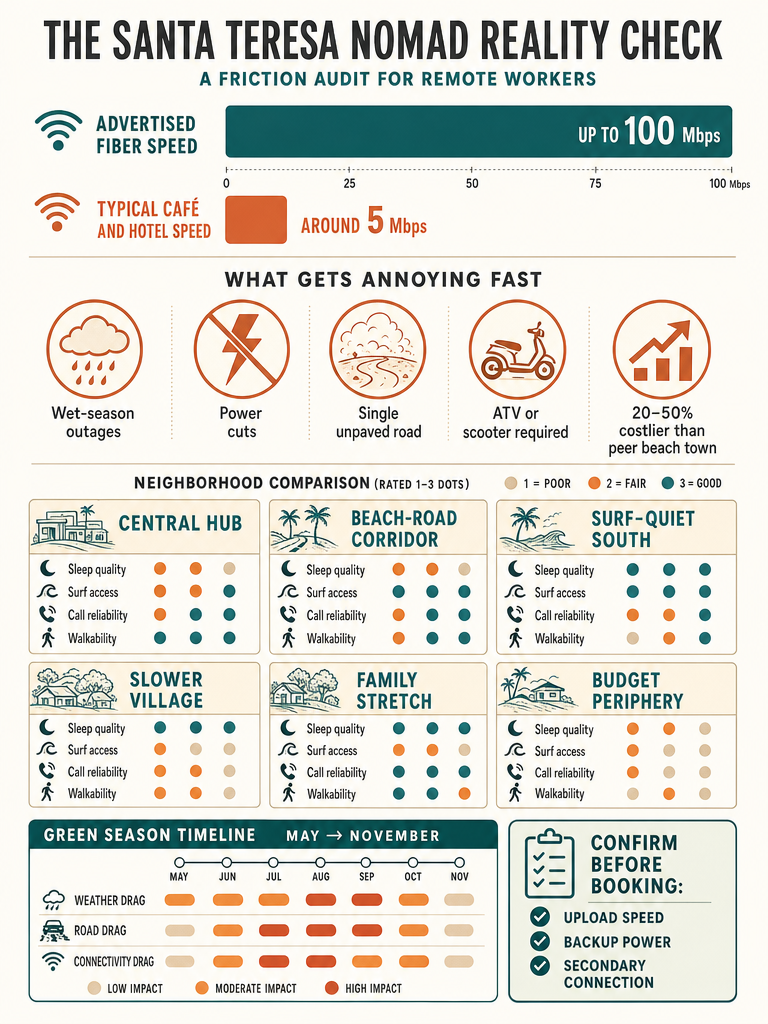
Can you reliably work full-time from Santa Teresa if you have daily Zoom calls?
Yes, but only if you treat connectivity as something you actively engineer, not something you assume from a listing photo. The infrastructure is uneven, and the gap between marketing copy and lived experience is wider here than in almost any other Costa Rican nomad town.
The contradiction is right on the surface. Outsite says Santa Teresa is "equipped with glass fibre cables and can reach speeds of up to 100mbps." A Reddit thread from r/digitalnomad reports the opposite from the ground: "Most cafes and hotels still run around 5mbps, and it gets spotty when it rains. Power outages happen too. If you're on video calls all day, stay [somewhere with backup]." Punta splits the difference, noting that connectivity "can vary, even though many cafes, coworking spaces, and accommodations now offer high-speed internet."
Both are true. Fiber exists, but it is not everywhere, and rain knocks out power often enough that backup matters more than peak speed. PuraSurfers notes that "many Santa Teresa accommodations now offer high-speed fiber optic internet and Starlink backup in case of outages" — that last phrase is the one to copy into every booking message.
Before you pay for a long-stay rental, ask the host three questions: What is the upload speed on a Speedtest screenshot taken today? Is there Starlink or a secondary connection? What happens during a power cut — battery, generator, or nothing? If they cannot answer all three, keep looking.
| Work setup | Realistic for Santa Teresa? | What to confirm |
|---|---|---|
| Async-only, occasional calls | Yes | Fiber accommodation, hotspot SIM as backup |
| Daily 1–2 Zoom calls | Yes, with planning | Fiber + Starlink, coworking fallback within 5 min |
| Back-to-back calls 9–5 | Risky | Dedicated cowork desk + home Starlink + UPS |
| Live streaming, trading, on-call ops | No | Pick Escazú or a fiber-confirmed Tamarindo rental |
The practical rule: never trust a Wi-Fi claim you have not personally tested, and always have a Plan B within scooter distance.
Where can digital nomads find coworking spaces in Santa Teresa?
The current coworking lineup in Santa Teresa centers on Selina Santa Teresa, Outsite, SkyLoft, Seas The Day Cowork, and Somos, with several coliving-style options layered on top. Older guides — including Outsite's own — still claim there is "no established coworking space" in town; Cowork506's more recent reporting says the scene has caught up with demand. Trust the newer signal, but verify operating status the week you arrive.
| Space | Best for | Watch out |
|---|---|---|
| Selina Santa Teresa | Budget day-pass work, social scene | Day passes around $15 per Cowork506; can get loud |
| Outsite | Curated coliving + cowork combo | Higher price; book the Playa location for beach proximity |
| SkyLoft | Quieter deep-work sessions | Smaller capacity, confirm desk availability |
| Seas The Day Cowork | Dedicated cowork feel | Check current hours and call-room availability |
| Somos | Community-driven workspace | Verify it is operating before relying on it |
For call-heavy days, the question is not "is there Wi-Fi" but "is there a phone booth, a soundproofed room, or at minimum a corner where a barking dog will not derail your client meeting." Selina is great for the network and terrible for a 10-person Zoom; Outsite and SkyLoft trend quieter. Do a half-day trial pass before committing to a monthly membership — the vibe shifts noticeably between high and low season.
Where should you stay in Santa Teresa as a digital nomad?
The right neighborhood is the one that matches your work pattern, not your Instagram feed. Outsite notes that most accommodation runs along the beach road "stretching from the south near Carmen beyond Santa Teresa and into Hermosa Cóbano" — that single corridor contains five very different lifestyles.
| Area | Vibe | Good for | Tradeoff |
|---|---|---|---|
| Playa Carmen | Central, walkable, busiest | First-timers, social nomads, easy logistics | Road noise, dust, tourist density |
| Central Santa Teresa | Restaurants, cowork access | Daily call workers needing fallback options | Generator backup matters; ATV traffic |
| Playa Santa Teresa | Surf-forward, slightly north | Intermediate-to-advanced surfers | Less walkable to nightlife |
| Hermosa Cóbano | Quieter, surf-paced | Long-stay surfers, deeper sleep | Further from cowork; more scooter dependence |
| Mal País | Slowest, most local | Quiet workers, lower budget | Cowork506 says it has "fewer coworking options"; 10 minutes south of the action |
If your priority is sleep and a clean call signal, push north toward Hermosa Cóbano or south to Mal País and accept the commute. If you need to walk to a cowork at 9am because your fiber dropped overnight, stay in Playa Carmen or central Santa Teresa.
Independent, vetted intel on stays, surf, and life on the peninsula — get the Nicoya dispatch from Onda Teresa: ondateresa.com.
For a sharper compare-and-contrast on basing yourself nearby, see Santa Teresa or Montezuma? Pick the Right Base Fast.
How annoying is the single unpaved beach road in daily life?
Very. The road is the defining piece of Santa Teresa infrastructure, and most nomad guides undersell what it costs you in daily friction. Cowork506 confirms what locals already know: Santa Teresa and Mal País are "connected by a single unpaved road." A widely shared Facebook group post from the area is blunter: "It's a fun surfer town. The roads are terrible if you have a car."
What that translates to, day to day:
- Transport defaults to scooter or ATV. Cars are slower, harder to park, and beat themselves up on the washboard. Most long-stay nomads rent a scooter or quad within the first week.
- Dry season means dust. Everything you own — laptop, clothes, board bag — develops a fine layer of road dust within days. Plan accordingly.
- Wet season means mud. Sections become genuinely sketchy on two wheels after heavy rain. Allow extra time for grocery runs, deliveries, and airport transfers.
- Deliveries and transfers cost more. Drivers know the road. Expect higher quotes for late-night, rainy, or far-end Mal País runs.
- Nightlife movement requires a plan. Walking the beach road at night is dark and not recommended; scooter back tipsy is worse. Budget for taxis.
First-week scooter accidents are the single most common way nomads end their Santa Teresa trip early. Wear closed shoes and a helmet, and skip the night ride if you've had drinks.
What does green season change from May to November?
Green season makes Santa Teresa cooler, cheaper, and meaningfully harder to work from on a fixed schedule. PuraSurfers identifies May to November as the green-season window, with "evening storms" common against a backdrop of sunny days and fewer crowds. That framing is accurate for tourists. For nomads, the operational picture is messier.
What actually changes:
- Power stability drops. Storms knock out the grid more often; a UPS or laptop with strong battery becomes essential, not optional.
- Internet drops with the rain. This is the connection between two findings that other guides keep separate: Reddit's report of rain-spotty cafe Wi-Fi maps directly onto green-season afternoons.
- Roads slow down. The unpaved corridor turns muddy in stretches, and what was a 7-minute scooter trip becomes 15.
- Surf windows narrow. Mornings are usually clean; afternoons shift between offshore and storm-driven chop. Plan deep-work blocks for the rainy afternoons and surf the dry mornings.
- Prices ease. Long-stay rentals open up and rates drop, especially September and October.
Green season is the better value if your work is async and the worse choice if your calendar is full of fixed calls.
Keep reading
- Free vs Enhanced Listings on Onda Teresa: What Changes
- Santa Teresa or Montezuma? Pick the Right Base Fast
- How to Read the Santa Teresa Surf Report Like a Local
How expensive is Santa Teresa compared with Tamarindo?
Santa Teresa runs 20–50% higher than Tamarindo across most categories, according to AllWorld, which uses surfboard rental as a representative example: roughly $10 per day in Tamarindo versus $15 per day in Santa Teresa. That gap is consistent across accommodation, eating out, groceries, and rentals.
| Category | Santa Teresa cost driver | Why higher than Tamarindo |
|---|---|---|
| Accommodation | Long-stay rentals on the beach road | Limited supply, harder access |
| Coworking | ~$15 day pass at Selina | Fewer competing spaces |
| Scooter / ATV | Daily and weekly rentals | Road conditions, fewer providers |
| Groceries | Imported items at Super Ronny / similar | Single road = higher logistics cost |
| Eating out | Beach-road restaurants | Tourist density, expat-driven menus |
| Surfboard rental | $15/day | AllWorld's direct comparison vs Tamarindo's $10 |
| Laundry, gyms, yoga | Multiple options, premium pricing | Wellness-tourism overlay |
A nomad spending $2,000/month in Tamarindo should budget $2,400–$3,000 in Santa Teresa for the same lifestyle, before factoring in scooter rental and coworking.
The cost is not a deal-breaker — it is a planning input. If your budget is tight and you do not need the specific Santa Teresa surf and scene, AllWorld's read is fair: Tamarindo's road is "easier to access" and the math is friendlier.
How do newcomers find the real community without buying into coliving?
The useful community layer in Santa Teresa is informal, current, and mostly invisible from search. Outsite says the town has "a digital nomad community but is quieter than Jaco or Puerto Viejo" — that quiet is real, and it means the network operates on word-of-mouth more than on Slack channels.
The practical entry points:
- Coworking events. Selina, Outsite, and SkyLoft all run mixers, dinners, and skill-shares. One week of showing up beats six months of lurking online.
- WhatsApp groups. Ask at your cowork, your accommodation, and your surf school. The active ones are not on Google. Topics range from rentals to lost dogs to "anyone driving to San José tomorrow."
- Facebook Groups. Still the layer where housing leads, scooter sales, and ride shares circulate. Search "Santa Teresa expats" and "Santa Teresa Costa Rica community."
- Nomad List and WiFi Tribe. Useful for trip-planning and finding existing cohorts, less useful for ground truth.
- Stolas Guesthouse and similar small operators. Smaller houses produce tighter networks than 200-bed coliving.
- Surf and yoga. The fastest social shortcut. Same break, same time, three days running, and you have a circle.
You do not need to pay for coliving to find people. You need to be in town, off your laptop, two or three nights a week.
Is Santa Teresa Beach safe for travelers and digital nomads?
Santa Teresa Beach is generally considered safe for travelers and digital nomads, with the qualifier that it is a surf town, not a resort, and it deserves the same precautions you would take in any beach destination at night. Punta puts it directly: it is "considered a safe destination for travelers and digital nomads," but advises "standard precautions, especially at night."
What that looks like in practice on the Nicoya Peninsula:
- Do not leave valuables on the beach while you surf. Phones and wallets disappear from towels.
- The beach road is dark. Many stretches have no lighting. Walk with a friend or take a taxi after midnight.
- Lock your scooter and helmet. Both walk away if left unsecured outside busy bars.
- Scooter accidents are the bigger statistical risk than crime. Helmet, closed shoes, no riding drunk.
- Solo late-night transport: pre-arrange. Have a driver's WhatsApp saved before you go out.
- Beach valuables in the rainy season: afternoon storms move fast; dry-bag the laptop if you bring it.
Santa Teresa is not dangerous. It is just not a bubble, and treating it like one is how you lose a phone.
What should long-stay nomads set up in the first 48 hours?
The first 48 hours decide whether your first month is a routine or a logistics scramble. Run this checklist before your first work day, not after.
- Confirm backup internet at your accommodation. Speedtest the upload, ask about Starlink, ask what happens during a power cut. If the answers are vague, identify a coworking fallback within scooter distance.
- Get a SIM or eSIM with data. Kolbi and Claro both work on the peninsula. Use it as a tethering backup the first time the fiber drops.
- Identify a coworking fallback. Even if you plan to work from home, buy a single day pass at Selina, Outsite, or SkyLoft so you know the route and the vibe before you actually need it.
- Save emergency contacts. Local clinic, your accommodation host, a trusted taxi driver's WhatsApp, and the nearest pharmacy.
- Sort transport. Scooter or ATV rental, helmet that actually fits, and a clear understanding of where you are not insured to ride (some rentals exclude the road north toward Playa Hermosa).
- Locate laundry, groceries, ATM, and a doctor. Walk or scoot the loop in your first day. Cash is still useful on the peninsula.
- Check your visa math. PuraSurfers notes that Costa Rica now allows 180-day tourist visas, which removes the old 90-day border-run pressure for many nomads — but confirm what stamp you actually received on entry.
- Bookmark a current surf source. Conditions change fast on this coast; learn the swell and tide read for your level. (See Onda Teresa's How to Read the Santa Teresa Surf Report Like a Local.)
Do all of this before your first workday, not after. The town runs on an "I'll handle it tomorrow" tempo that quietly eats your week.
Who should choose Mal País, Montezuma, Nosara, Escazú, Jaco, Puerto Viejo, or Tamarindo instead?
Santa Teresa is not the only Costa Rican answer, and forcing it when the friction does not match your work or pace is the most common mistake nomads make. The decision matrix:
| You should consider | If you want |
|---|---|
| Mal País | Same surf coast, slower pace, lower cost, fewer coworking options — Cowork506 calls it "quieter and more local" |
| Montezuma | A different Nicoya base with arts-and-waterfall energy; see Onda Teresa's Santa Teresa vs Montezuma guide |
| Nosara | A more structured wellness-and-yoga nomad scene, better roads, similar surf |
| Tamarindo | Easier access from Liberia airport, 20–50% lower costs, family-friendlier per AllWorld |
| Escazú | Real urban infrastructure, hospitals, reliable fiber, San José proximity — best for corporate remote workers |
| Jaco | Fast Pacific access from San José, more nightlife, less surf prestige |
| Puerto Viejo | Caribbean coast, different culture, lower cost, looser remote-work scene |
If your job has rigid Zoom infrastructure needs, choose Escazú. If you want surf without the Santa Teresa price tag and road, choose Tamarindo or Mal País. If you want yoga and a stable nomad rhythm, Nosara. If you want what makes Santa Teresa specifically Santa Teresa — surf, scene, peninsula edge, slightly chaotic charm — accept the friction described above and come anyway.
For the kind of locally-vetted, unhyped intel the travel blogs do not cover — including the Santa Teresa or Montezuma base guide and the Santa Teresa surf report read — get the Nicoya dispatch from Onda Teresa.
Sources
- Working Remotely in Santa Teresa, Costa Rica - Amy Sutowww.amysuto.com
- Advice for remote work in Santa Teresa? - Facebookwww.facebook.com
- Full Digital Nomad Guide Santa Teresa, Costa Ricadigitalnomads.world
- Working Remotely In Santa Teresawww.purasurfers.com
FAQ
How much should I budget per month to live and work in Santa Teresa?
A realistic monthly budget for a digital nomad in Santa Teresa runs roughly $2,400–$3,000 if you're coming from a comparable Tamarindo lifestyle at $2,000, once you account for scooter rental, coworking day passes, and the logistics premium baked into everything that travels that single unpaved road. Green season (September–October) is the exception: rental supply opens up and rates ease noticeably, making it the best window to negotiate a long-stay deal.
Which SIM card works best on the Nicoya Peninsula?
Kolbi and Claro both have usable coverage on the peninsula, and either will serve as a tethering backup when your accommodation fiber drops — which it will. Buy a SIM at the airport or in Cobano rather than counting on finding stock in Santa Teresa itself, and load it with a data plan before your first workday.
Can I get by without renting a scooter in Santa Teresa?
Technically yes, but in practice the single unpaved road makes walking slow, taxis inconsistent, and car rentals an expensive punishment. Most long-stay nomads pick up a scooter or ATV within the first week; the real question is whether you've ridden one before, because first-week accidents are the most common way people end their stay early.
How does the 180-day Costa Rica tourist visa work for nomads?
Costa Rica now stamps many nationalities with 180 days on arrival, which eliminates the old 90-day border-run calculus for qualifying passport holders — but the length you actually receive depends on the officer and your passport, so check your entry stamp the same day you arrive rather than assuming the maximum.
Is Mal País actually cheaper and quieter than Santa Teresa, or is that outdated?
The quieter-and-cheaper read is still accurate: Mal País sits about ten minutes south on the same unpaved road, has a more local pace, and tends to run lower on accommodation and food costs, but it has noticeably fewer coworking options and puts you further from the central Santa Teresa restaurant and nightlife corridor — a real tradeoff if you need a reliable desk backup on short notice.
Santa Teresa eSIM and SIM Cards on Arrival
For most Santa Teresa trips, an eSIM is the cleanest answer: install it before you fly, keep your home number active, and arrive already connected. Buy a physical Costa Rican SIM only when you need a local number for calls, drivers, or a longer stay.
Read →Santa Teresa Pharmacies and Clinics: Where to Go
Public, verifiable pharmacy and clinic details for Santa Teresa are thin, and search results often mix in Wichita listings. This guide shows what to ignore and how to confirm care locally on the day.
Read →Santa Teresa Grocery Stores and Markets: What to Expect
Santa Teresa works best for daily top-ups, while Cóbano is the smarter larger shop. Mini markets cover water, eggs, bread, coffee, beer, and fruit.
Read →