Santa Teresa Power and Water Outages: How Locals Cope
Short outages in Santa Teresa usually clear fast, but longer planned shutdowns are part of life on the peninsula. This guide shows the backup stack locals rely on for power and water.
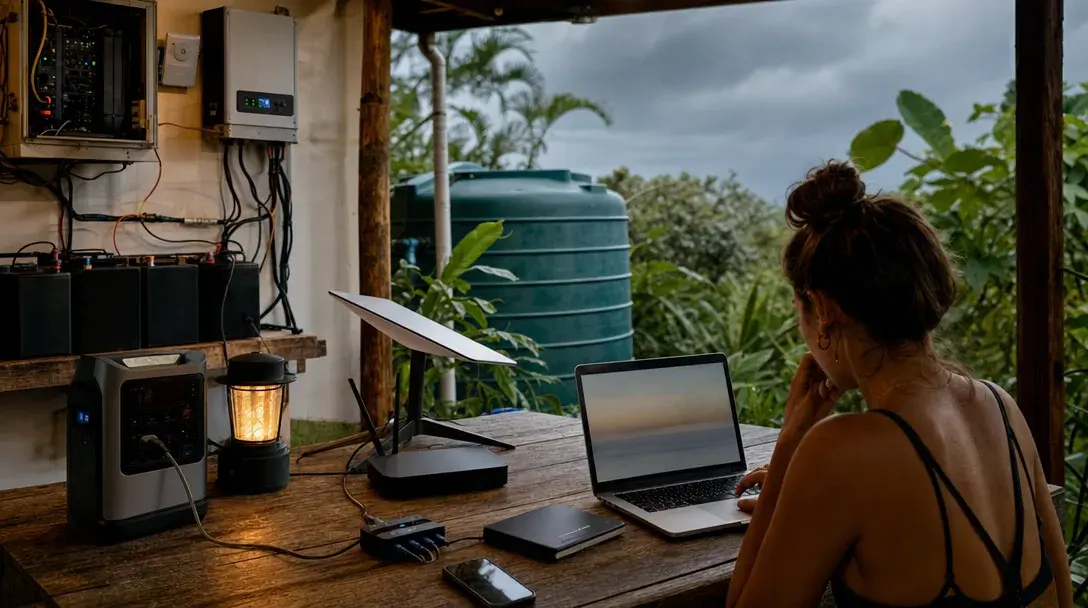
Key takeaways
- Short power blips are common in Santa Teresa, usually clearing within minutes once a router reboots, while dry-season water shortages are a separate problem tied to December through April.
- Santa Teresa's power cuts split into two distinct patterns rather than one average duration.
- The backup gear locals lean on for a Santa Teresa power cut is short and cheap relative to what it protects.
- Both can help, but they solve different problems, and neither is a guaranteed fix documented for every outage type.
How Common Are Power Outages in Santa Teresa?
Short power blips are common in Santa Teresa, usually clearing within minutes once a router reboots, while dry-season water shortages are a separate problem tied to December through April. Locals cope with a layered backup stack: a UPS on the router, portable battery packs, mobile data or Starlink, and water storage tanks for longer stays.
A report in r/CostaRicaTravel describes near-daily interruptions that resolve in about five minutes with a reboot. Onda Teresa's relocation guide treats these short cuts as routine: keep backup gear charged, and check local WhatsApp groups before assuming a wider grid failure.
Longer, planned shutdowns are a different pattern entirely. One ran from 7 a.m. to 5 p.m. on April 25, 2024, according to a post in the What's On Santa Teresa Facebook group. Commenters on that thread said the outage covered the whole Nicoya Peninsula, not just Santa Teresa, sending residents in nearby beach towns outdoors for a forced day off work.
A router reboot clears most short outages in Santa Teresa, but a full workday shutdown is also a documented part of the picture. The available reporting doesn't say how often full-day shutdowns like the April 2024 event recur, so it's worth planning for the possibility rather than treating it as a one-time fluke.
How Long Do Santa Teresa Power Cuts Actually Last?
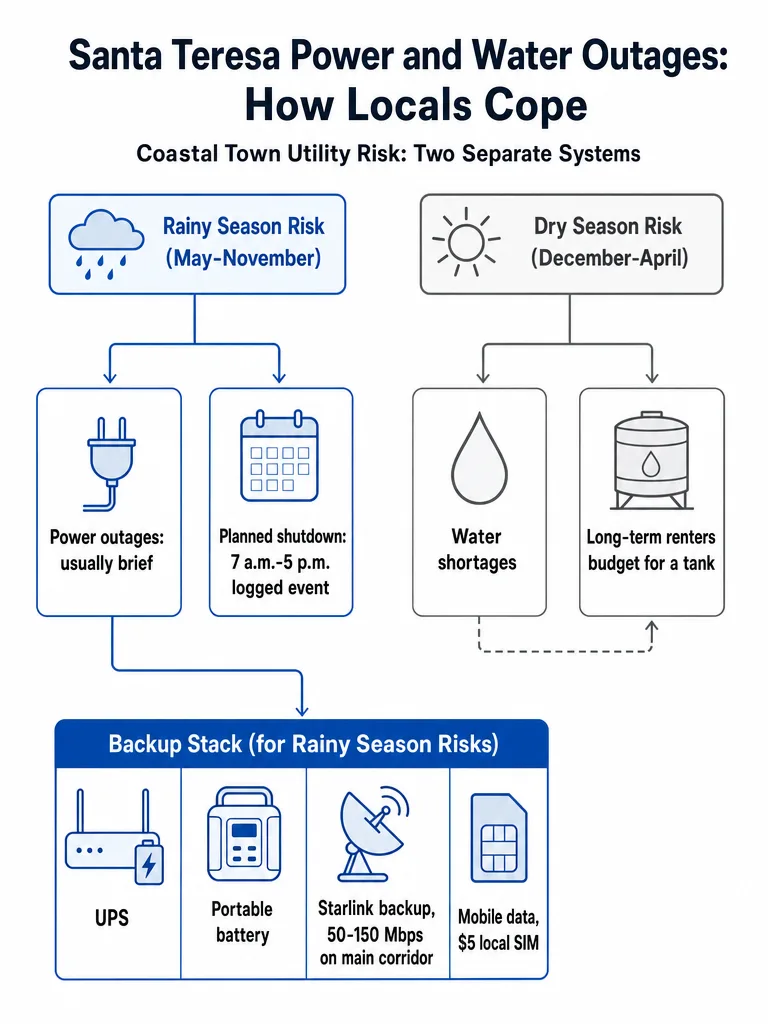
Santa Teresa's power cuts split into two distinct patterns rather than one average duration. Near-daily short interruptions clear in about five minutes once equipment reboots, based on the Reddit report cited above. Separately, planned shutdowns like the one on April 25, 2024 can run most of a working day, from 7 a.m. to 5 p.m.
The guide's relocation notes flag rainy season, running May through November, as the stretch when outages happen more often. Dry season, December through April, carries less mention of power interruptions in that same guide, but it's when the peninsula's separate water problem shows up (more on that below).
the one documented planned outage in the available reporting ran the entire 7 a.m. to 5 p.m. workday across the whole Nicoya Peninsula, not just Santa Teresa, per resident comments in the What's On Santa Teresa Facebook group on April 25, 2024.
The practical takeaway is that you can't predict which pattern you'll get on a given day. A rental with no backup gear survives the five-minute version fine and loses a working day to the other version.
What Should You Keep on Hand for a Power Cut?
The backup gear locals lean on for a Santa Teresa power cut is short and cheap relative to what it protects. Onda Teresa's relocation guide calls a UPS and a portable battery pack essential precisely because outages do happen, not as an abstract precaution.
- A UPS (uninterruptible power supply) on your router. This is the single piece of gear that turns a five-minute blip into a non-event: Wi-Fi keeps running on battery while the grid resets, instead of dropping the moment power cuts.
- A portable battery pack for phones and laptops. Charge it overnight so it's ready before a cut, not after.
- A flashlight or headlamp within reach. Nights on the peninsula get dark fast once the grid drops, and a phone flashlight burns the battery you may need for connectivity.
- A basic stock of shelf-stable food and water. Longer or planned shutdowns are the moments a quick top-up run gets harder, not easier. Building a small buffer from what's available at Santa Teresa's grocery stores and markets means a cut doesn't force an emergency trip while the power is still out.
None of this is complicated gear, and none of it needs to be expensive. It just needs to be charged and in the house before the outage, not after it starts.
Is Starlink or Mobile Data a Real Backup When the Power Goes Out?
Both can help, but they solve different problems, and neither is a guaranteed fix documented for every outage type. Onda Teresa's relocation guide describes fiber, Starlink, and mobile SIMs as the local connectivity options, with real figures attached to each one.
The guide says fiber-optic connections now reach most of the main road corridor, with realistic speeds of 50-150 Mbps at established coworking spaces and well-equipped rentals. It also describes Starlink as increasingly common in villas farther from the center, working as either a backup or a primary connection, which makes it the option most likely to carry a whole rental through a longer outage. A local SIM, at around $5, is the cheaper fallback for keeping a phone connected while the main line is down.
| Connectivity option | What the guide says | Cost |
|---|---|---|
| Fiber (main road corridor) | 50-150 Mbps at established coworking spaces and well-equipped rentals | Not itemized publicly; varies by property |
| Starlink | Increasingly common in villas farther out; works as backup or primary connection | Not itemized publicly |
| Local mobile SIM (Kolbi/Claro) | A fallback for phone connectivity if the local network stays up | Around $5 |
Costa Rica's mobile networks run through Kolbi, operated by the Instituto Costarricense de Electricidad (ICE), and Claro. Reliability of either during a specific outage isn't detailed in available reporting, so a charged phone on a local SIM is worth having as a floor, not a guarantee. It's worth getting a Santa Teresa SIM or eSIM before you arrive rather than sorting one out after your first cut.
Keep reading
- Santa Teresa Rainy Season: What Still Works, What Doesn't
- Santa Teresa Grocery Stores and Markets: What to Expect
- Where to Work in Santa Teresa: Wi-Fi, Noise, and Backup
- Santa Teresa Banking, ATMs, and Cash: What to Expect
- Santa Teresa Laundry, Showers, and Coworking Backup Plans
- What to Do in Santa Teresa When the Surf Is Bad: 11 Solid
Does Santa Teresa Also Have Water Outages?
Yes, but water outages in Santa Teresa are a separate, dry-season problem, not a side effect of the power cuts covered above. Onda Teresa's relocation guide identifies December through April as the window when shortages are especially real, distinct from the May-through-November stretch when power interruptions run more often.
Available reporting does not confirm the exact cause of these dry-season shortages, whether it's rationing, pump limitations, or simple seasonal scarcity in the water supply, and it would be a stretch to guess at a mechanism the sources don't support. What's clear is the timing: dry-season pressure on water and rainy-season pressure on power run on two different calendars, and treating them as the same risk leads to preparing for the wrong problem at the wrong time of year.
For a short trip, this mostly means don't assume an always-on tap the way you might at a hotel elsewhere. For longer stays, it changes the prep list in a specific way.
How Should Long-Term Renters Prepare for Dry-Season Water Shortages?
Long-term renters in Santa Teresa should budget for a water storage tank rather than assume dry-season pressure will hold. Onda Teresa's relocation guide recommends this directly for anyone signing a longer lease on the peninsula, tying the advice to the December-through-April window when shortages are most likely.
The practical shift is treating water risk and power risk as two separate line items, not one combined "utilities" concern. A UPS and battery pack address rainy-season power cuts from May through November; a storage tank addresses the dry-season water problem from December through April. A rental that's covered on one isn't necessarily covered on the other, so it's worth asking a landlord about both before signing, not just whichever one happens to be relevant the week you tour the property.
ask specifically about tank capacity and refill schedule, not just whether a tank exists. A tank with no refill plan during a dry-season shortage buys you a few extra days, not a solved problem.
How to Choose a Santa Teresa Rental That Won't Leave You Stranded
Choosing a Santa Teresa rental that survives an outage means checking backup infrastructure before checking photos. A short-stay traveler can usually tolerate a five-minute blip and move on; a long-term renter needs to know what happens when the grid or the water main goes down for hours.
- Confirm fiber access on the main road corridor. The relocation guide puts realistic speeds at 50-150 Mbps for established coworking spaces and well-equipped rentals along this stretch; ask directly if the property sits farther off the main road.
- Ask whether a UPS is already installed on the router. This single detail separates a rental that stays online through a short cut from one that drops the moment power blinks.
- Check Starlink availability if the property sits farther out. Villas away from the center increasingly carry it as backup or primary connectivity, per the same guide.
- Look for a visible water storage tank. This matters most for stays that run through December to April, when dry-season shortages are most likely.
- Ask directly about backup infrastructure if you're comparing a private rental to a larger managed property. A hotel-and-coworking setup like Selina's Santa Teresa location may or may not run separate backup power or water systems; specifics vary by property and aren't something to assume either way, so put the question to the host or property manager before booking.
A traveler booking three nights doesn't need to interrogate a host about UPS units. A renter signing three months does, and the questions above are the ones that predict whether a bad outage week costs a lost afternoon or a lost work deadline.
FAQ
Which season brings more power outages to Santa Teresa, rainy or dry?
Rainy season, running May through November, is when power interruptions happen more often, according to Onda Teresa's relocation guide. Dry season, December through April, carries less mention of power problems in that guide but is instead when the peninsula's separate water shortages set in. Treating these as one combined 'utilities' risk is a mistake: a renter covered for rainy-season power cuts with a UPS still needs a water storage plan for the opposite half of the year.
How often do full-day power shutdowns like the April 2024 outage happen in Santa Teresa?
Available reporting documents only one full-day shutdown, the one that ran from 7 a.m. to 5 p.m. across the entire Nicoya Peninsula on April 25, 2024, and doesn't say how often events like it recur. That makes it impossible to call the event routine or a one-time fluke with confidence. The safer approach for anyone staying more than a few days is to keep backup gear charged as if a full-day cut could happen again, rather than assuming it won't.
Should a short-term traveler in Santa Teresa worry about power outages?
For most short stays, no: a traveler can usually ride out the five-minute blips that clear once equipment reboots, based on reports from r/CostaRicaTravel describing near-daily interruptions of that length. The bigger risk is a longer planned shutdown, like the one that ran across the entire Nicoya Peninsula from 7 a.m. to 5 p.m. on April 25, 2024, an event rare enough that most short trips won't overlap with one. Long-term renters face more exposure and should prepare accordingly.
How do locals find out about a power outage before it starts in Santa Teresa?
There's no official outage-alert system documented for Santa Teresa; word travels through local WhatsApp and Facebook groups instead. The one documented example is a post in the What's On Santa Teresa Facebook group on April 24, 2024, warning residents that power would go out across the whole Nicoya Peninsula from 7 a.m. to 5 p.m. the next day. Checking those groups before assuming a wider grid failure is standard practice, since a five-minute blip and a planned shutdown feel identical for the first minute.
Does Selina Santa Teresa have backup power or water during an outage?
It isn't documented publicly whether Selina's Santa Teresa property runs separate backup power or water systems, and this varies by property rather than being a given for larger managed hotels. Anyone comparing a private rental to a hotel-and-coworking setup like Selina should ask the host or property manager directly rather than assume a bigger operation automatically has better outage coverage. The same question applies to any managed property on the peninsula, not just one brand.
What's the cheapest way to stay connected if Santa Teresa's power grid goes down?
A local mobile SIM from Kolbi or Claro, priced around $5, is the cheapest fallback for keeping a phone connected during an outage, according to Onda Teresa's relocation guide. It won't fix a downed local network if the outage affects cell towers too, but as a backup to home Wi-Fi it costs less than a UPS or a Starlink subscription. Buying one before arrival, rather than sorting it out after the first cut, is the practical move.
Cabo Blanco From Santa Teresa: Day Trip or Skip?
Cabo Blanco is worth it if you want a real forest hike, not an easy beach add-on. This guide breaks down the route, trail choice, hours, and who should skip it.
Read →Santa Teresa With Kids: What Actually Works
A practical family brief for Santa Teresa: which beaches fit toddlers vs older kids, where high tide gets rough, and how to plan surf lessons, day trips, and transfers without wasting time.
Read →ATVs in Santa Teresa: When They're Worth It
ATV Santa Teresa is a trip-by-trip decision, not a blanket yes. Use one for steep access, boards, and longer runs; skip it for flat, short errands.
Read →