Santa Teresa Weather in 2026: Rain, Heat, and Dust
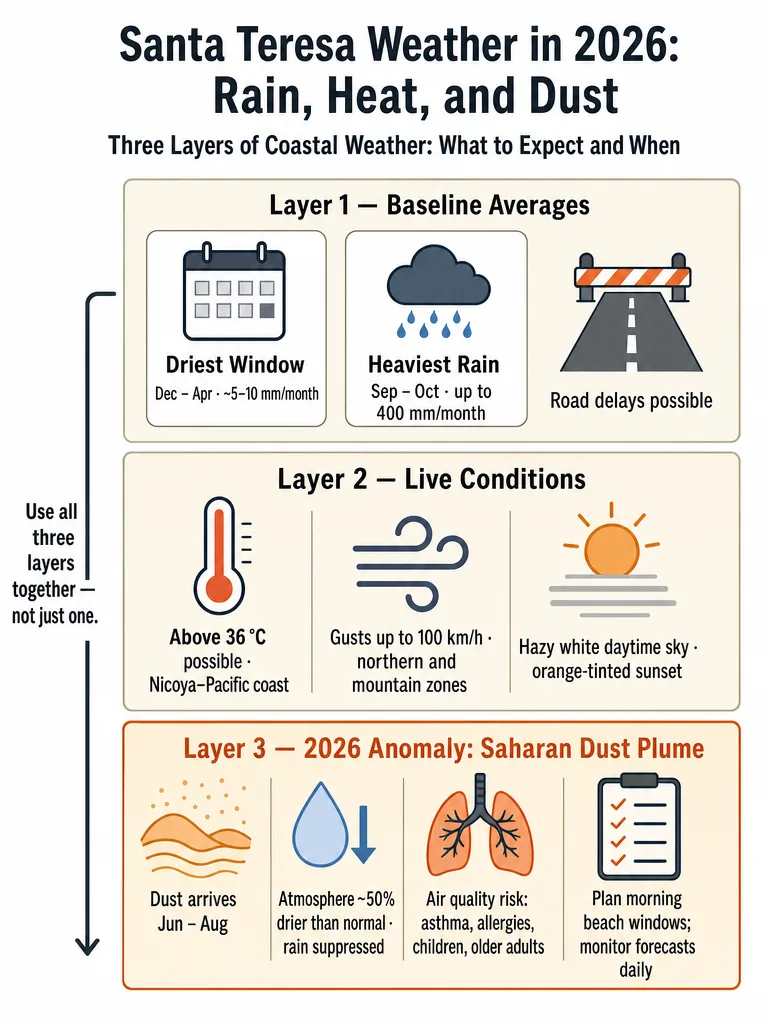
Plan Santa Teresa weather in three layers: the monthly average, the live forecast, and 2026 dust or rainfall anomalies. Use mornings for surf, transfers, and anything time-sensitive.
Key takeaways
- Plan Santa Teresa weather in three layers, not one: the long-run monthly average, the live forecast, and whatever 2026 is doing that's off-pattern.
- Yes, and the split is sharp.
- September and October are the wettest months in Santa Teresa by a wide margin.
- Green season doesn't mean all-day rain.
What is the weather like in Santa Teresa this month?
Plan Santa Teresa weather in three layers, not one: the long-run monthly average, the live forecast, and whatever 2026 is doing that's off-pattern. The baseline is a tropical dry-season and green-season split on the Nicoya Peninsula, with warm temperatures year-round. Live readings sit close to that: AccuWeather's Santa Teresa page showed a current 81°F with a 84°F heat index and east wind at 12 mph, plus a 10-day run of humid mornings with scattered rain.
The 2026 layer is where it gets interesting. Tico Times reported a late-June Saharan dust plume expected to bring hotter, drier, hazier conditions across much of Costa Rica, with the National Meteorological Institute (IMN) forecasting reduced rainfall as trade winds picked up dust off the Sahara. A local Nicoya outlook cited IMN projections of a weaker rainy season for the Pacific coast, with totals possibly 10% to 30% below normal.
Read the average for what to pack, the forecast for this week, and the anomalies for why the two might not agree.
Want this filtered for your travel dates? Get the Nicoya dispatch.
Does Santa Teresa have a dry season and a green season?
Yes, and the split is sharp. Santa Teresa runs a dry season from December to April and a wet or green season from May to November, according to the Santa Teresa climate guide published by Coldwell Banker Sunset Reef Realty. The dry months bring hot, sunny days, low humidity, and rare rain, with average temperatures of 28 to 31°C.
The green season isn't a washout. That same source describes May through November as a period of daily afternoon and evening showers, cooler evenings, and a landscape that turns lush. Dry season draws the largest crowds; the green season pulls eco-travelers and surfers chasing bigger swell.
Best time to visit depends on what you're optimizing for. Want reliable sun and beach days? Book December to April. Want fewer people, greener surroundings, and often better waves? The green-season shoulder months work, with the caveat below about September and October.
The green season shoulder, May or November, gives you the crowd-and-price advantage of low season without the heaviest rain months. See our Santa Teresa rainy season breakdown for what still works.
What are the wettest months in Santa Teresa?
September and October are the wettest months in Santa Teresa by a wide margin. The Coldwell Banker Sunset Reef Realty monthly table lists September at 350 mm of rainfall and October at 400 mm, both with average temperatures around 27°C and only about 5 sunshine hours a day. Those two months carry roughly double the rain of the early wet season.
| Month | Avg. Temp (°C) | Rainfall (mm) | Sunshine hrs |
|---|---|---|---|
| May | 30 | 200 | 7 |
| June | 29 | 250 | 6 |
| July | 29 | 220 | 7 |
| August | 28 | 240 | 6 |
| September | 27 | 350 | 5 |
| October | 27 | 400 | 5 |
| November | 28 | 150 | 7 |
The same source flags the practical consequence: September and October can occasionally bring road closures or travel delays. On the Nicoya Peninsula, that friction hits unpaved sections and river crossings first. If you're arriving or moving between towns during those weeks, build slack into the plan and check road conditions before committing to a same-day transfer.
If a trip is date-flexible, September and October are the two months worth actively avoiding for reliable beach time.
Will it rain every day in Santa Teresa during the green season?
Green season doesn't mean all-day rain. The Coldwell Banker Sunset Reef Realty guide describes May through November as a pattern of daily showers concentrated in the afternoon and evening, with mornings and mid-day often clearer and usable for outdoor plans. Evenings tend to run cooler and more comfortable.
The intensity climbs through the season rather than staying flat. Rainfall starts at 200 mm in May, holds in the 220 to 250 mm range through summer, then jumps to 350 mm in September and 400 mm in October before dropping back to 150 mm in November. So a May or June visit means occasional afternoon soakings around otherwise workable days; a late-September visit means a lot more sky time under cloud.
The AccuWeather 10-day outlook matched this shape, showing humid days with morning or afternoon rain rather than steady all-day precipitation. That's the planning takeaway: treat mornings as your reliable window and keep afternoons flexible. For surf, outdoor tours, and long transfers, schedule them early before the clouds build. Our guide to what still works in Santa Teresa's rainy season breaks down the fallback options when an afternoon does close in.
How hot does Santa Teresa get in 2026 weather spikes?
During the late-June 2026 dust event, IMN forecast temperatures climbing above 36°C in Guanacaste and Puntarenas, the province Santa Teresa sits in, according to Tico Times. Those figures are provincial highs, not a Santa Teresa station reading, so treat them as the regional ceiling rather than a guaranteed beach-town number.
Day to day, the town runs cooler and steadier. AccuWeather's Santa Teresa 10-day outlook showed highs mostly between 83°F and 87°F (roughly 28 to 31°C) with lows from 69°F to 80°F, plus a live heat index of 84°F. That's typical tropical warmth, not extreme heat.
What pushes a normal day toward uncomfortable is the combination the dust event created: higher temperatures, stronger trade winds, and drier air feeling hotter than the thermometer suggests. IMN warned wind gusts could reach up to 100 km/h in the north, the Central Valley, and mountain areas during that weekend, though those wind figures apply to elevated and northern zones, not the Santa Teresa coast specifically.
For beach and surf plans, the practical shift is timing. On a spike day, the morning window before mid-day sun matters more, and midday shade and water become the smart default.
Keep reading
- What to Pack for Santa Teresa: Dust, Rain, and Roads
- Santa Teresa Rainy Season: What Still Works, What Doesn't
- What to Do in Santa Teresa When the Surf Is Bad: 11 Solid
- Best Time to Surf Santa Teresa by Swell, Wind, and Tide
- Santa Teresa vs Mal Pais for Surf Stays: What Changes
- How Many Days in Santa Teresa Is Actually Enough?
What does Saharan dust mean for Costa Rica weather?
Saharan dust makes Costa Rica hotter, drier, and hazier, even in the rainy season. Tico Times reported that a late-June 2026 plume was expected to reduce rainfall, strengthen winds, and raise temperatures across much of the country as trade winds carried fine North African particles across the Atlantic. The effect is seasonal and recurring, commonly reaching the Caribbean and Central America between June and August.
The mechanism is dry air. NOAA, cited by Tico Times, describes the Saharan Air Layer as warm, dry, and dusty, with roughly 50% less moisture than a typical tropical atmosphere, which suppresses cloud development and cuts afternoon rain. IMN expected dry conditions and limited rainfall across much of Costa Rica during the event as accelerated trade winds combined with the dust.
On the ground in Santa Teresa, that translates into a few visible changes:
- Haze: milky or whitish skies by day, and NOAA notes affected areas often see orange-glowing sunsets.
- Less rain: afternoon showers can be thinner than the calendar suggests.
- Warmer feel: drier air plus stronger sun reads hotter.
- Air quality: IMN said concentrations that week weren't expected to be unusually high but could still reduce air quality in places.
The health note matters for some travelers. Tico Times reported the biggest short-term concern is air quality for people with asthma, allergies, chronic respiratory conditions, older adults, and young children. If that's you, watch for haze days and keep outdoor exertion earlier and lighter.
A hazy, rain-free green-season day isn't a bonus if you have respiratory sensitivity, it's the dust layer doing its work. Plan indoor or low-exertion activities on the haziest days.
Santa Teresa averages vs AccuWeather forecasts vs 2026 anomalies: which should you trust?
Trust all three, for different jobs. Monthly averages tell you what to pack and roughly when to book. A live forecast tells you what this specific week looks like. The 2026 anomaly signals tell you why the first two might disagree. Collapsing them into one "Santa Teresa is rainy in October" line is exactly the flattening that makes generic weather pages useless for planning.
Here's how the layers stacked up in the captured data:
| Layer | What it tells you | Sourced example |
|---|---|---|
| Monthly average | Long-run pattern for packing and booking | October: 400 mm rain, 27°C, ~5 sun hrs |
| Live forecast | This week's actual conditions | AccuWeather: highs 83–87°F, morning/afternoon rain |
| 2026 anomaly | Off-pattern signals to hold loosely | IMN outlook: Pacific rainfall 10–30% below normal |
The anomaly layer is the one to hold most loosely. The 10% to 30% below-normal Pacific rainfall figure comes from IMN projections summarized in a local Nicoya article, not a primary IMN bulletin we can point you to, so treat it as a provisional outlook rather than settled fact. Same with the dust event: it was a specific late-June forecast, not a season-long guarantee.
Averages are the plan; the forecast is the edit; the anomalies are the reason to keep the plan flexible. When a live AccuWeather reading and a monthly average contradict each other for your travel dates, the forecast wins for the next 10 days and the average wins for anything further out.
How should weather shape surfing, packing, and getting around Santa Teresa?
Weather in Santa Teresa mostly decides your timing, not whether the trip works. The consistent green-season pattern of afternoon and evening showers, per the Coldwell Banker Sunset Reef Realty guide, points to one rule: front-load the day. Surf, tours, and long transfers belong in the morning window when skies are clearer and conditions steadier.
Translate the sourced facts into decisions:
- Surf in the morning. With rain and cloud building through the afternoon in the green season, the morning is your reliable session. Match the break to the day with our guide on reading the Santa Teresa surf report like a local, and pick spots by conditions using the best time to surf by swell, wind, and tide.
- Pack for dust and rain, not just sun. Haze days, drier heat, and afternoon downpours all show up in the same trip. See what to pack for Santa Teresa's dust, rain, and roads so you're covered for both extremes.
- Respect road friction in peak rain. September and October can bring road closures or delays, so plan transfers with slack. Compare routes in getting to Santa Teresa by ferry, drive, or shuttle and decide whether you even need a vehicle with the honest tradeoffs on renting a car.
- Keep a wet-afternoon fallback. When rain closes in, you still have options: 11 solid things to do when the surf is bad.
Build the day around a dry morning and a flexible afternoon, and Santa Teresa weather rarely costs you more than a plan B.
For live conditions and honest local intel before you go, get the Nicoya dispatch.
Sources
- Costa Rica Faces Hotter Weekend as Sahara Dust ...ticotimes.net
- What's the weather like in Santa Teresa this month?cbsunsetreefrealty.com
- Understanding the Climate in Santa Teresa (2025)www.accuweather.com
- Santa Teresa, Puntarenas, Costa Rica Weather Forecastwww.ventusky.com
- Santa Teresa - 14-Day Forecast & Rainwww.weather.gov
- El Paso, TXsantateresadirtroad.com
FAQ
What are the wettest months in Santa Teresa, Costa Rica?
October is the wettest month, averaging 400 mm of rainfall, followed by September at 350 mm — roughly double the rain of May or June. Both months average around 27°C with only about 5 sunshine hours a day. Road closures and river-crossing delays are a real possibility on the Nicoya Peninsula during those weeks. If your dates are flexible, September and October are the two months worth actively scheduling around.
Does it rain every day in Santa Teresa during the green season?
Green season rain is concentrated in the afternoon and evening, not spread across the whole day. Mornings and mid-day are often clear enough for surfing, outdoor tours, or long transfers. Rainfall starts at 200 mm in May, holds between 220 and 250 mm through summer, then spikes in September and October before dropping back to 150 mm in November. Front-load your day and the green season rarely shuts you down entirely.
What is the best time to visit Santa Teresa for good weather?
December through April is the dry season: high temperatures between 28 and 31°C, low humidity, rare rain, and the largest tourist crowds. For fewer people, lower prices, and often better surf, the shoulder months of May and November offer green-season conditions without the heaviest rainfall of September and October. The dry season is the safest bet for reliable beach days; the shoulder months reward flexible planners.
How hot does Santa Teresa get, and are there heat spikes in 2026?
Day-to-day highs run between 83°F and 87°F (roughly 28–31°C), per AccuWeather's Santa Teresa 10-day outlook, with a live heat index of 84°F. During the late-June 2026 Saharan dust event, IMN forecast provincial highs above 36°C in Puntarenas — the region Santa Teresa sits in — though that's the regional ceiling, not a guaranteed beachfront reading. Dust days feel hotter because drier air and stronger sun combine.
What does Saharan dust do to Costa Rica weather and should I worry about air quality?
Saharan dust suppresses rainfall, raises temperatures, and turns skies milky or hazy. NOAA describes the Saharan Air Layer as carrying roughly 50% less moisture than a typical tropical atmosphere, cutting afternoon cloud development. IMN said the late-June 2026 concentrations weren't expected to be unusually high but could still reduce air quality. People with asthma, allergies, or chronic respiratory conditions should watch for haze days and keep outdoor exertion to cooler morning hours.
How should I plan surfing and transfers around Santa Teresa's weather?
Schedule surf sessions, long transfers, and outdoor tours in the morning — that's the reliable window before afternoon clouds and rain build through the green season. September and October can bring road closures on unpaved sections and river crossings, so build slack into any same-day transfer plan. On a dust or heat-spike day, the morning window matters even more; midday shade and water become the practical default by mid-afternoon.
Santa Teresa eSIM and SIM Cards on Arrival
For most Santa Teresa trips, an eSIM is the cleanest answer: install it before you fly, keep your home number active, and arrive already connected. Buy a physical Costa Rican SIM only when you need a local number for calls, drivers, or a longer stay.
Read →Santa Teresa Pharmacies and Clinics: Where to Go
Public, verifiable pharmacy and clinic details for Santa Teresa are thin, and search results often mix in Wichita listings. This guide shows what to ignore and how to confirm care locally on the day.
Read →Santa Teresa Grocery Stores and Markets: What to Expect
Santa Teresa works best for daily top-ups, while Cóbano is the smarter larger shop. Mini markets cover water, eggs, bread, coffee, beer, and fruit.
Read →