Things to Do in Santa Teresa 2026: By Area and Season
Plan Santa Teresa by area, not by a generic top-15 list. This field guide separates the beach strip, Mal País, and day trips so you can choose fast.
Key takeaways
- The best way to plan Santa Teresa isn't a top-15 list, it's a map.
- Pick your beach by the job you want it to do, not by the photo.
- Yes, and Playa Carmen is the clearest place to start.
- Non-surf activities in Santa Teresa center on beaches, yoga and wellness, local trails, ATV coastline exploring, the Montezuma Waterfall, a Tortuga Island boat trip, and condition-dependent El Chorro.
What are the best things to do in Santa Teresa in 2026 by area?
The best way to plan Santa Teresa isn't a top-15 list, it's a map. The town runs as a thin coastal strip on the southern Nicoya Peninsula, and what you do changes street by street: surf and dining cluster around Playa Carmen and central Santa Teresa, quieter beach time sits north toward Playa Hermosa and Playa Manzanillo, and the calmer, more spread-out scene is south in Mal Pais. Day trips run outward toward Montezuma and Tortuga Island.
Tripadvisor frames its Santa Teresa attractions roundup as the "15 Best Things to Do," listing 5 surfing lessons, 4 beaches, and 3 day trips. Useful as a sanity check, useless as an itinerary, because it flattens the geography.
Here's the practical version. Most of what you'll do sorts into three buckets:
- On the strip: surf, beach time, and eating, concentrated between Playa Carmen and central Santa Teresa.
- North and south: quieter sand at Playa Hermosa and Playa Manzanillo; a slower base in Mal Pais.
- Off the coast: Montezuma Waterfall by 4x4 or ATV, and Tortuga Island by boat.
Decide your base before your activities. In Santa Teresa, a five-minute difference in where you sleep changes your whole day. See where to stay for walkability vs quiet.
What are the best beaches in Santa Teresa for your trip?
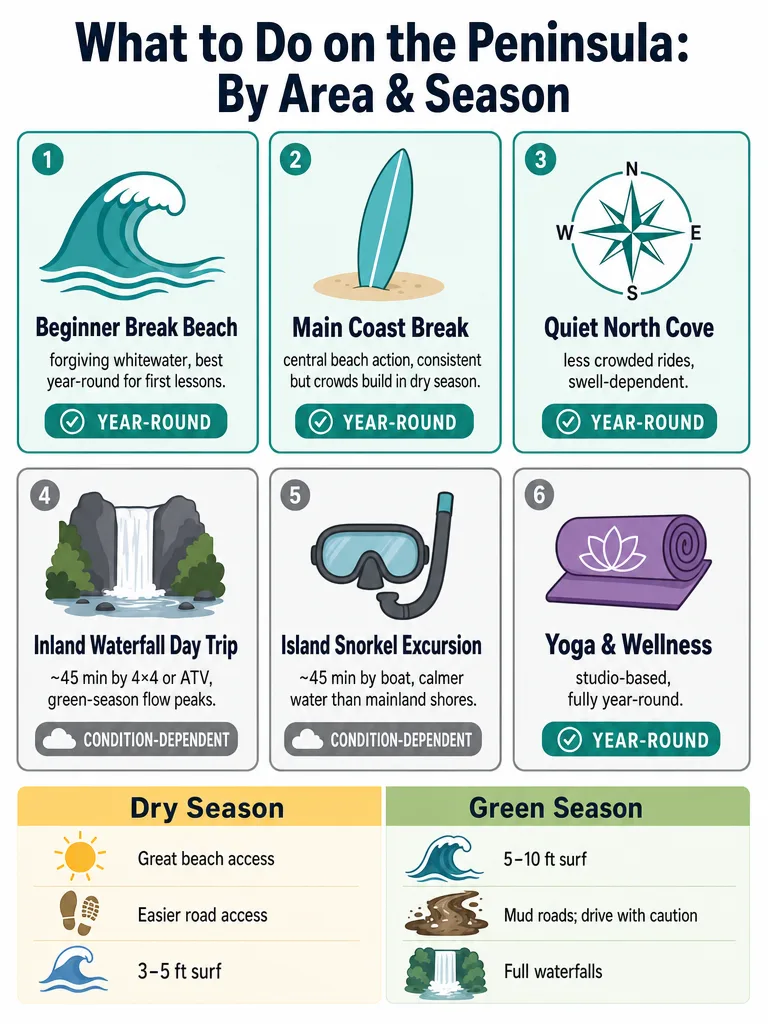
Pick your beach by the job you want it to do, not by the photo. Costa Rica Experts identifies the main Santa Teresa-area beaches as Playa Santa Teresa, Playa Carmen, Playa Hermosa, Playa Manzanillo, La Lora/Suck Rock, and Mar Azul, and the same guide says Playa Carmen, La Lora, and Playa Hermosa are the local picks for surf, with Mar Azul offering a less crowded ride.
Here's how they line up against what you're actually trying to do:
| Beach | Best for |
|---|---|
| Playa Carmen | Beginner surf, main strip access |
| Playa Santa Teresa | Central beach break, main beach hours |
| Playa Hermosa | Quieter beach time, backup beginner sessions |
| Playa Manzanillo | Quieter beach time farther north |
| La Lora / Suck Rock | Surf when conditions line up |
| Mar Azul | Less crowded rides |
| Mal Pais | Calmer base, surf south of the strip |
The coast is long and the beaches run into each other, so "Santa Teresa beach" is really a chain. Choose the segment, then walk.
For the surf-first version of this call, see where to stay for surf access, not vibes.
Can beginners surf in Santa Teresa?
Yes, and Playa Carmen is the clearest place to start. Toorizta says beginners tend to find forgiving whitewater near Playa Carmen, while more advanced surfers look to the northern reef breaks or toward Mal Pais when the swell fills in. Playa Hermosa works as a quieter backup, while Playa Santa Teresa, La Lora, Suck Rock, Mar Azul, and Mal Pais depend more on swell and skill.
Two details worth booking around. Toorizta says most Santa Teresa surf lessons run about 2 hours, and Tripadvisor lists 5 surfing lessons among its popular Santa Teresa experiences. The bottom helps too: Toorizta notes the surf is mostly sand, with warm water year-round, which is exactly what forgives a beginner's fall.
Don't judge a break by the crowd. A packed lineup at Playa Santa Teresa can mean advanced conditions, not a beginner day. Read the day, not the hype.
For the break-by-break beginner call, see beginner surf in Santa Teresa by conditions.
What are the best things to do in Santa Teresa besides surfing?
Non-surf activities in Santa Teresa center on beaches, yoga and wellness, local trails, ATV coastline exploring, the Montezuma Waterfall, a Tortuga Island boat trip, and condition-dependent El Chorro. That's the supported core, not a wishlist.
Yoga and wellness are woven into the town. Costa Rica Experts notes the Nicoya Peninsula's status as one of five global Blue Zones and says many top hotels include complimentary classes with a nightly stay. On the road, We Are Global Travellers says ATVs make up roughly half the traffic and recommends hiring one to explore the coastline, at around $50-70 USD a day.
The most reliable non-surf day out is the Montezuma Waterfall, about 45 minutes away by 4x4 or ATV.
The sources for this piece don't verify specific restaurants, bars, or shops, so no ranked list of them appears here; a "best of" list without editorial backing is worse than none. For vetted, visited picks, use the site's Santa Teresa restaurants brief and its nightlife guide. Rain in the forecast? See what to do when the surf is bad.
What is the best time to visit Santa Teresa?
December through April for dry weather, May through November for bigger surf. Toorizta identifies December through April as the best window for dry conditions, while surfers often prefer May through November for larger swells. The split is real, and it changes almost every decision you'll make once you land.
Toorizta's month-by-month table puts numbers on it:
| Months | Swell size |
|---|---|
| January – March | 3 to 5 ft |
| April | 2 to 4 ft |
| May – July | 4 to 8 ft |
| August – October | 5 to 10 ft |
| November – December | 3 to 6 ft |
What this means in practice: dry season gives you reliable beach afternoons, easier roads, and mellower waves, better for beginners and general trips. Green season trades guaranteed dry afternoons for the season's most powerful swell, which is what pulls stronger surfers to the northern breaks and Mal Pais.
The season also touches everything downstream: waterfall flow, road conditions, and how much of a day trip gets eaten by transport. Warm water is the constant; Toorizta says it stays warm year-round.
Peak surf hits 5 to 10 ft from August through October, per Toorizta's table, the biggest window on the calendar.
For the surf-tuned version, see best time to surf Santa Teresa by swell, wind, and tide and what still works in rainy season.
Which Santa Teresa activities work year-round, and which depend on swell, rain, or access?
Some Santa Teresa activities are dependable in any month; others hinge on swell, weather, or a boat. Warm-water beach time and warm-water surfing run year-round, since Toorizta notes the water stays warm all year and the bottom is mostly sand. That's your reliable floor.
The conditional list is where trips go sideways:
- Stronger-current beaches: Costa Rica Experts frames many Santa Teresa beaches as having strong currents and rocky coast, so swim conditions vary by beach and day.
- Tortuga Island snorkeling: boat-only, so it depends on tour schedules and sea state, not on walking to the sand.
- Montezuma Waterfall: reachable year-round but access runs on road conditions and a scramble, both weather-sensitive.
- El Chorro: Costa Rica Experts says this seaside waterfall only emerges at certain times depending on the weather. Treat it as a maybe, not a plan.
The sources for this piece don't verify specific road-dust or mud severity by month, so no month-by-month claim on that appears here. Plan the flexible activities on your best-weather days and keep the dependable ones as your fallback.
Keep reading
- Where to Stay in Santa Teresa by Beach, Road, and Noise
- What to Do in Santa Teresa When the Surf Is Bad: 11 Solid
- How to Get Around Santa Teresa Without Wasting Half a Day
- What to Pack for Santa Teresa: Dust, Rain, and Roads
- Where to Stay in Santa Teresa for Walkability vs Quiet
- Santa Teresa vs Mal Pais for Surf Stays: What Changes
What day trips can you do from Santa Teresa?
The realistic day trips sort by time and transport. Costa Rica Experts puts Tortuga Island about 45 minutes by boat from the Santa Teresa area and the Montezuma Waterfall about 45 minutes away by 4x4 car or ATV. El Chorro sits five miles north of Montezuma and needs a roughly 2-hour beach hike to reach.
| Day trip | Travel from Santa Teresa | Transport |
|---|---|---|
| Tortuga Island | About 45 minutes | Boat / tour |
| Montezuma Waterfall | About 45 minutes | 4x4 car or ATV |
| El Chorro | 5 miles north of Montezuma, then a ~2-hour beach hike | 4x4 + hike |
Two well-known reserves, Cabo Blanco Nature Reserve and Curú Wildlife Refuge, sit within reach on the southern peninsula, but the sources here don't confirm 2026 hours, fees, or access conditions for either, so confirm those directly before you build a day around them.
The pattern to notice: your transport dictates your trip. A boat unlocks Tortuga; a 4x4 or ATV unlocks Montezuma and the El Chorro trailhead.
For the full route menu south, see Santa Teresa to Montezuma by taxi, ATV, shuttle, or car and whether you need a car at all.
Is Tortuga Island worth it from Santa Teresa?
If snorkeling is what you're after, Tortuga Island is the stronger pick than trying to snorkel off the Santa Teresa strip. Costa Rica Experts calls Tortuga Island the best place for snorkeling from the area and frames it as a break from the strong currents and rocky coast on many Santa Teresa beaches. The crossing runs about 45 minutes by boat.
On price, Travelocity lists a Tortuga Island Sunset and Bioluminescence Tour at $137 and a Tortuga Island Tour with Costa Cat at $174. Those are two examples of what's out there, not a ranked tour endorsement; the point is the ballpark, roughly $137 to $174 per seat for a full boat day.
The straight read: Santa Teresa is a surf coast, not a snorkeling one. If clear water and reef life are your priority, budget for the boat rather than expecting easy snorkeling from the beach.
How do you get to Santa Teresa, Costa Rica?
Your arrival choice depends on where you start. Onda Teresa's getting-there guide says most overland arrivals from San José cross the Gulf of Nicoya on the Puntarenas to Paquera ferry, unless they fly into Cobano. Liberia is the alternative gateway, at about 4 hours by road with no ferry.
Here's the route-by-origin breakdown, using Onda Teresa's timings:
| From | Route | Time |
|---|---|---|
| San José (SJO) | Drive ~2 hrs to Puntarenas, 75-minute ferry to Paquera, then 1.5-2 hrs to Santa Teresa | Half a day |
| San José (SJO) | Fly to Cobano | 30-40 min flight, then ~40 min onward |
| Liberia | Drive/shuttle, no ferry | About 4 hours |
| San José | Bus (direct + local connection) | 5-6.5 hours or more |
For the ferry route, Onda Teresa advises being at the Puntarenas dock by 7:15am for the 8am crossing. Onda Teresa puts the Cobano-to-town leg at about 40 minutes, so the flight is the fastest option end to end. Indie Traveller recommends booking domestic Cobano flights through the in-country airline SANSA, since aggregators like Google Flights won't list routes within Costa Rica.
For deeper route breakdowns, see getting to Santa Teresa by ferry, drive, or shuttle and from Liberia specifically.
How much should you budget for Santa Teresa?
Budget around $80 to $150 per day for a comfortable mid-range trip, per Toorizta. That covers a real trip, not just free beach hours, and the extras add up fast once you rent wheels, take a lesson, or book a boat.
The line items sources actually verify:
- Daily mid-range budget: $80-150 per day (Toorizta).
- ATV rental: around $50-70 per day (We Are Global Travellers).
- Domestic flight to Cobano: $100-130 (Indie Traveller).
- Tortuga Island tour: roughly $137-174 per seat (Travelocity examples).
- San José bus fare: around 10,000 CRC, roughly $20-22 USD as of 2026 (Onda Teresa).
The bus is the cheapest way in but the slowest, at 5-6.5 hours or more. The flight costs more but buys back most of a day. Onda Teresa's transport figures give you the ground-level numbers most roundups skip.
A "free beach vacation" isn't free here. One ATV day plus one Tortuga boat trip can top $200 for two people before food. Plan the paid days deliberately.
Where should you base yourself for surf access, walkability, or quiet?
Base yourself by what you'll do every day, not by the prettiest listing. Santa Teresa isn't one compact town; it's a strip where Playa Carmen, central Santa Teresa, north Santa Teresa, Playa Hermosa, and Mal Pais each fit a different rhythm. Get this call right and half your transport problem disappears.
The quick logic:
- Playa Carmen: closest to beginner surf, dining, and the main strip. Best for walkability.
- Central Santa Teresa: main beach break and the densest cluster of services.
- North Santa Teresa / Playa Hermosa: quieter beach time, a short hop from the action.
- Mal Pais: calmer, darker, more spread out, with surf access still close by.
Match the base to the trip, then layer the rest. For the full decision set, Onda Teresa covers walkability vs quiet, surf access over vibes, what Mal Pais is really like, getting around without wasting half a day, and reading the surf report like a local.
We track conditions, routes, and openings on the peninsula so you don't have to reassemble them from a dozen tabs. Get the Nicoya dispatch: Get the Nicoya dispatch.
Sources
- THE 15 BEST Things to Do in Santa Teresa (2026)www.tripadvisor.com
- Santa Teresa Travel Guide | Things To Do Besides Surfwww.indietraveller.co
- The best things to do in Santa Teresaweareglobaltravellers.com
- Things To Do In Santa Teresa 2026 - Activities & Attractionswww.facebook.com
- Things to do in Santa Teresa, Puntarenas Province Costa ...costaricaexperts.com
- Santa Teresa: Things To Do & Where To Staysantateresadirtroad.com
- Santa Teresa Costa Rica: Surf, Stay & Explore (2026 Guide)www.travelocity.com
FAQ
What's the best time of year to visit Santa Teresa in 2026?
December through April for dry conditions; May through November for bigger surf. Swell peaks between August and October at 5 to 10 ft, per Toorizta's month-by-month table. Dry season suits beginners and general trips — roads are easier, afternoons are reliable, and waves are manageable. Green season trades that predictability for the most powerful swell on the calendar, which draws stronger surfers to the northern breaks and Mal Pais. Water stays warm year-round regardless.
Can beginners surf in Santa Teresa, or is it too advanced?
Playa Carmen is the clearest starting point — it offers forgiving whitewater and a mostly sand bottom that forgives falls. Most Santa Teresa surf lessons run about 2 hours. Playa Hermosa works as a quieter backup. La Lora, Suck Rock, and Mal Pais depend on swell and skill level. One warning: a packed lineup at Playa Santa Teresa often signals advanced conditions, not a beginner-friendly day.
How much does a day trip to Tortuga Island cost from Santa Teresa?
Expect to pay roughly $137 to $174 per seat for a full boat day. Travelocity lists a Tortuga Island Sunset and Bioluminescence Tour at $137 and a Tortuga Island Tour with Costa Cat at $174. The crossing is about 45 minutes by boat. Santa Teresa's beaches have strong currents and a rocky coast in places, so Tortuga Island is the stronger snorkeling pick — budget for the boat rather than expecting clear-water reef access from the sand.
What are the best non-surf things to do in Santa Teresa?
The dependable non-surf options are yoga and wellness studios (many hotels include complimentary classes), ATV coastline exploring at around $50–70 per day, the Montezuma Waterfall about 45 minutes away by 4x4 or ATV, and a Tortuga Island boat trip for snorkeling. El Chorro, a seaside waterfall north of Montezuma, only appears at certain times depending on weather — treat it as a bonus, not a plan. The Nicoya Peninsula is one of five global Blue Zones, which explains the density of wellness offerings.
How do you get to Santa Teresa from San José?
The most common overland route drives roughly 2 hours to Puntarenas, takes a 75-minute ferry to Paquera, then continues 1.5–2 hours to Santa Teresa — half a day total. Arrive at the Puntarenas dock by 7:15am for the 8am crossing. Flying domestically into Cobano is faster: the flight takes 30–40 minutes, then about 40 minutes onward. Domestic flights run $100–130 and should be booked through SANSA, since aggregators like Google Flights don't list in-country Costa Rica routes. From Liberia, the drive is about 4 hours with no ferry.
How much should you budget per day for a trip to Santa Teresa?
Budget $80–150 per day for a comfortable mid-range trip, per Toorizta. That floor shifts quickly once you add wheels or activities: ATV rental runs $50–70 per day, one Tortuga Island tour seat costs $137–174, and a domestic flight into Cobano adds $100–130. A single ATV day plus a boat trip can top $200 for two people before food. The bus from San José costs around $20–22 USD but takes 5–6.5 hours or more.
Santa Teresa eSIM and SIM Cards on Arrival
For most Santa Teresa trips, an eSIM is the cleanest answer: install it before you fly, keep your home number active, and arrive already connected. Buy a physical Costa Rican SIM only when you need a local number for calls, drivers, or a longer stay.
Read →Santa Teresa Pharmacies and Clinics: Where to Go
Public, verifiable pharmacy and clinic details for Santa Teresa are thin, and search results often mix in Wichita listings. This guide shows what to ignore and how to confirm care locally on the day.
Read →Santa Teresa Grocery Stores and Markets: What to Expect
Santa Teresa works best for daily top-ups, while Cóbano is the smarter larger shop. Mini markets cover water, eggs, bread, coffee, beer, and fruit.
Read →