Where to Stay in Santa Teresa by Beach, Road, and Noise
Santa Teresa is not one hotel zone, and the wrong side of the road can ruin a trip. Use this field guide to choose between beach, main road, and hillside stays.

Key takeaways
- Stay as close as possible to the stretch of beach you actually plan to use, on a side road off the main drag, and accept that "Santa Teresa" is at least four different towns stacked end-to-end along one dusty road.
- Santa Teresa is not a single hotel zone.
- Position matters as much as zone.
- There is no universal best side — there's only the side that matches your priorities.
Where should you stay in Santa Teresa if beach, road, and noise are the real trade-offs?
Stay as close as possible to the stretch of beach you actually plan to use, on a side road off the main drag, and accept that "Santa Teresa" is at least four different towns stacked end-to-end along one dusty road. That's the honest answer. The star rating on your booking page tells you almost nothing useful here — the question that matters is whether your room sits 40 meters off Calle Carmen with motorbikes ripping past until 2 a.m., or 400 meters up a quiet hillside lane with a five-minute walk to the sand.
Santa Teresa runs roughly 6 kilometers from Mal Pais in the south to the far north end past Playa Hermosa, connected by a single mostly unpaved road that doubles as the main artery, the loudest street in town, and the only sensible way to get anywhere. Where you sleep on that road determines how your trip actually feels far more than the property itself does. Beach access, walking distance to dinner, exposure to dust and ATV noise, and how badly you need a vehicle all shift dramatically over a 10-minute drive.
Use this guide to make three decisions in order: which zone (north end, center, Playa Carmen, or the Mal Pais edge), which position relative to the main road (beachfront, roadside, or hillside), and which property type fits how you actually travel. Skip the booking-site filter labels — they group very different properties under the same tag — and read the section that matches your trip.
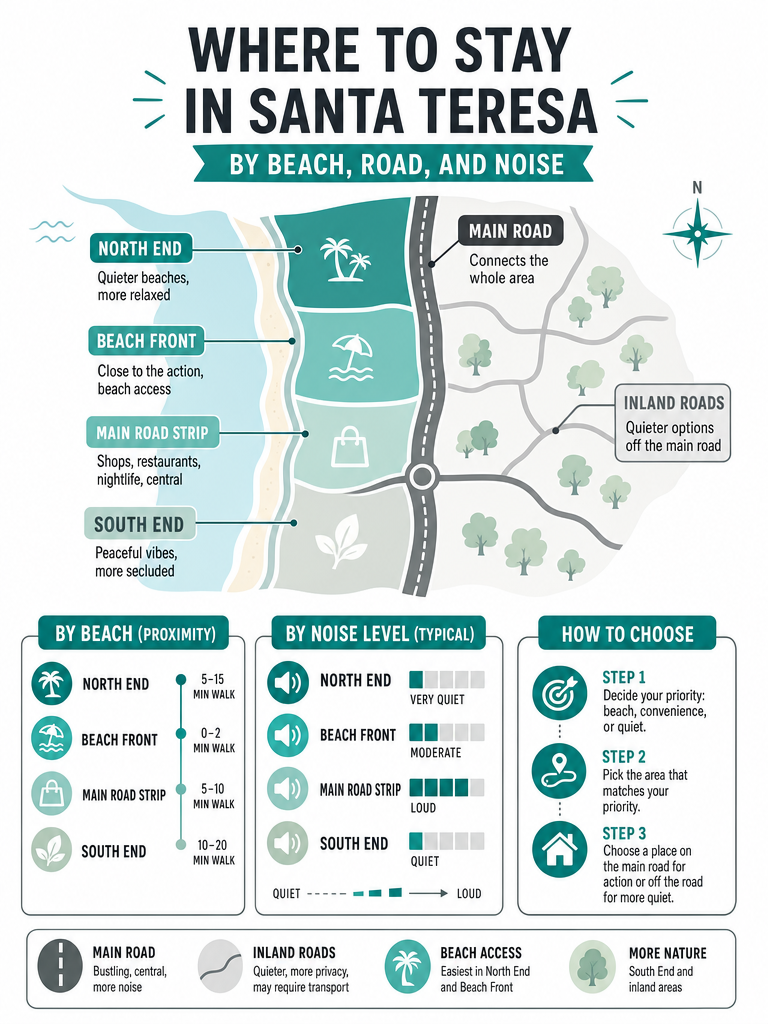
Which Santa Teresa area fits your trip: north end, center, Playa Carmen, or the Mal Pais edge?
Santa Teresa is not a single hotel zone. Locals and longtime visitors talk about it as four distinct bases, each with a different rhythm, and travelers on Reddit and Facebook groups consistently ask north-vs-south because the answer genuinely changes the trip (Source: r/CostaRicaTravel; Costa Rica travel Facebook groups).
Here is how the zones actually break down:
| Zone | Vibe | Best for | Trade-offs |
|---|---|---|---|
| North end (past the football field, toward Playa Hermosa) | Quieter, more residential, longer beach with fewer crowds | Surfers wanting space, families, repeat visitors who already know town | Need a vehicle or scooter; further from most restaurants and bars |
| Center (around La Lora, Rocamar, the main beach access points) | Densest concentration of restaurants, shops, surf schools, nightlife | First-time visitors, social travelers, people without a vehicle | Loudest, dustiest, busiest stretch of road |
| Playa Carmen (the southern beach near the main intersection) | Slightly more polished, closer to the Mal Pais turnoff, walkable to center | Couples, slightly older travelers, people who want walkability without the loudest blocks | Still on the main road; busy intersection in high season |
| Mal Pais edge (south of the Carmen intersection, before Mal Pais village) | Calmer, more boutique, closer to fishing-village feel | Travelers prioritizing sleep, longer stays, anyone considering Mal Pais but wanting easier access to Santa Teresa dinner | Limited walkable nightlife; dinner usually means a short drive or taxi |
If you've never been before and you're staying four nights or fewer, the center is almost always the right call — you lose less time moving around, even if you sleep slightly worse.
The north end has gotten more developed in recent years, but it's still where you go if you want to hear waves instead of motorbikes. The Mal Pais edge is the underrated middle ground for travelers who want quiet but don't want to commit fully to Mal Pais village. Choose your zone based on how often you plan to leave the property, not on which beach photo looked best.
Should you stay on the beach, along the main road, or up the hill?
Position matters as much as zone. A beachfront room in the loud center is a completely different experience from a hillside room in the same zone, and a "beach hotel" 300 meters from the sand on the inland side of the main road is a different animal again.
Three positions, three honest trade-offs:
- Beachfront and beach-access stays. Walk straight to the sand, hear the surf at night, and skip the dust. These are the surf houses and beach hotels listed under labels like Hotel Santa Teresa By The Beach, Hotel Tropico Latino, Dream Surf House, and Canaima Chill House (Source: Tripadvisor; Hotels.com). You pay more, and the cheaper beachfront options often trade aesthetics for location.
- Main-road stays. Most convenience, most noise. You're walking distance to dinner, surf shops, and groceries, but you'll hear ATVs, motorbikes, and the occasional 1 a.m. truck. Light sleepers should not book a room with windows facing Calle Carmen unless the listing explicitly says double-glazed or set back from the road.
- Hillside stays. Quieter, often cheaper for the square meterage, with better views and breeze. The trade is real: a 10-minute walk down to the beach becomes a 20-minute climb back up in 32°C heat, and at night you'll want a vehicle, a scooter, or a comfortable taxi habit.
"Near the beach" on booking sites can mean anything from 50 meters to 800 meters, and the route may cross the main road or wind through unlit lanes. Always check the property's pin on a map and trace the actual walk before you pay.
Before booking any property, verify four things: exact map pin (not the neighborhood label), walking time to your preferred beach access, whether the route is shaded and walkable at night, and whether the windows face the main road.
North Santa Teresa vs south Santa Teresa: what changes for surf, food, and nightlife?
There is no universal best side — there's only the side that matches your priorities. The surf-and-nightlife traveler asking on Reddit whether to stay north or south is asking the right question, because the answer flips depending on which one matters more (Source: r/CostaRicaTravel).
For the surf-first traveler, the north end usually wins. The beach is longer, the lineups spread out more, and you can paddle out from your front door at several stretches. You'll drive or scooter into the center for dinner, but you'll surf better and sleep better.
For the nightlife-and-meet-people traveler, the center and Playa Carmen win clearly. Bars, beach clubs, sunset spots, and the social density that makes Santa Teresa famous are concentrated in a 1.5-kilometer stretch. Staying north and trying to commute in for nightlife means a $10–$15 taxi each way and a logistics problem at 1 a.m.
For first-time visitors splitting the difference, the center wins on sheer convenience. You'll surf decent waves at La Lora or Suck Rock, walk to dinner, and decide on your next trip whether you want quieter or louder.
For anyone who wants to sleep before midnight, go north or to the Mal Pais edge. The center does not get quiet.
How do surfers choose where to stay in Santa Teresa?
Surfers should book lodging the way they read a forecast: location first, everything else second. The break you want to surf most often should be within a 10-minute walk or a 5-minute drive, because conditions in Santa Teresa change fast and the difference between scoring and missing it is often whether you can grab your board and go without a 25-minute logistics chain.
A practical workflow:
- Decide your daily break. If you're a beginner, you want easy whitewater near the center or Playa Carmen. If you're intermediate, the north end and Suck Rock area give you more options. Advanced surfers chase shifting peaks and need flexibility.
- Match lodging to that break. Walking distance beats anything else. Carrying a 7'2" down a dusty road in the dark is fine; doing it after a 15-minute scooter ride with a sore back is not.
- Check tide and wind windows for your dates. Tides shift roughly every six hours, and offshore winds usually die by mid-morning in the dry season. Your stay should let you surf the right window without a commute.
- Plan board logistics. Confirm board storage, outdoor rinse, and whether the property allows wax and sand inside. Surf houses are built for this; boutique hotels often are not.
For tide-and-wind timing across the seasons, see the Onda Teresa guide to the best time to surf Santa Teresa by swell, wind, and tide, and for daily decision-making, the how to read the Santa Teresa surf report like a local guide explains why a five-star rating on a generic forecast site often means nothing here.
The right Santa Teresa surf stay is the one that lets you check the report and be in the water within 15 minutes.
Keep reading
- Where to Stay in Mal Pais If You Hate Santa Teresa Chaos
- Best Time to Surf Santa Teresa by Swell, Wind, and Tide
- Free vs Enhanced Listings on Onda Teresa: What Changes
- Santa Teresa or Montezuma? Pick the Right Base Fast
- How to Read the Santa Teresa Surf Report Like a Local
How should you choose a hotel, villa, hostel, or surf house without trusting booking filters blindly?
Booking-site categories collapse very different properties into the same label. "Beach hotels in Santa Teresa" on Hotels.com lumps Bohemia Experience, Dream Surf House, Villa Taleona, Canaima Chill House, Hotel Tropico Latino, and Selva Resort into one list — those are five wildly different experiences ranging from social surf house to boutique hideaway (Source: Hotels.com). The category is useless. The map pin and the property type are everything.
Before paying, verify the following:
| Check | What to look for | Why it matters |
|---|---|---|
| Exact location | Map pin, not neighborhood label | "Santa Teresa" spans 6 km |
| Road exposure | Set-back distance from main road; window orientation | Determines noise, dust |
| Beach access | Actual walking route and time | Booking copy inflates this |
| AC vs airflow | AC in dry season heat, cross-breeze in green season | December–April gets hot |
| Workspace | Desk, chair, fiber or Starlink Wi-Fi | Calls drop on weak networks |
| Parking / ATV | Secure off-road parking | Theft happens; insurance demands it |
| Cancellation | Free cancellation window | Flights and swells shift |
| Property fit | Solo, couple, family, group | Surf houses skew social; villas skew quiet |
Property type guidance, kept blunt:
- Hostels and surf houses for solo travelers, social trips, surf-first stays under $50/night. Expect noise, expect to meet people, expect basic rooms.
- Boutique hotels (the kind cataloged on sites like myboutiquehotel.com) for couples and design-forward travelers willing to pay $180+ for atmosphere, pool, and breakfast (Source: myboutiquehotel.com).
- Villas and full houses for families, groups of four or more, and stays of a week or longer. Per-person cost often beats hotels and you get a kitchen.
- Hotels with restaurants on-site for travelers who want to land, eat, and not move for two days.
Santa Teresa lodging spans roughly $25 to $1,200 per night, and the only thing the price guarantees is that you should ask harder questions before booking, not fewer.
What are the awkward edge cases that ruin otherwise good Santa Teresa stays?
Generic guides skip these. They're where most trips actually go wrong.
- Light sleepers. The main road runs late and starts early. Book hillside, north end, or Mal Pais edge, and ask the host directly: "Do guests hear the road from this room at night?" Hosts who answer honestly are worth booking.
- Families with young children. Surf houses and party hostels are out. Look for villas with private pools on the north end or Mal Pais edge. Verify pool fencing — it's not standard in Costa Rica.
- Remote workers on calls. Confirm fiber or Starlink in writing, not "fast Wi-Fi." Test by asking the host to send a Speedtest screenshot. Power cuts happen in green season; ask whether the property has a backup.
- Visitors without a rental vehicle. Stay center or Playa Carmen, full stop. Anywhere else and you'll spend $30–$50 a day on taxis.
- Green-season arrivals (May–November). Dirt roads turn to mud. Confirm 4x4 access if your stay is on a hillside lane. Some properties are genuinely hard to reach in October.
- Party-sensitive travelers. Avoid stays within 200 meters of La Lora, Banana Beach, or Kika. The bass carries.
- One- or two-night stays. Don't go cheap. The transit from the ferry or Liberia is long; you've earned a property that works on arrival.
When should you skip Santa Teresa and stay in Mal Pais or Montezuma instead?
If your honest priorities are quiet sleep, slower mornings, longer dinners, and not hearing motorbikes, you may be planning the wrong base. Santa Teresa is busy, dusty, and increasingly built up. That's not a flaw — it's the trade-off for having the densest restaurant scene and most consistent surf access on the southern Nicoya. But it's the wrong call for some trips.
Mal Pais sits 5 minutes south and operates on a different frequency. Smaller, quieter, more fishing-village than party-village, with boutique stays scattered along the coast toward Cabo Blanco. It works for couples, longer stays, and travelers who want Santa Teresa's restaurants accessible by short drive without sleeping in the noise. The Onda Teresa guide on where to stay in Mal Pais if you hate Santa Teresa chaos breaks down the lodging pockets in detail.
Montezuma, on the eastern side of the peninsula, is a different trip entirely — waterfalls, calmer water, a more bohemian and less surf-driven scene, and a 45-minute drive from Santa Teresa. It suits travelers who want hiking, swimming, and a smaller-town pace more than they want surf and sunset bars. The Santa Teresa or Montezuma comparison is the fastest way to decide between the two.
A simple rule: if reading this guide made Santa Teresa sound like more chaos than you signed up for, trust that instinct. The peninsula has three good answers, and the right one depends on the trip you actually want.
For honest, locally vetted lodging, surf, and dining intel across Santa Teresa, Mal Pais, and Montezuma — updated by people who live here, not influencers passing through — get the Nicoya dispatch from Onda Teresa.
Sources
- Staying in Santa Teresa - Getting Aroundwww.tripadvisor.com
- What area to stay in Santa Teresa?www.facebook.com
- Best Beach Hotels in Santa Teresa, Costa Ricawww.hotels.com
- Stay near the north or south end of Santa Teresa?www.reddit.com
- Boutique hotels in Santa Teresa Beachwww.myboutiquehotel.com
- Costa Rica Relaxed Beach vibe - Santa Teresa Forumwww.tripadvisor.com
- Stay in Santa Teresa, Costa Rica | Feeling PURA VIDA » Feeling PURA VIDAfeelingpuravida.com
FAQ
Do you need a car or scooter to stay in Santa Teresa?
Only if you stay outside the center or Playa Carmen. Those two zones are walkable to most restaurants, surf shops, and beach access points. Stay north of the football field or on the Mal Pais edge without wheels and you'll be spending $30–$50 a day on taxis, which adds up fast over a week.
Is Santa Teresa too noisy to sleep well?
It depends entirely on where your room sits relative to Calle Carmen. The main road runs late and starts early — motorbikes, ATVs, and the occasional truck don't care about your checkout time. Book hillside, north end, or Mal Pais edge if sleep matters, and ask the host directly whether guests hear road noise from the room before you pay.
What's the price range for accommodation in Santa Teresa?
Roughly $25 a night for a surf hostel bunk to $1,200 for a private villa with a pool — and the price tells you almost nothing useful without checking the map pin and road exposure first. Mid-range boutique hotels with a pool and breakfast typically run $150–$300 in high season.
When is the worst time of year to visit Santa Teresa for road and weather conditions?
October sits at the peak of green season and is the month locals are most likely to warn you about: hillside dirt lanes turn to mud, some properties become genuinely hard to reach without 4x4, and power cuts are more frequent. If you're booking a hillside stay between May and November, confirm road access and backup power in writing.
Is Mal Pais worth considering instead of Santa Teresa for accommodation?
Yes, for specific trips — particularly couples on longer stays, anyone who prioritizes sleep over nightlife convenience, and travelers who want boutique lodging with a fishing-village feel rather than a surf-town buzz. Mal Pais sits five minutes south and still puts Santa Teresa's restaurant scene within a short drive.
Santa Teresa eSIM and SIM Cards on Arrival
For most Santa Teresa trips, an eSIM is the cleanest answer: install it before you fly, keep your home number active, and arrive already connected. Buy a physical Costa Rican SIM only when you need a local number for calls, drivers, or a longer stay.
Read →Santa Teresa Pharmacies and Clinics: Where to Go
Public, verifiable pharmacy and clinic details for Santa Teresa are thin, and search results often mix in Wichita listings. This guide shows what to ignore and how to confirm care locally on the day.
Read →Santa Teresa Grocery Stores and Markets: What to Expect
Santa Teresa works best for daily top-ups, while Cóbano is the smarter larger shop. Mini markets cover water, eggs, bread, coffee, beer, and fruit.
Read →