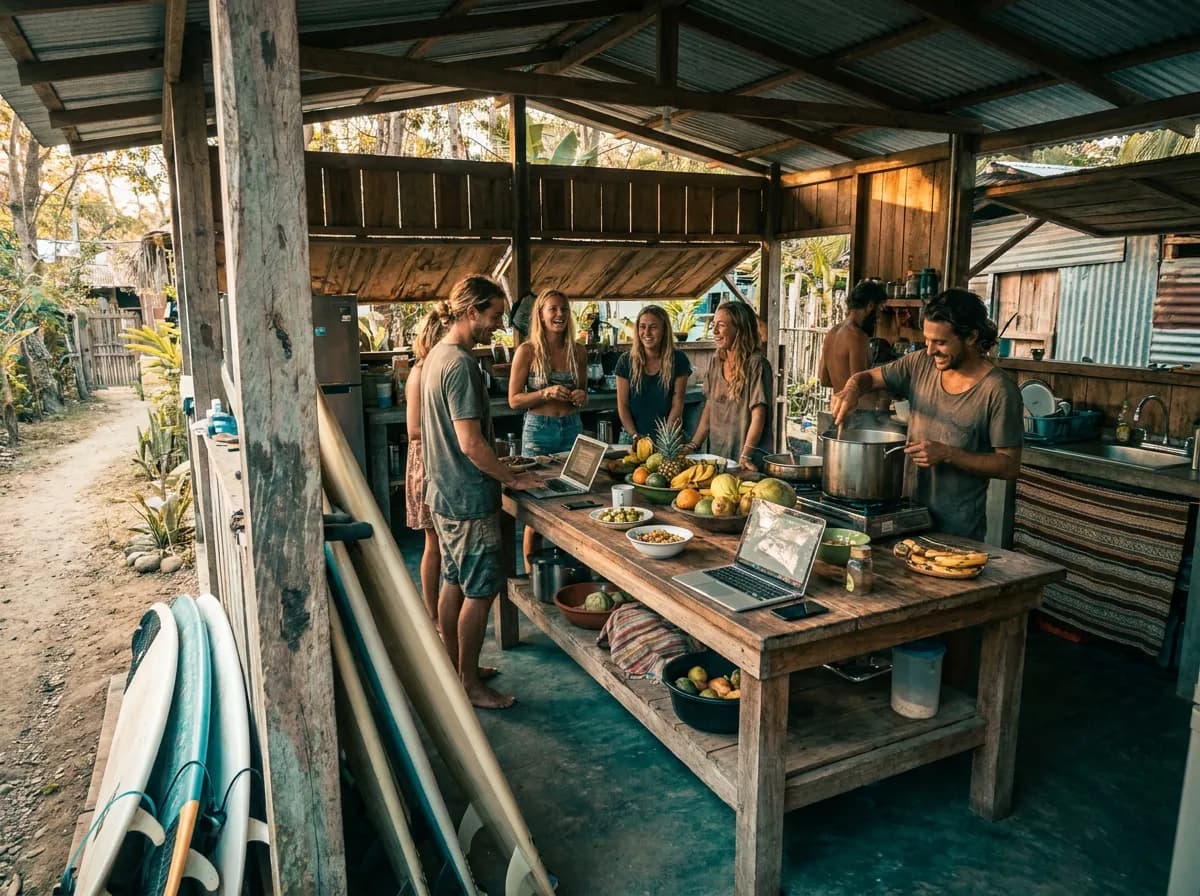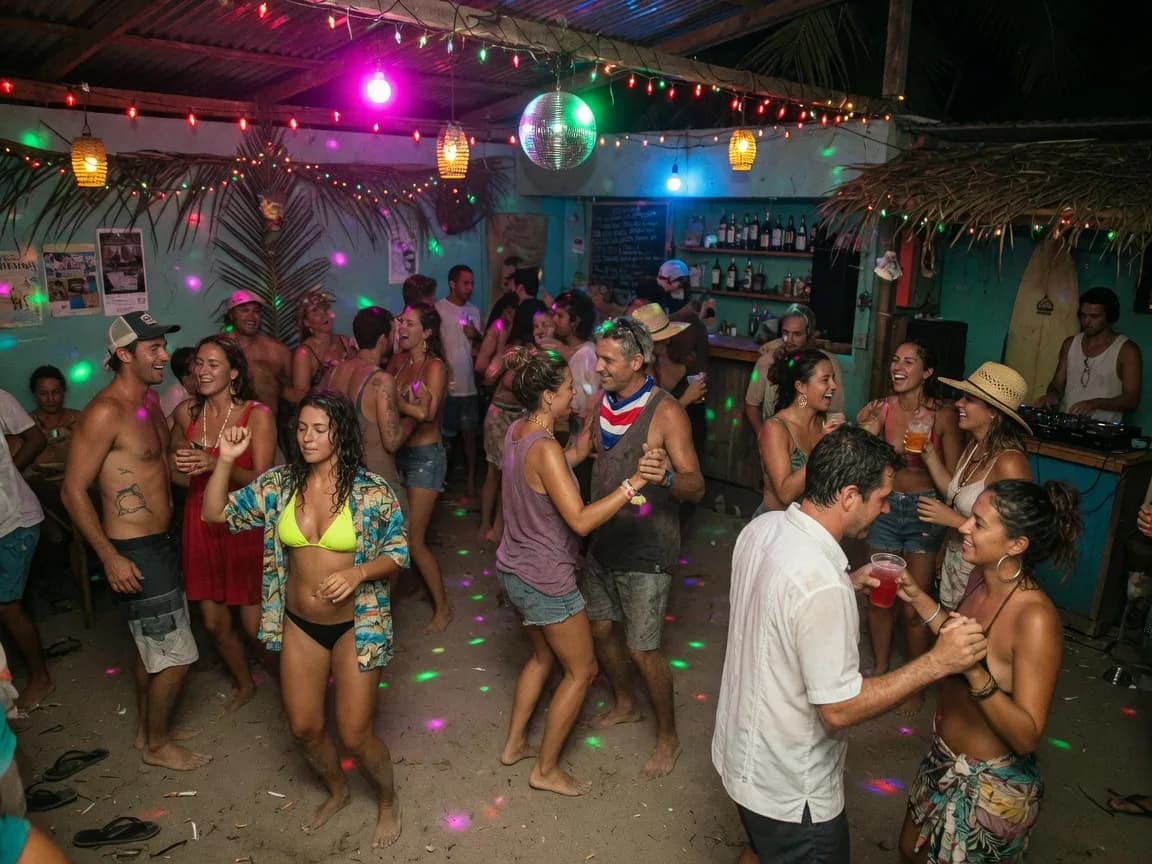
Permits, costs, competition, and the realities of running a business in a small Costa Rican beach town.
People come here dreaming of the "own a restaurant in paradise" life, and some of them pull it off beautifully. A lot more go home broke. Here is what nobody tells you before you sign a lease on the main road.
The Market Reality: Who You Are Competing With
Santa Teresa feels like a dusty surf outpost that somehow became one of the most popular beach towns in Central America. The entire town revolves around one rough road packed with surfers, backpackers, yoga studios, smoothie shops, and enough ATVs to make you think nobody owns a normal car. That density is the first thing to understand before you open anything here.
The main road is lined with yoga studios, boho boutiques, wellness cafes, and surf schools. Every single one of those categories is saturated. Surf schools, in particular, are stacked on top of each other. New surfers can find numerous surf schools, and board rentals are available for every preference. If you are planning to open the tenth surf school on a 3km stretch of road, you need a very specific reason why yours wins.
The categories with more room to breathe, as of mid-2026, are services that locals actually need year-round: hardware and supplies, reliable vehicle repair, quality childcare, and anything in the medical or dental space. There is also raw land or existing structures that can be used for multiple commercial options, from fitness/pilates/yoga studios, co-working centers, to retail stores, to rental facilities for quads/surfboards/cars, food and beverage, medical facilities, and massage. The point is not that all of those are open, it is that the market is actively looking for the right operator in each.
Prices here are exorbitant, significantly more expensive than almost any other beach town in the country. That cuts both ways. Your customers have money, but so do your competitors, and your overhead will be higher than you expect.
Check out the /directory/services hub for a sense of what is already operating in town before you commit to a concept.
Legal Structure: What You Actually Need
Foreigners may own 100% of a Costa Rican company. Residency is not required to own, but is required if you will work in the company. Read that second sentence carefully. You can own the thing, but if you plan to be behind the counter every day without residency, you are technically working illegally. Many people do it anyway. The risk is real. Sort out your visa situation first. See our visa rules guide for the full picture.
The two structures you will hear about are:
- S.A. (Sociedad Anónima): The more common form of corporation in Costa Rica because of its flexibility. It needs at least three people to sit on a board of directors, and its structure is very flexible, depending mostly on how your attorney builds it.
- S.R.L. (Sociedad de Responsabilidad Limitada): Costa Rica's version of a limited liability company, designed for small to medium-sized businesses. Instead of shares, ownership is divided into non-transferable quotas. SRLs may be formed by a single member and are managed by one or more managers, offering a simplified management structure that appeals to solo entrepreneurs.
For most small businesses in Santa Teresa, the SRL is the cleaner choice. Legal costs to form a corporation average $800-$1,200 and include numerous governmental registration and licensing fees. Budget toward the top of that range if you are using a bilingual attorney in the Cobano or San Jose area, which you should be.
One important 2025 update: A major legal update effective May 30, 2025 under Law 10729 modernized company formation. New entities are no longer required to select a traditional name; instead, the National Registry assigns a legal ID number as the official company name. However, companies can still register a trade name through the Intellectual Property Office for branding purposes.
Also critical for 2026: A key update took effect on June 4, 2025. All legal entities must register a unique and verifiable email address with the National Registry. This email becomes the official channel for administrative and judicial notices. Existing companies must register it by June 5, 2026, or the Registry will stop processing filings. If you have an existing S.A. or SRL and have not done this, stop reading and go do it.
While many of the steps involved in starting a business in Costa Rica can happen quickly, putting it all together and getting everything checked off the list can take around 2-3 months. There will no doubt be some holiday or glitch in the system that will delay you, so count on a few months or even more if you need special licenses or permits. Administrative tasks in Costa Rica can take a lot longer than expected.
The Permit Stack: What You Are Actually Signing Up For
Every physical business in Santa Teresa needs to work through the Municipalidad de Cobano, which is your local government. In practice, most businesses touch several institutions: the National Registry for company registration, the Ministry of Finance for tax registration and electronic invoicing, your local municipality for a business license (patente municipal), the Ministry of Health for the sanitary operating permit for many activities, and the CCSS if you have employees.
Here is the basic permit checklist for a physical business:
- Patente Municipal: If your company will have a physical presence in the country, you will need a business license (Patente Municipal) from the local municipality. The cost varies depending on the business location and type. Confirm exact fees and documentation with the Cobano municipality directly, as requirements change.
- Permiso Sanitario (Ministry of Health): Businesses related to food, health, and hospitality sectors need a health permit issued by the Ministry of Health. This involves an inspection and a fee based on the size and nature of the business.
- Liquor License: If you plan to open a restaurant, bar, or any type of business where you will serve food and alcohol, you will also need a health permit from the Ministry of Health, a permit to handle food, and also a liquor license. Liquor licenses in Costa Rica are notoriously slow and expensive. Budget 6-12 months and talk to a lawyer before you sign any lease that depends on one.
- Tourism Registration (ICT): Sector permits include, for example, restaurants (health and safety), construction (engineering boards), and tourism (ICT). If you are running a surf camp, hotel, or tour operation, you need ICT registration on top of everything else.
- Electronic Invoicing (Hacienda): Every active business must issue electronic invoices through the Ministry of Finance system. VAT (IVA) is 13% standard rate on taxable goods and services. If your goods/services are subject to VAT, you must collect and remit.
For a restaurant or bar, plan for the full permit process to take 4-8 months before you can legally open. Budget accordingly in your runway.
The Real Cost of Hiring Staff
This is where a lot of first-time business owners in Santa Teresa get blindsided. Employer contributions total approximately 26.67% of an employee's gross salary, covering various benefits such as health insurance, pensions, and family allowances. Employee contributions amount to about 10.67% and are withheld from their salaries.
That 26.67% is just the start. CCSS contributions alone run 26.67% of gross salary (increased in January 2026). Add aguinaldo, vacation accrual, and labor risk insurance and total employer cost reaches 39-50% above base salary.
The aguinaldo is the mandatory 13th-month salary. All employees are entitled to a 13th-month salary (aguinaldo), equal to one-twelfth of all ordinary and extraordinary earnings received during the year. It must be paid no later than December 20 each year. If you are paying someone $800/month, you owe them roughly $800 extra in December on top of their regular salary. Model this into your cash flow from day one.
As part of a pre-scheduled CCSS reform, IVM (pension) contributions rose by 0.16 percentage points for both employer and employee on January 1, 2026. The new rates are employer 5.58% and employee 4.33%, up from 5.42% and 4.17% in 2025. Small change, but confirm locally as these rates adjust on a schedule.
The practical upshot: if you budget $1,000/month for a full-time employee, your actual cost is closer to $1,400-$1,500 once you factor in all contributions and the aguinaldo provision. Do not open a business here without running those numbers.
Location, Rent, and the Seasonality Problem
Commercial space on the main road in Santa Teresa is expensive and getting more so. The real estate market features a distinctive mix of properties, and values have seen appreciation of 8-12% annually over the past decade, with premium prices due to limited supply and strict regulations. That appreciation hits commercial rents too. Expect to confirm current rates locally, as prices shift fast, but budget $1,500-$3,500/month for a small street-front commercial space in a good location as of mid-2026. Confirm locally before signing anything.
The other thing to model honestly is seasonality. High-season occupancy rates run 85-95% from December to April, with green season performance at 45-65% from May to November. That 30-40% swing in foot traffic is the difference between a full house and an empty dining room. Most guidebooks will tell you to visit during the pristine dry season (December to April), but what they fail to mention is that the town becomes utterly crowded with tourists, prices skyrocket, and getting a seat at a local restaurant becomes a competitive sport.
The businesses that survive long-term here are the ones that either have a loyal local and expat base to carry them through green season, or they close for a month or two and plan for it financially. Do not assume you can run at full cost structure year-round on tourism revenue alone.
Also read our cost of living guide and monthly rentals guide to understand what your personal overhead looks like while you are building the business.
What Actually Works Here
Investors from North America and Europe have opened surf hostels, eco-lodges, and boutique hotels catering to different budgets and preferences. These properties often market themselves as surf-first destinations, with easy access to breaks, surfboard storage, and in-house instructors. The hospitality model works when the product is genuinely differentiated. A generic 6-room guesthouse with no identity is a tough sell.
The food scene here is exploding, with a massive variety of global culinary options, from vegan cafes to high-end sushi. But the restaurant graveyard is also real. The places that last are those with a clear identity, a loyal community following, and an owner who is physically present and cooks or manages with genuine care. Absentee restaurant ownership in Santa Teresa almost never works.
The wellness sector, including yoga, massage, and retreat hosting, continues to grow. Commercial spaces catering to wellness, hospitality, and outdoor activities perform exceptionally well. If you are thinking about this space, check the best yoga studios guide and massages guide to see who you would be competing with.
One honest note on the community dynamic: As more foreigners purchase property, local residents have found it increasingly difficult to keep up with the rising cost of living and property prices. The influx of foreign-owned businesses has raised concerns about the preservation of local culture and identity. If you open a business here, hire locally, pay fairly, and actually engage with the Tico community. It is not just the right thing to do. It is also the thing that determines whether your business has roots or blows away in the first green season.
FAQ
Can I start a business in Santa Teresa without Costa Rican residency? Yes, you can legally own a company. Owning a business is permitted as a foreigner, even without any type of residency status. In general, you can own and operate your own business with only a tourist visa. When doing so, you must hire locals for the actual labor, but you can do the management and related tasks. If you want to work inside the business yourself in a hands-on role, you need residency or a work permit. Talk to a lawyer.
How long does the full permit process take for a restaurant or bar? Most incorporations can be structured in a few business days once documentation is complete. Sector permits and municipal licenses can add time depending on activity and location. For a food and beverage business specifically, realistically budget 4-8 months for the full stack of permits including the health permit, patente, and liquor license. Do not sign a lease that starts your rent clock before you have at least the core permits in hand.
Do I need a local lawyer, or can I handle this remotely? Hire a lawyer that is easy to communicate with and fully bilingual so that you understand everything going on. You can start the incorporation process remotely, but you will need someone on the ground in Cobano or Puntarenas to handle municipal filings. A bilingual attorney with experience in the Nicoya Peninsula is worth every colon. Ask around at the /directory/services hub or in the expat community for current referrals.
What is the biggest financial surprise for new business owners here? Payroll costs. Most people budget for a salary and forget the CCSS contributions, the aguinaldo, and labor risk insurance. When you hire in Costa Rica, CCSS contributions alone run approximately 26% of gross salary, but that is only the starting point. Add mandatory aguinaldo, vacation provision, labor risk insurance, and workers' compensation, and total employer cost reaches 39-50% above base salary.
Is the market too saturated to start something new? For restaurants, surf schools, and yoga studios, yes, you need a very strong concept and a real competitive edge. For services that the local and expat community actually needs year-round, such as reliable vehicle repair, healthcare, quality childcare, and specialty retail, there is still genuine room. Read our moving to Santa Teresa guide to understand what the resident community is actually missing before you commit to a concept.
Browse all local businesses