How long you can stay, border run realities, extension options, and what the digital nomad visa actually requires.
If you're planning to stay in Santa Teresa longer than a quick surf trip, you need to understand how Costa Rica's entry rules actually work in 2026, not how the hostel rumor mill says they work. The rules have tightened, enforcement has gotten more consistent, and the old "just wing it" approach can now cost you real money or get you banned from re-entry.
How Long You Can Actually Stay
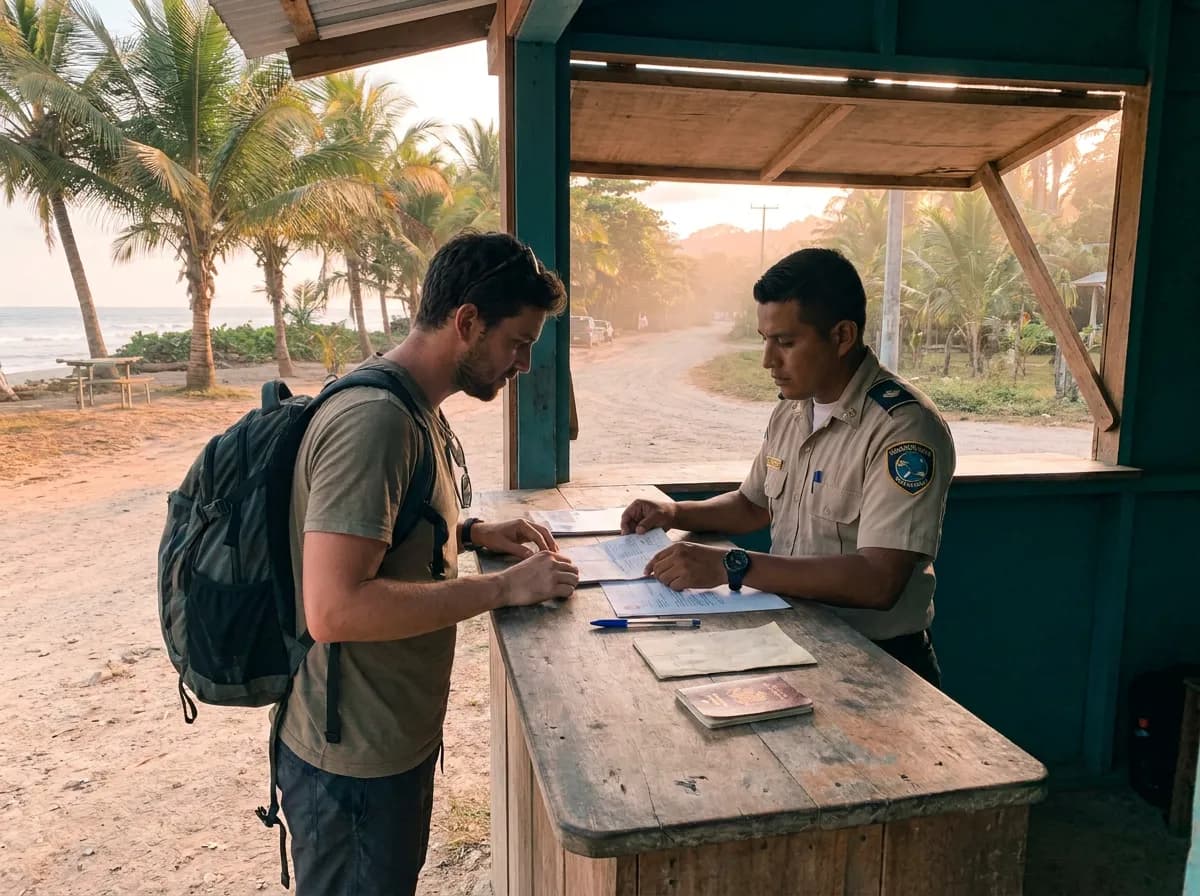
Most visitors from the US, Canada, UK, EU, Australia, and a long list of other countries enter Costa Rica without a visa and get a tourist stamp in their passport. As of 2026, that stamp can cover up to 180 days, a change from the old 90-day default that confused people for years.
A few things to know immediately:
- The officer at immigration has discretion. They may stamp you for 90 days, 120, or the full 180. Check your passport the moment you clear the desk.
- You are a tourist, not a resident. That stamp gives you no right to work, no access to the public health system (CAJA), and no path to anything permanent.
- You must show a return or onward ticket. A one-way flight into Costa Rica without residency will get you questioned or turned back. Have a booked exit ticket ready, even if it's a cheap bus ticket to Panama you never use. (aglegal.com)
- Immigration officers also want to see proof of funds, roughly $100 USD per month of your intended stay. A credit card or a bank statement you can pull up on your phone usually satisfies this.
If you're arriving via the Paquera or Tambor ferry route from the mainland, the same rules apply. For the logistics of getting here, check our getting to Santa Teresa guide.
Extensions: Harder Than You Think
Here's the honest answer: tourist visa extensions are rarely granted to visitors from the US, Canada, or most Western countries. The immigration authority (migracion.go.cr) technically has the power to extend your stay, but in practice, Group 1 nationalities almost never receive one. Don't count on this route. (crie.cr)
If you've applied for formal residency, that's a different situation. Once your residency application is filed and accepted, you can legally remain in Costa Rica beyond your original stamp without doing border runs, even if your initial 90 or 180 days have expired. That's a meaningful benefit and a reason to start the process sooner rather than later.
Border Runs: Still Common, No Longer Risk-Free
The "perpetual tourist" strategy, leaving to Nicaragua or Panama briefly to reset your stamp, has been the informal solution for years. Plenty of people in Santa Teresa still do it. But in 2026, the risks are real and worth naming clearly.
- Immigration officers track your entry history. If you're crossing into Panama every 180 days for two or three years, that pattern gets flagged.
- There is no legal right to re-entry. An officer can deny you at the border if they decide you're living here without proper status.
- It creates zero path to residency, a bank account, or legal work. (costaricavibes.com)
- Overstaying your stamp is now enforced with real consequences: a fine of $100 per month overstayed, payable before you can exit, and potential entry bans of up to three times the overstay period.
Border runs work as a short-term bridge while you sort out your actual status. They are not a long-term plan, and if you're thinking about putting down roots here, you need to read our moving to Santa Teresa guide and talk to an immigration lawyer.
The Digital Nomad Visa: What It Actually Requires
Costa Rica's Digital Nomad Visa (Law 10008) is a legitimate option for remote workers, and it's genuinely useful if you qualify. But there's a lot of noise online about it, so here are the real numbers as of mid-2026.
Income requirement: The official Costa Rica Tourism Board lists $3,000 per month for individuals and $5,000 for families. Some sources cite slightly lower thresholds, but use the higher figures when you're preparing your application documents to be safe. You must show this income was consistent for at least the past year. (visitcostarica.com)
What you get:
- Legal stay of one year, renewable for a second year
- Exemption from Costa Rican income tax
- Ability to open a bank account in the national banking system (a genuinely big deal here)
- Validation of your home country driver's license
- Possible waiver of customs taxes on work-related electronics
What you need to apply:
- Proof of stable remote income (you work for clients or employers outside Costa Rica)
- Valid health insurance covering your full stay, minimum $50,000 USD coverage. Dependents must also be covered.
- A $100 USD government fee, paid to Banco de Costa Rica, account number 001-0242480-0. Factor in bank transfer fees on both ends, BCR charges $15 on their side alone.
- Apostilled supporting documents
What it does not give you: Any path to permanent residency or citizenship. The Digital Nomad Visa is a temporary authorization, not a residency category. If you want to start a clock toward permanent residency, you need to look at Rentista (requires $2,500/month in passive income for two years), Pensionado, or Inversionista categories instead. (crie.cr)
If you're working remotely and thinking about the longer arc, the Digital Nomad Visa buys you two good years. But if you meet its income requirements, you likely also qualify for Rentista, which actually counts toward permanent residency. Worth talking through with a lawyer. Our digital nomad guide covers the day-to-day practicalities of working from here, and for coworking spots, see best coworking spaces in Santa Teresa.
Residency: The Short Version
If you're serious about staying long-term, formal residency is the only real answer. The main categories are:
- Rentista: $2,500/month in passive income (rental income, dividends, pensions) for a minimum of two years.
- Pensionado: For retirees with qualifying pension income.
- Inversionista: For those making a qualifying investment in Costa Rica.
All require apostilled documents from your home country, which takes time to gather. Processing takes 12 months to 2 years, sometimes longer. Once approved, you get a DIMEX card (your official resident ID) and, after 3 years of legal temporary residency, can apply for permanent residency. (costaricavibes.com)
Always verify current rules at migracion.go.cr. Rules shift, and anything in this guide should be confirmed locally or with a licensed Costa Rican immigration attorney before you make decisions.
For budgeting your extended stay, pair this with our cost of living in Santa Teresa guide and ATMs and money guide.
FAQ
Can I just stay 180 days, leave for a week, and come back for another 180? Technically possible, but increasingly risky. Officers track your history and can deny re-entry if they determine you're living here as a perpetual tourist. Fine as a short bridge, not a multi-year strategy.
Do I need a lawyer to apply for the Digital Nomad Visa? No, legal assistance is not required. But the document requirements are specific and errors cause delays. Many people use an immigration attorney or a service like CRIE to handle the paperwork. Expect to pay for that help.
What happens if I overstay my stamp? You pay $100 per month overstayed when you exit. Refuse to pay and you can be banned from re-entry for up to three times the overstay period. Don't overstay.
Can I work remotely on a tourist stamp? It's a legal gray area. Remote work for foreign employers on a tourist stamp is widely done and rarely enforced, but it is not technically legal. The Digital Nomad Visa exists precisely to solve this problem.
How do I check how many days I was granted at the border? Look at the stamp in your passport immediately after clearing immigration. The date and duration are written there. Don't assume you got 180 days.
Find vetted local lawyers, immigration services, and other practical help in our services directory.