Cabo Blanco From Santa Teresa: Day Trip or Skip?
Cabo Blanco is worth it if you want a real forest hike, not an easy beach add-on. This guide breaks down the route, trail choice, hours, and who should skip it.
Key takeaways
- Cabo Blanco from Santa Teresa is a legitimate day trip, but it isn't an easy add-on.
- You reach Cabo Blanco only through the ranger station near Cabuya, south of Montezuma.
- The Mal País shortcut is the faster line on a map, but it crosses a river that turns impassable in rainy season.
- Cabo Blanco has two main visitor trail options that serve completely different kinds of trips, according to Two Weeks in Costa Rica's trail guide.
Is Cabo Blanco Worth a Day Trip From Santa Teresa?
Cabo Blanco from Santa Teresa is a legitimate day trip, but it isn't an easy add-on. The reserve sits about 45 minutes to an hour away by rough road, entry happens only through the ranger station near Cabuya, and the main trail is a genuine 10-kilometer round-trip hike, not a stroll to a lookout, according to Two Weeks in Costa Rica's trail breakdown.
Whether it earns a day on your itinerary depends on four things: your vehicle, the season, how early you can start, and whether you actually want a forest hike rather than a lounge-and-swim beach day. Cabo Blanco Nature Reserve, formally Reserva Natural Absoluta Cabo Blanco, was Costa Rica's first protected area, founded in 1963, according to Two Weeks in Costa Rica and Sally Sees' history of the park. That founding status is part of why the reserve is managed more tightly than a typical beach park, with a five-day week and a hard closing time.
If you have a 4x4 or don't mind a taxi, a full day free, and you're up for two hours of uphill and downhill trail in tropical heat, it's worth the trip. If you're short on time, traveling with small kids, or picturing a calm swim beach at the end, the math works against you. The sections below break down the route, the trail choice, the schedule, and who should spend that day somewhere closer instead.
How Do You Get to Cabo Blanco From Santa Teresa?
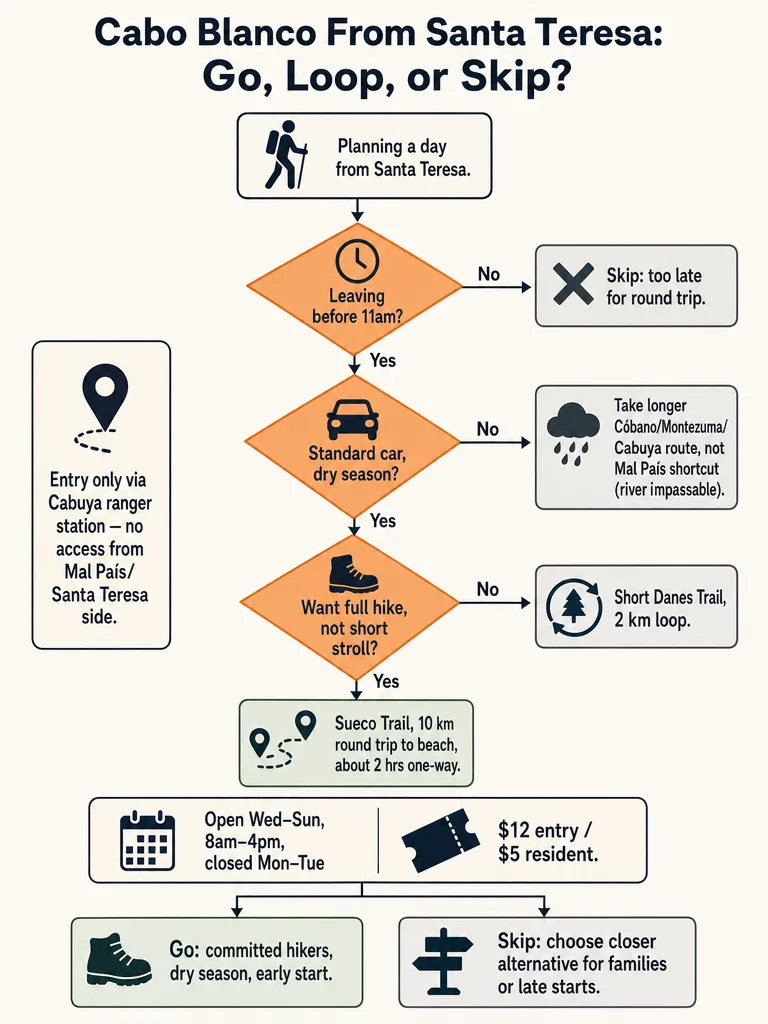
You reach Cabo Blanco only through the ranger station near Cabuya, south of Montezuma. There is no visitor entrance on the Mal País side, even though the reserve's boundary runs close to it, according to Two Weeks in Costa Rica. That entrance point is fixed no matter which road you drive: depending on the season and road conditions, you can take a shorter Mal País-side shortcut or the longer Cóbano/Montezuma/Cabuya road, a route choice covered in detail below.
- Treat the Cabuya entrance as non-negotiable. Whichever road you take to get there, check-in happens at the ranger station south of Montezuma, not anywhere near Mal País.
- Budget the drive time honestly. True Adventure Seeker puts the trip at about 45 to 60 minutes from Santa Teresa; Two Weeks in Costa Rica lists it at closer to an hour, citing rough, unpaved sections as the reason for the slower end of that range. Plan for an hour, especially outside peak dry season.
- Decide between a taxi, your own vehicle, or an ATV. A Tripadvisor reviewer who made the trip from Santa Teresa reports paying $50 USD for a one-way cab, or $100 USD round trip. That's a single traveler's account, not a verified current rate; current sources don't confirm a standard taxi price range, so confirm the fare with your driver before you commit. For the rougher stretches of road, some visitors rent an ATV in Santa Teresa instead.
- Skip the public bus if you're day-tripping from Santa Teresa. Reaching Cabo Blanco by bus from Santa Teresa requires multiple connections through Cóbano and Montezuma, according to Sally Sees' route breakdown, which makes it impractical for a same-day hike. The bus works better as an option from Montezuma itself, where a direct connection toward Cabuya exists.
- Don't assume cash is required at the gate. The available sources don't verify the reserve's current payment method for entry. Bring a card as backup and confirm locally rather than counting on paying in colones only.
Dry Season Shortcut or the Cabuya Route: Which Way Should You Drive?
The Mal País shortcut is the faster line on a map, but it crosses a river that turns impassable in rainy season. The Cóbano/Montezuma/Cabuya route is the safer default for most of the year, even though it adds distance and time to the drive.
Costa Rica Vibes' visitor guide flags this directly: the shortcut between Mal País and the Cabuya area depends on a river crossing that becomes unreliable, and unworkable in some cases, once the rains set in. That makes the longer route through Cóbano and Montezuma the sane choice during rainy season, when water levels are unpredictable day to day.
if you're not certain the shortcut is currently passable, take the longer Cóbano/Montezuma/Cabuya road instead. Costa Rica Vibes calls the river crossing unreliable once rains begin, and guessing wrong costs you a stuck vehicle, not just extra minutes.
If you're staying on the quieter side of the peninsula and weighing where to base yourself for trips like this one, it's worth reading how Mal País compares to Santa Teresa for a calmer stay before you settle on a lodging zone and a route.
Danes Trail vs Sueco Trail: Which One Fits Your Time and Energy?
Cabo Blanco has two main visitor trail options that serve completely different kinds of trips, according to Two Weeks in Costa Rica's trail guide. The Danes Trail is a short forest loop near the ranger station; the Sueco Trail is the long haul to the beach and the reason most people make the trip at all.
| Trail | Distance | Typical time | Difficulty |
|---|---|---|---|
| Danes Trail | 2 km (1.2 mi) loop | Under an hour | Easy forest walk |
| Sueco Trail | 10 km (6.2 mi) round trip | About 2 hours each way | Steep, humid, uneven ground |
Those figures come from Two Weeks in Costa Rica's recently updated breakdown, which lists the Sueco Trail as 5 km to the beach and 5 km back. Other sources disagree: CostaRica.org lists a 4.2 km Sueco Trail and a 1.5 km Danes Trail, and Sally Sees describes three trails total rather than two. If you're planning hike timing, use the 10 km round-trip figure and the two-hour-each-way estimate from Two Weeks in Costa Rica, not the shorter numbers still circulating elsewhere.
The Danes Trail suits anyone who wants tropical forest without a commitment measured in hours. The Sueco Trail is a real hike, not a nature walk, and it should be treated that way when you're deciding how much of your day to give it.
Hours, Entry Fees, and Rules You Need Before You Go
Cabo Blanco is open Wednesday through Sunday, from 8:00 a.m. to 4:00 p.m., and closed Monday and Tuesday, according to Costa Rica Vibes. Show up on a closed day and you'll be turning around at the gate, so build your Santa Teresa week around that schedule first.
Entry costs $12 per person, with a reduced rate of around $5 for Costa Rican residents, per the same source. Parking at the ranger station is free. The reserve falls under Costa Rica's Ministry of Environment and Energy (MINAE) and its protected-areas system, SINAC, which sets hours, fees, and trail rules for parks like this one. Current sources don't verify a reservation requirement or confirm whether the gate takes cash, card, or both; call ahead or check with a ranger on arrival, and carry a card as backup rather than assuming cash is the only option.
Keep reading
- Montezuma Waterfall From Santa Teresa: Go or Skip It?
- How to Get Around Santa Teresa Without Wasting Half a Day
- ATVs in Santa Teresa: When They're Worth It
- How Many Days in Santa Teresa Is Actually Enough?
- Where to Stay in Santa Teresa for Walkability vs Quiet
- Where to Stay in Santa Teresa by Beach, Road, and Noise
How Early Do You Need to Leave Santa Teresa to Finish the Hike Before Closing?
If you're doing the full Sueco Trail to the beach, plan to be at the ranger station by around 11:00 a.m., a deadline Two Weeks in Costa Rica recommends explicitly. Work backward from the 4:00 p.m. closing time and the math gets tight fast.
- Start from the closing time. Costa Rica Vibes and Two Weeks in Costa Rica both confirm the gate shuts at 4:00 p.m.
- Subtract the hike. At roughly two hours each way per Two Weeks in Costa Rica, the round trip alone eats four hours.
- Add real beach time. Costa Rica Vibes recommends budgeting five to six hours total for the hike plus time to actually enjoy the beach before turning back.
- Set your arrival deadline. That window means being through the gate and starting the trail no later than about 11:00 a.m., per Two Weeks in Costa Rica's own tip for visitors.
- Add the drive. With the Santa Teresa-to-Cabuya drive running 45 minutes to an hour, per True Adventure Seeker and Two Weeks in Costa Rica, leave Santa Teresa by around 10:00 a.m., earlier if you want a buffer for the entry line or a slower stretch of road.
leave Santa Teresa by 9:30 a.m. if you can. It buys slack for the entry desk, a bathroom stop, and the inevitable slower-than-expected stretch of road.
Is the Beach and Trail Worth the Effort? Setting Real Expectations
The Sueco Trail is a real forest hike, not a scenic path. Expect steep climbs and descents, uneven ground, and heavy tropical heat with limited shade in sections, a combination Two Weeks in Costa Rica describes from repeat visits, including one hiked with young kids. It's a demanding half-day, and treating it as a casual afternoon stroll is the fastest way to have a bad time.
The reserve's history explains why it's protected this hard. A Swedish naturalist named Nicolas Wessberg and his Danish wife, Karen Mogensen, pushed for the land's protection after Wessberg came to the area in the 1960s searching for native seeds and realized how much forest was being cleared for agriculture, according to Sally Sees' history of the park. Costa Rica declared the area protected in 1963, making it the country's first nature reserve and the starting point for its national park system. The Danes and Sueco trails carry the couple's names in tribute.
Visitors regularly report seeing howler monkeys, capuchin monkeys, coatis, white-tailed deer, and a range of tropical birds along the trail, per CostaRica.org's wildlife notes. The beach at the end, Playa Cabo Blanco, is remote and undeveloped rather than a groomed swim spot. Go expecting a wild, untouched stretch of sand as the reward for the trail, not a lounge-chair beach day, and the trip lands right.
Who Should Skip Cabo Blanco and Choose Something Closer Instead?
Skip Cabo Blanco if you're short on time, traveling with young kids, starting your day late, or hoping for an easy swim beach. The reserve rewards committed hikers with time to spare, and it punishes everyone else with a long drive, a five-day week, and a 4:00 p.m. deadline that's easy to blow.
Families with a toddler or a tight afternoon plan will get more out of a closer option than a five-to-six-hour round trip built around a strenuous trail. If you want forest and a swim without the full-day commitment, the Montezuma waterfall trip from Santa Teresa is a shorter, more forgiving alternative with an actual swimming pool at the end rather than a wild, undeveloped beach. For a family-specific read on what actually works logistically with kids on the peninsula, including which day trips are realistic and which ones burn a whole vacation day, a Santa Teresa with kids guide covers the tradeoffs directly.
Non-hikers, anyone without a firm morning start, and travelers who just want a beach to lounge on all fall into the same skip category. Cabo Blanco isn't a bad destination; it's a specific one, built for people who want the hike as much as the beach at the end of it.
FAQ
Can you enter Cabo Blanco from the Mal País or Santa Teresa side?
No. Cabo Blanco has no visitor entrance on the Mal País side, even though the reserve's boundary runs close to Santa Teresa and Mal País. Every visitor, regardless of which road they drove, checks in at the ranger station near Cabuya, south of Montezuma, according to Two Weeks in Costa Rica's route breakdown. Plan your drive to end at Cabuya, not Mal País, or you'll arrive at a boundary with no gate.
Is Cabo Blanco open every day of the week?
No, Cabo Blanco is closed Monday and Tuesday, open Wednesday through Sunday from 8:00 a.m. to 4:00 p.m., according to Costa Rica Vibes. Show up on a closed day and you'll be turning around at the gate with no hike to show for the drive. Build your Santa Teresa week around this five-day schedule before you plan any other day trip around it.
How far is Cabo Blanco from Santa Teresa in kilometers?
Cabo Blanco sits about 20 km from Santa Teresa by road, according to True Adventure Seeker's day-trip breakdown, translating to roughly 45 minutes to an hour of driving depending on road conditions and season. The distance itself is short; rough, partly unpaved sections between Santa Teresa and Cabuya are what stretch the drive time, not the kilometers themselves.
Do you need a 4x4 to drive from Santa Teresa to Cabo Blanco?
A 4x4 isn't strictly required, but it's the safer choice given the rough, partly unpaved road between Santa Teresa and Cabuya. Some visitors use a taxi or a rented ATV instead. During rainy season, a shortcut route near Mal País crosses a river that can become impassable, according to Costa Rica Vibes, so a higher-clearance vehicle or the longer Cóbano route matters more once the rains set in.
How much does a taxi from Santa Teresa to Cabo Blanco cost?
A one-way taxi from Santa Teresa to Cabo Blanco cost about $50 USD, with $100 USD round trip, according to a Tripadvisor reviewer who made the trip. That's a single traveler's account, not a verified standard rate, so confirm the fare with your driver before you commit. Renting an ATV is a common alternative for travelers who want more flexibility on the return trip.
Can young kids handle the Cabo Blanco hike?
Young kids can finish the Sueco Trail, but it's a genuine effort, not a casual walk. Two Weeks in Costa Rica hiked it with a preschooler and a 1.5-year-old in a carrier, taking about 2.5 hours each way instead of the usual two, and called it hard on their five-year-old despite him finishing smiling. Families on a tighter schedule usually get more out of the shorter Montezuma waterfall hike instead.
Santa Teresa With Kids: What Actually Works
A practical family brief for Santa Teresa: which beaches fit toddlers vs older kids, where high tide gets rough, and how to plan surf lessons, day trips, and transfers without wasting time.
Read →ATVs in Santa Teresa: When They're Worth It
ATV Santa Teresa is a trip-by-trip decision, not a blanket yes. Use one for steep access, boards, and longer runs; skip it for flat, short errands.
Read →Santa Teresa eSIM and SIM Cards on Arrival
For most Santa Teresa trips, an eSIM is the cleanest answer: install it before you fly, keep your home number active, and arrive already connected. Buy a physical Costa Rican SIM only when you need a local number for calls, drivers, or a longer stay.
Read →