Is Santa Teresa Safe in 2026? What Changes at Night
Santa Teresa is safe for most visitors in 2026, but the real risks are roads after dark, petty theft, and rip currents. This guide separates crime from the practical hazards that catch travelers off guard in Santa Teresa and Mal Pais.
Key takeaways
- Santa Teresa, Costa Rica is safe for the vast majority of visitors in 2026.
- Santa Teresa at night changes more because of infrastructure than crime.
- A short walk alone at night in an active, lit part of Santa Teresa is generally fine.
Is Santa Teresa Safe in 2026?
Santa Teresa, Costa Rica is safe for the vast majority of visitors in 2026. Onda Teresa's field-checked guide, updated September 21, 2026, found that violent crime is rare here, while ATV and motorbike crashes, petty theft, and rip currents cause the most harm. The same stretch of unpaved coastal road runs through Santa Teresa and neighboring Mal Pais.
That verdict comes from a guide marked "verified on the ground," not a single traveler's impression. Safe is not the same as risk-free. A handful of specific hazards are serious enough to plan around before you land, not after you've already rented an ATV for the week.
The recurring pattern involves roads, unattended belongings, and ocean conditions, not street crime. People get hurt on the dirt road after dark, lose a bag they left unattended on the beach, or misjudge a rip current. Build your week around those three risks, the road, the beach bag, and the ocean, and you're ahead of most visitors who show up without a plan.
Is Santa Teresa Safe at Night?
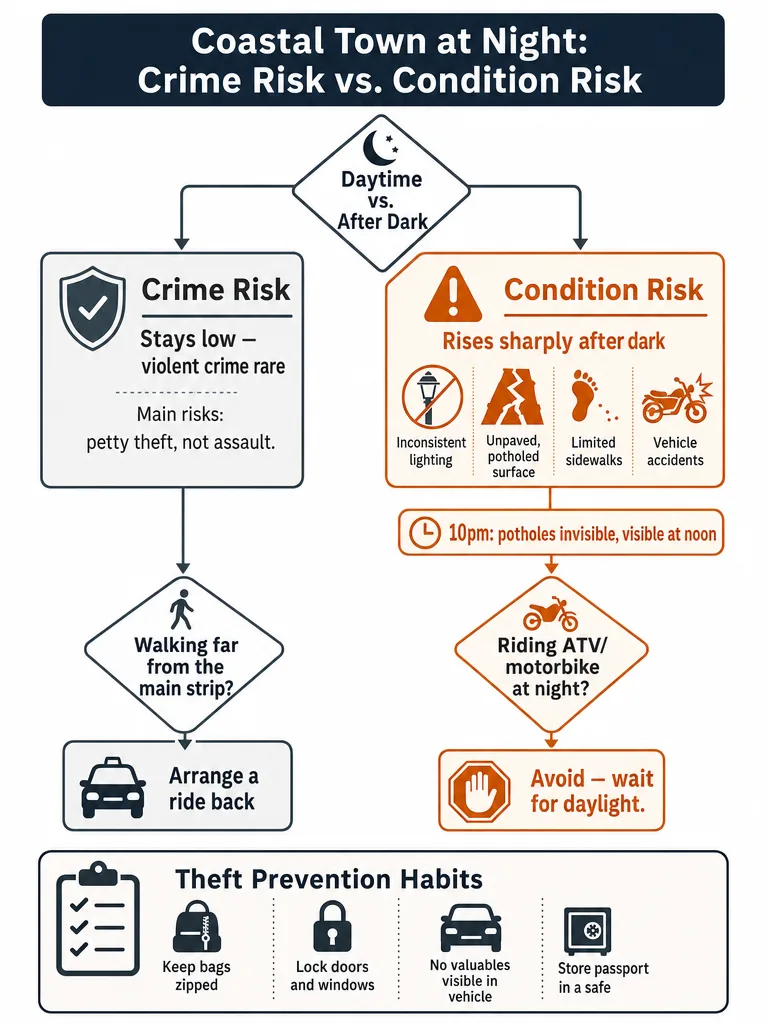
Santa Teresa at night changes more because of infrastructure than crime. Available local sources emphasize road, visibility, and isolation risks after dark; they do not provide verified night-versus-day crime statistics for the town. What they describe in detail is what happens to the physical town once the sun goes down: lighting turns inconsistent, roads get harder to navigate, and the quiet stretches away from the restaurants and bars feel far more isolated.
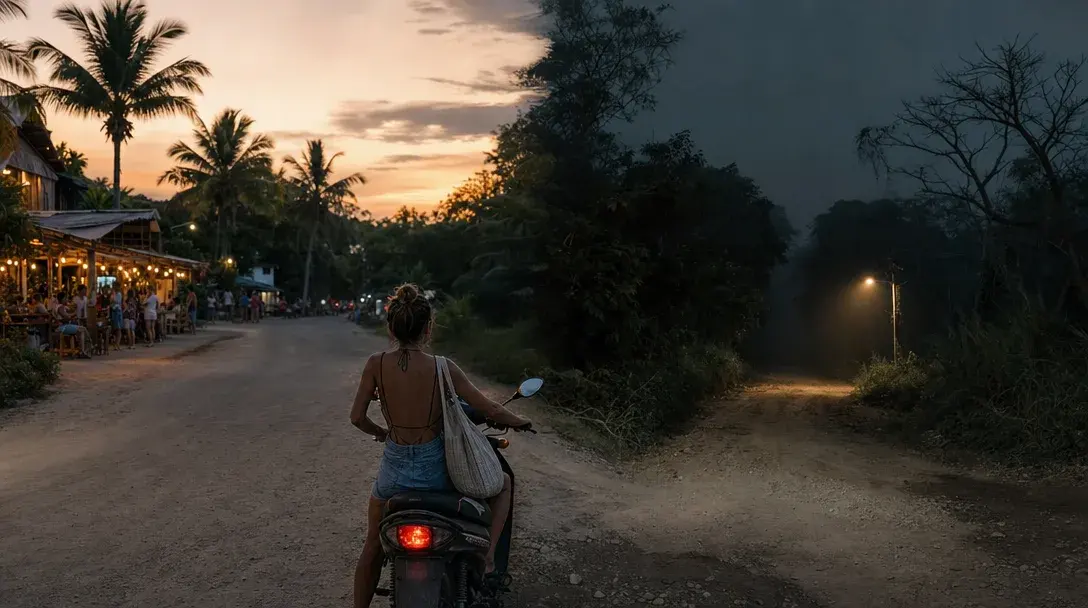
Lighting along the main strip is inconsistent once you move past the restaurants and bars. Roads that are merely dusty and rutted at noon turn into a guessing game in the dark, since there are few sidewalks once you leave the commercial core. Add stray dogs, loose horses, and the same ATVs and motorbikes that share the road all day, and a five-minute walk home takes on a different character after 9 or 10pm.
This split matters for how you plan an evening. If you're deciding where to spend the night itself, where to go out in Santa Teresa without regretting it covers which stretches stay busy late and which ones empty out early, which is a useful filter before you commit to walking anywhere once the sun is down.
Available sources focus more on road conditions, lighting, and isolation after dark than on violent crime. Plan for a pothole, a dark patch of road, or a long walk with no plan for getting home, not for a run-in with a stranger.
Are ATVs and Motorbikes the Biggest Safety Risk After Dark?
Yes. ATV and motorbike crashes are the risk that actually hurts travelers in Santa Teresa, and night riding is where that risk concentrates. The main road running through Santa Teresa and Mal Pais is unpaved, potholed, and sandy in patches, shared by ATVs, motorcycles, pedestrians, dogs, horses, and the occasional delivery truck, all day and into the night.
The same safety guide notes that a pothole merely annoying at noon becomes effectively invisible by 10pm. Rain and dust make the same stretch worse in either direction: wet ruts hide depth, and dry dust hides edges. If you're timing a trip around either extreme, Santa Teresa's 2026 rain, heat, and dust patterns explains when road conditions get the roughest.
A short list of habits accounts for most of the difference between a fine week and a bad one:
- Never ride at night on a road you don't already know well.
- Wear real shoes you can walk and brake in, not flip-flops.
- Lock your ATV every time you park it outside a bar or restaurant.
- Never drink and ride, even for the short stretch back to your room.
None of these are complicated. They're ignored constantly anyway, which is why this stays the top safety issue in town rather than a rare exception.
Is It Safe to Walk Alone at Night in Santa Teresa?
A short walk alone at night in an active, lit part of Santa Teresa is generally fine. A longer walk is a different calculation, since darkness, traffic, and the lack of real sidewalks compound the farther you get from the main strip.
Exposure time matters more than distance on a map. A two-minute walk between two lit restaurants carries little of the risk that a twenty-minute walk down an unlit stretch of road does, even if both technically count as walking at night in Santa Teresa.
The simplest fix is arranging your return before you go out, not figuring it out at midnight. If you're still choosing where to stay, picking a base close to where you'll actually spend your evenings shortens every one of these walks by default. Where to stay in Santa Teresa by beach, road, and noise breaks down which stretches put you close to the action versus a longer ride or walk home. The safest version of a night out here is one where you never have to make that walk-or-ride decision in the dark in the first place.
Can You Walk on the Beach at Night in Santa Teresa?
The beach is best enjoyed in daylight or around sunset in Santa Teresa, not late at night. One local safety guide specifically advises against using beach shortcuts after dark, since the same stretch that feels open and social at 6pm becomes far more isolated by 11pm, with no lighting and few people around if something goes wrong.
Sunset works as a practical cutoff rather than a hard rule. Early evening on the sand, with the bars and restaurants along the beach road still active, still feels social. Once that activity thins out, so does the safety net of simply having other people nearby.
If you want beach time after dark, treat it like any other dark walk: know exactly where you're going, go with someone, and skip the shortcut across an empty stretch of sand in favor of the lit road. Save the long, quiet beach walks for the morning, when the same stretch that feels isolated at night is one of the better reasons to be in Santa Teresa at all.
Keep reading
- Santa Teresa Weather in 2026: Rain, Heat, and Dust
- Things to Do in Santa Teresa 2026: By Area and Season
- Santa Teresa vs Mal Pais for Surf Stays: What Changes
- Santa Teresa Nightlife: Where to Go Out Without Regretting
- Where to Stay in Santa Teresa for Walkability vs Quiet
- Santa Teresa Rainy Season: What Still Works, What Doesn't
Is Santa Teresa Safe for Solo Female Travelers?
Santa Teresa is generally welcoming for solo female travelers, with a tight-knit community of surfers, expats, and repeat visitors, but night safety is a real consideration rather than an afterthought. The practical advice that holds up here is simple: walk with people you know after dark instead of alone, especially once you're off the main strip.
One travel writer's account of a multi-week stay in town mentions sticking close to the Selina area for extra peace of mind. That is a single traveler's personal preference, not a verified neighborhood-by-neighborhood safety comparison, and it shouldn't be read as a general rule about which part of Santa Teresa is safest.
None of this is specific to Santa Teresa. It's the same baseline caution that applies in any small town built around tourism, where most nights are uneventful but a few specific choices, who you walk with, where you stay, how late you're out, change the odds meaningfully. The town's small size cuts both ways: it's easy to get to know people fast, and also easy to end up somewhere quiet and unfamiliar without meaning to.
What Habits Prevent Most Theft in Santa Teresa?
Petty theft, not violent crime, is the most common safety problem travelers run into in Santa Teresa. The pattern is consistent: an unattended bag on the beach, valuables visible through a car or ATV window, or an unlocked room. A short list of habits turns this into a non-issue for most visitors.
- Leave your passport in your accommodation's safe and carry a photo on your phone instead.
- Never leave a bag, towel, or sandals unattended on the beach while you surf.
- Use a bag that actually zips closed when you're walking around town.
- Never leave anything visible inside a parked car or rented ATV.
- Carry only the cash you need for the day.
That last point takes real planning in Santa Teresa specifically. According to a local safety guide, the town has only two ATMs, and they sometimes run out of cash entirely.
Pull more cash than you think you need on your first good ATM run. With only two machines in town, running dry isn't a rare event.
What Emergency Numbers Should You Save Before Going Out?
Save four numbers before you head out for the evening in Santa Teresa, not after something happens. According to the Santa Teresa Dirt Road guide, Costa Rica's national emergency line covers police, ambulance, and fire response, and the peninsula has dedicated backups for tourist-specific and medical situations.
- 911: national emergency line for police, ambulance, and fire
- 800-800-6455: Costa Rica Tourist Police Hotline
- 128: OIJ, the Judicial Investigation Police
- 8512 9111: local Red Cross contact
- Nearest police presence: Fuerza Pública Cóbano
Add 911 as a speed-dial contact before you go out, not while you're trying to explain where you are. None of these numbers do much good buried in a search history at the moment you actually need them. A saved contact beats a search every time.
FAQ
Why do some online safety guides about Santa Teresa seem to contradict each other?
Several widely shared "Santa Teresa safety" articles are actually describing Santa Teresa, Rio de Janeiro, a hillside Brazilian neighborhood with its own crime concerns, not Santa Teresa, Costa Rica's surf town on the Nicoya Peninsula. Confirm a source names Mal Pais, Cóbano, or the Nicoya Peninsula before trusting its safety claims. Onda Teresa's field-checked guide, updated September 21, 2026, covers the Costa Rica town specifically, where the real risks are ATV crashes, petty theft, and rip currents, not street crime.
Is the tap water safe to drink in Santa Teresa?
Don't assume it is, unless your hotel or rental specifically guarantees it. A multi-week traveler account used in local safety research notes that water safety varies by property, so check with your accommodation rather than assuming municipal water meets the same standard everywhere in town. Many hotels and hostels default to filtered or bottled water, which is the safer choice if you haven't confirmed otherwise.
Does Santa Teresa have frequent power outages?
Yes, frequent power outages are a known issue in Santa Teresa, according to a multi-week traveler account used in local safety research. Outages knock out both lighting and WiFi, which adds to the after-dark visibility risks on unlit roads. Booking a room with a backup generator or a battery-powered router is a practical workaround if you need to stay connected or keep lights on during an evening outage.
Is Mal Pais safer than Santa Teresa at night, since they're so close together?
No, there's no meaningful safety difference between the two towns, since they share the same unpaved coastal road, the same inconsistent lighting, and the same ATV and motorbike traffic after dark. A field-checked local safety guide treats Santa Teresa and Mal Pais as one continuous risk corridor rather than two separate safety profiles. Pick a town based on vibe, lodging, or beach access, not an assumption that one side of the road is safer.
How many ATMs does Santa Teresa have, and can they run out of cash?
Santa Teresa has only two ATMs, and according to a local safety guide, they sometimes run out of cash entirely. Pull more cash than you think you'll need on your first successful ATM run rather than counting on a second attempt later in your trip. Carrying only the cash you need for the day, rather than a large amount, also limits what you'd lose if a bag goes missing on the beach.
Are rip currents a real danger at Santa Teresa's beaches?
Yes, rip currents are one of the three hazards that actually hurt visitors in Santa Teresa, alongside ATV crashes and petty theft, according to Onda Teresa's field-checked safety guide. Unlike the road risks that concentrate at night, rip currents are a daytime, in-water hazard tied to surf and tide conditions rather than lighting or traffic. Check conditions at a given break before swimming or surfing, since the pattern holds across the stretch of coast rather than at one specific beach.
Do Flights From Liberia to Santa Teresa Exist?
There’s no scheduled direct flight from Liberia to Santa Teresa in 2026. The practical options are a San Jose connection, shuttle, drive, or charter.
Read →Santa Teresa in October: Rain, Crowds, and Rooms
October is Santa Teresa’s wettest stretch, but it also brings quieter beaches, lower rates, and fewer crowds. The tradeoff is rain, mud, and a trip that rewards flexibility.
Read →Dogs in Santa Teresa: Beaches, Rentals, and Rules
Dogs in Santa Teresa are common in town, but beach access and rental rules are not the same thing. This guide separates booking tags from real policy so you can book with fewer surprises.
Read →