Where to Stay in Santa Teresa for Surf Access, Not Vibes
Pick your Santa Teresa base by surf access, not hotel photos. Playa Carmen, La Lora, Playa Hermosa, and Mal País each fit a different kind of session.
Key takeaways
- Choose your Santa Teresa base by break, not by hotel photos.
- Match the stay zone to your surf level: Playa Carmen for beginners, central Santa Teresa near La Lora for intermediate-to-advanced surfers chasing power, and Playa Hermosa for a quieter north-side base.
- Playa Carmen is the clearest beginner base near Santa Teresa.
- Stay central if you want to walk to surf, food, and shops; stay outside town if you'd trade convenience for emptier waves.
Where to stay in Santa Teresa for surfing if break access matters more than vibe
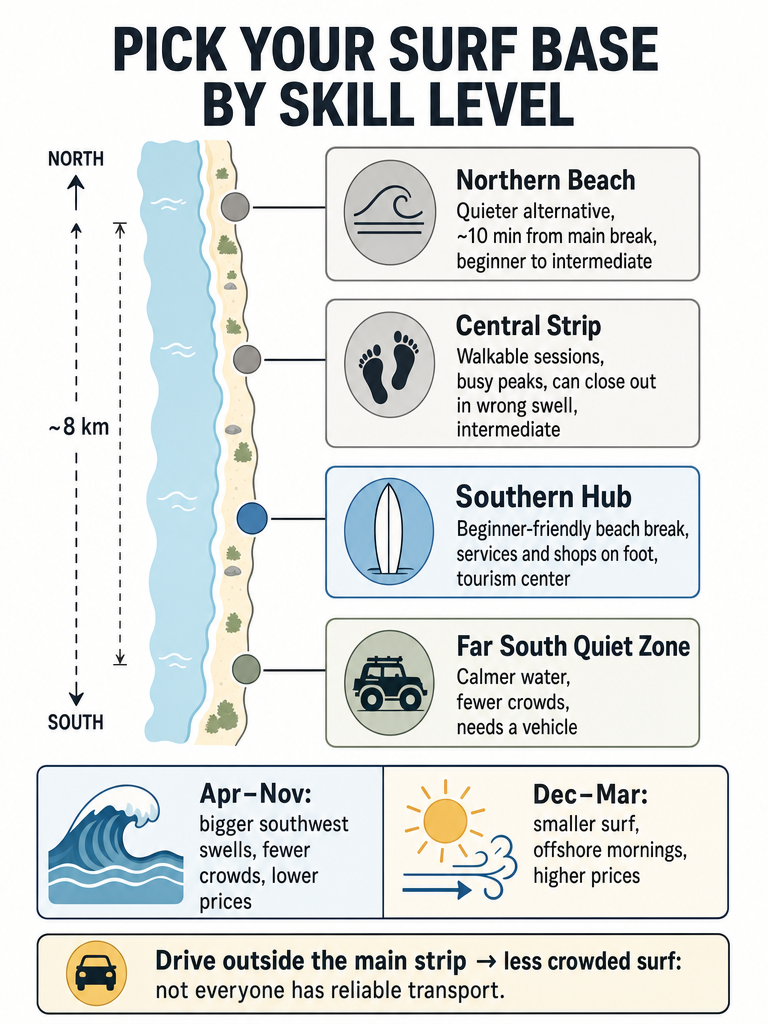
Choose your Santa Teresa base by break, not by hotel photos. Playa Carmen is the beginner-friendly call, central Santa Teresa near La Lora suits stronger surfers, Playa Hermosa is the quieter north-side option about 10 minutes from Playa Santa Teresa, and Mal País works when you want calm over convenience. One local guide says the main stretch runs about 8 km from Playa Carmen to Playa Hermosa, so where you sleep decides your daily paddle-out.
That distance is the whole point. Santa Teresa isn't one beach with one wave — it's a string of breaks along a mostly unpaved road. La Lora, in the center of town, is a powerful beach break best for intermediate and advanced surfers (Source: Hotel Fermata). Playa Carmen stays a beginner favorite. Booking blind, near whichever place had the nicest plunge pool, is how surfers end up with a 20-minute ATV ride to the wave they actually wanted.
The peninsula is remote enough that logistics compound the mistake. One travel account puts the Liberia Airport drive at roughly 4 hours, and Santa Teresa sits about 150 kilometers west of San José. You don't want to arrive tired and discover your base is on the wrong end of the strip.
This guide maps lodging to break difficulty, crowd patterns, tide behavior, and season — the way a surfer decides, not the way a listicle sells. If you also want the map by road, beach, and noise, the Santa Teresa stay guide by beach and road covers that layer.
For the surf, lodging, and logistics that change week to week on the peninsula, get the Nicoya dispatch.
Playa Carmen vs La Lora vs Playa Hermosa: which surf base fits your level?
Match the stay zone to your surf level: Playa Carmen for beginners, central Santa Teresa near La Lora for intermediate-to-advanced surfers chasing power, and Playa Hermosa for a quieter north-side base. Costa Rica Experts lists Playa Carmen, La Lora, and Playa Hermosa as the beaches locals point to for surf, with Mar Azul suggested for a less crowded ride.
The difference between these three is real, not marketing. La Lora is described as a powerful beach break that suits intermediate to advanced surfers best (Source: Hotel Fermata). Playa Carmen remains a favorite for beginners. Playa Hermosa sits about 10 minutes north of Playa Santa Teresa and reads as quieter and more family-friendly than the central strip.
| Stay zone | Surf fit | Character | Position on the strip |
|---|---|---|---|
| Playa Carmen | Beginner-friendly | Tourism hub with shops, restaurants, hostels, larger grocery stores | South end, center point toward Mal País |
| La Lora / central Santa Teresa | Intermediate–advanced, powerful beach break | Busiest, most walkable to dining and surf shops | Center of town |
| Playa Hermosa | Quieter alternative | Less crowded, more family-friendly | North end, ~10 min from Playa Santa Teresa |
Across that 8 km of road, where you sleep decides which wave is a walk and which is a drive. Sort your break first, then shortlist lodging inside that zone — for the level-by-level breakdown, see beginner surf in Santa Teresa by conditions.
What are the best beginner surf spots near Santa Teresa?
Playa Carmen is the clearest beginner base near Santa Teresa. It stays a favorite for first-timers, and it sits at the center point between Santa Teresa to the north and Mal País to the south, with shops, restaurants, hostels, and larger grocery stores close by. Playa Hermosa, about 10 minutes north, is the quieter backup when the central beach gets crowded.
Learning here is easy to arrange. TripAdvisor's Santa Teresa activity hub lists surfing lessons among its highlighted experience categories, so booking a lesson near your base is straightforward. That means you can match a session to the beach you're staying near rather than commuting to one.
One caution before you commit to a single beach: Santa Teresa's main break can close out when the swell direction isn't right (Source: TRVL Collective). A beginner staying central may want to check the forecast and be ready to walk to Playa Carmen or Hermosa on a bad day.
For picking a lesson format that fits your trip, see when to book a school vs a coach.
Central Santa Teresa vs outside town: walkable sessions or fewer crowds?
Stay central if you want to walk to surf, food, and shops; stay outside town if you'd trade convenience for emptier waves. If you drive just outside Santa Teresa, the surf gets less crowded because not everyone has reliable transportation (Source: TRVL Collective). The main dirt road runs roughly 7 kilometers from the Playa Carmen crossroads north through Santa Teresa to Playa Hermosa, so "outside town" is a short drive, not an expedition.
The tradeoff is straightforward. Central Santa Teresa is the busiest, most walkable stretch — you roll out of bed, grab coffee, and paddle out. The cost is company in the water. Move a few kilometers out and the lineups thin, but you'll likely need a car, ATV, or a taxi to reach the beach and back after dinner.
If you don't have transport, base central and use the empty stretches only on days you're willing to walk. If you have an ATV, the quieter waves outside town are the better deal.
Whether a rental is worth it depends entirely on where you land — the guide on whether you need a car in Santa Teresa walks through the real tradeoffs, and how to get around without wasting half a day covers the daily logistics.
Is Mal País a better surf base than central Santa Teresa?
Mal País is the better base if you want quiet over convenience; central Santa Teresa wins on services and walkability. Mal País may be a good option for a more relaxed beach vibe because it's less crowded and busy (Source: TripAdvisor forum). It sits just south of Playa Carmen, which is the tourism hub with the larger grocery stores, most restaurants, and hostels.
The tradeoff is services and night activity. Mal País trades convenience for calm — fewer shops, less late-night noise, and a base spread out enough that errands often mean driving north toward Playa Carmen. For surfers who want early sessions and quiet evenings, that's a feature. For anyone who wants to walk to dinner and a bar, it's friction.
Because Playa Carmen sits between the two, a Mal País stay isn't far from Santa Teresa's surf — it's a short hop up the road. That's what makes it viable as a surf base rather than an isolated retreat.
The full comparison runs two ways: what changes staying in Mal País and, specifically for wave access, Santa Teresa vs Mal Pais for surf stays. If you've already decided on quiet, where to stay in Mal Pais if you hate the chaos narrows the zones.
When is the best season to surf Santa Teresa?
Season changes both the surf and the price of your bed. December to March tend to be the smallest surf months on the Nicoya Peninsula, while April to November is when bigger southwest swells fill in (Source: TRVL Collective). Dry season runs December to April with consistent morning offshore winds, low rainfall, and the busiest, most expensive crowds; May to November brings fewer people, lower prices, and bigger surf (Source: Santa Teresa Surf Camp).
That splits the booking decision cleanly.
| Window | Surf | Crowds & price | Lodging implication |
|---|---|---|---|
| Dec–Apr (dry) | Smaller, clean, glassy mornings | Busiest, most expensive | Book central early; rates and availability tighten |
| May–Nov (green) | Bigger SW swells | Fewer crowds, lower prices | More room to stay near your break for less; expect rain and 4WD roads |
One local surf-camp guide calls May and June the best balance — bigger waves without peak-season prices or crowds. If you want size and value together, aim for the shoulder of the green season rather than the dry-season crush.
Green season also rewards staying near your break, since morning surf is the reliable window when afternoons turn wet. The best time to surf Santa Teresa by swell, wind, and tide goes deeper, and what still works in rainy season covers the transport tradeoffs.
Keep reading
- Where to Stay in Santa Teresa by Beach, Road, and Noise
- Beginner Surf in Santa Teresa: Best Breaks by Conditions
- Nosara or Santa Teresa? The Better Fit Depends on This
- Santa Teresa vs Mal Pais for Surf Stays: What Changes
- How to Get Around Santa Teresa Without Wasting Half a Day
- Santa Teresa Surf Lessons: When to Book a School vs a Coach
What is the best tide for surfing Santa Teresa?
Santa Teresa has extreme tides, and the beach itself changes size dramatically between low and high. The beach is very big at low tide and small at high tide (Source: TRVL Collective). That swing alone affects how much sand you have to cross, where you enter, and whether a beachfront room is actually convenient at every hour.
Precise best-tide guidance for each individual break — Playa Carmen, La Lora, Playa Hermosa, Mar Azul, or Mal País — isn't something the current sources establish, so treat any single "surf at X tide" rule for a specific spot as unverified until you check a live report or local intel.
What the tide swing does confirm: check it before you plan a session, because a break that works on a dropping tide can be flat sand or closed out at another stage. For how to read those stages without getting fooled by star ratings, see how to read the Santa Teresa surf report like a local.
What surf report is most accurate for Santa Teresa right now?
Check a live report that shows swell, wind, and tide separately before you commit to a daily surf plan or lodging zone. A single "3-star" rating hides the direction and period that actually decide whether the break fires or closes out. At the time of crawl, Deepswell listed Santa Teresa surf at 3-4+ ft, tide at 1.8 ft, and wind offshore from the NW at 3 mph.
Those component numbers are what matter. The same Deepswell report broke the swell into a primary of 2.9 ft from 210° at 15s and a secondary of 2.5 ft from 180° at 10s. Direction is the tell: Santa Teresa's main break can close out when the swell direction isn't right (Source: TRVL Collective), so a big number from the wrong angle can mean a bad day, not a good one.
Onda Teresa runs a physics-based surf report updated every 30 minutes, built to show swell, wind, and tide rather than a mood rating — useful when you're deciding whether today's session is worth the walk or the drive.
Deepswell showed two overlapping swells at Santa Teresa — 2.9 ft at 15s from 210° plus 2.5 ft at 10s from 180° — a reminder that one "wave height" figure rarely tells the whole story.
Best hotels in Santa Teresa near the beach (what the sources can prove)
Verify beach-access claims directly rather than trusting "beachfront" in a listing title. Surf Paradise says the beach is a 2-minute walk away and offers 5 tropical houses with 2 bedrooms plus additional room types. Lucero Surf Retreats is described as a family-owned boutique hotel tucked on a hillside in the center of town, running surf retreats and guiding; one travel account puts Lucero at about a 6-minute walk to the beach.
Those are the specifics the sources actually support. Beyond them, several properties get named in guides without verifiable access details — treat everything else as marketing until you confirm it.
| Property | Sourced detail | What to verify yourself |
|---|---|---|
| Surf Paradise | Beach a 2-minute walk; 5 two-bedroom houses | Which break it's nearest; walk on high tide |
| Lucero Surf Retreats | Hillside, center of town; surf retreats & guiding; ~6-min walk to beach | Access at high tide |
| Horizon Hotel | Highly recommended surf & yoga retreat, hillside cabins | Distance and drive to your break |
| Nantipa | Yoga and wellness programming; fishing offerings | Which beach; walking distance; beginner vs advanced fit |
| Florblanca Resort | Spa Bambu, pilates, yoga, fitness offerings | Exact break access and price by season |
Onda Teresa's editorial listings are visited in person, so the access claim you read is the one that held up on the ground — not a phrase copied from a booking page. For lodging sorted by road and noise instead of surf, use the stay guide by beach, road, and noise.
How to choose your Santa Teresa surf stay before you book
Book by break fit, season, and verified access — in that order. The single most common mistake is picking a hotel for its aesthetics and discovering the surf you wanted is a drive away. Since the main strip runs about 8 km from Playa Carmen to Playa Hermosa, location is the decision that shapes every morning of your trip.
Run this checklist before you commit:
- Match break to level. Playa Carmen for beginners; central Santa Teresa near La Lora for intermediate-to-advanced power; Playa Hermosa or Mar Azul for quieter waves.
- Set your season. Dec–Mar for smaller, cleaner surf and peak prices; Apr–Nov (especially May–June) for bigger SW swells, fewer crowds, and lower rates.
- Decide: walk or drive. No transport means base central. With an ATV or car, quieter waves outside town open up.
- Verify the access claim. Confirm walking distance to your actual break — ideally at high tide, when the beach shrinks.
- Read the live forecast. Check swell direction, not just height; the main break closes out on the wrong angle.
- Ignore the plunge-pool photo. Aesthetics don't get you into the water faster.
We keep the peninsula's surf, lodging, and logistics coverage updated for people who live and travel here, not for a one-time trip post.
Sources
- What's the best area to stay in Santa Teresa, Costa Rica?www.facebook.com
- Nosara vs Santa Teresa, Costa Ricatrvlcollective.com
- Visit Santa Teresa Surf Town | Costa Rica Travel Guidewww.wildzephyrco.com
- Costa Rica Relaxed Beach vibe - Santa Teresa Forumcostaricaexperts.com
- Santa Teresa: Things To Do & Where To Stayhotelfermata.com
- Boutique & Family Hotel in Santa Teresa Costa Ricasurfparadise.cr
FAQ
What surf report is most accurate for Santa Teresa right now?
Check swell direction and period, not just a star rating. At the last crawl, Deepswell showed Santa Teresa at 3-4+ ft with two overlapping swells — 2.9 ft from 210° at 15 seconds and 2.5 ft from 180° at 10 seconds — plus offshore NW wind at 3 mph. Direction is the deciding factor: the main break closes out when the angle is wrong, so a big number from a bad direction means a bad day. Onda Teresa runs a physics-based report updated every 30 minutes showing those components separately.
When is the best season to surf Santa Teresa?
May and June hit the best balance — bigger southwest swells arrive without the peak-season crowds or prices. Dry season (December to April) delivers clean, glassy mornings with consistent offshore winds, but it's the busiest and most expensive window. The green season (May to November) brings larger SW swells, fewer people, and lower rates. If you want size without the crush, aim for the shoulder of green season rather than the dry-season peak.
What are the best beginner surf spots near Santa Teresa?
Playa Carmen is the clearest beginner option — it's the most-recommended first-timer break and sits at the tourism hub with hostels, restaurants, and larger grocery stores nearby. Playa Hermosa, about 10 minutes north, is the quieter backup when the central beach gets crowded. One caution: the main Santa Teresa break can close out when swell direction is off, so beginners staying central should be ready to shift to Carmen or Hermosa on an unfavorable day.
What is the best tide for surfing Santa Teresa?
Tides at Santa Teresa swing dramatically — the beach is large at low tide and shrinks significantly at high tide. That swing affects your paddle-out entry point and whether a break is working or flat. Precise tide preferences for each individual break (Carmen, La Lora, Hermosa, Mar Azul) aren't something a single rule covers reliably; check a live report before each session rather than assuming the same stage works across the whole 8 km strip.
Best hotels in Santa Teresa near the beach — what can you actually verify?
Two properties have sourced access details worth trusting. Surf Paradise puts the beach at a 2-minute walk and offers 5 two-bedroom tropical houses plus other room types. Lucero Surf Retreats is a family-owned boutique on a hillside in the center of town running surf retreats and guiding, with the beach roughly a 6-minute walk away. For anything else, confirm the actual walking distance to your specific break — especially at high tide, when the beach shrinks and 'beachfront' listings overstate convenience.
Is Mal País a better surf base than central Santa Teresa?
Mal País wins on quiet; central Santa Teresa wins on services. Mal País is less crowded and busy, making it the better call for surfers who want early sessions and calm evenings. The tradeoff is fewer shops, less dining within walking distance, and a base spread out enough that most errands mean driving north to Playa Carmen. Because Playa Carmen sits right between the two areas, a Mal País stay isn't far from the main surf — it's a short hop up the road, not an isolated retreat.
Santa Teresa eSIM and SIM Cards on Arrival
For most Santa Teresa trips, an eSIM is the cleanest answer: install it before you fly, keep your home number active, and arrive already connected. Buy a physical Costa Rican SIM only when you need a local number for calls, drivers, or a longer stay.
Read →Santa Teresa Pharmacies and Clinics: Where to Go
Public, verifiable pharmacy and clinic details for Santa Teresa are thin, and search results often mix in Wichita listings. This guide shows what to ignore and how to confirm care locally on the day.
Read →Santa Teresa Grocery Stores and Markets: What to Expect
Santa Teresa works best for daily top-ups, while Cóbano is the smarter larger shop. Mini markets cover water, eggs, bread, coffee, beer, and fruit.
Read →