The breaks that bite back, what you need to know before paddling out at Santa Teresa's expert-level reef and point breaks.
If you've been surfing the main stretch of Santa Teresa for a few sessions and you're starting to feel like the beach break isn't quite scratching the itch, this guide is for you. Suck Rock, Sunset Reef, and Punta Barrigona are the three breaks in this zone that will genuinely humble you, and each one demands something different before you paddle out.
Know What You're Getting Into
This is not a guide for beginners, and we're not going to soften that. These three breaks involve reef, rocks, rips, and consequences. If you're still working on reading lineups, building your pop-up, or figuring out where to sit in the water, check out /guides/learn-to-surf-santa-teresa first and come back when you're ready. If you want a broader picture of all the surf in the area before zeroing in on the heavy stuff, the /guides/surf-guide-santa-teresa is the right starting point.
For the expert breaks, the general rule here is this: if you cannot confidently surf overhead-plus beach break, hold your own in a crowded lineup, and handle a wipeout over shallow reef without panicking, you are not ready for these spots. That's not gatekeeping. That's just the truth.
Suck Rock
Suck Rock (also called Rocamar, after the small restaurant nearby) is a right-hand point break sitting in north Santa Teresa, near Florblanca Resort and Hotel Milarepa. It's the most accessible of the three expert spots, and on the right day it's as good as anything on the peninsula.
The wave breaks off a rocky point and can get hollow, particularly at low tide. According to malpaisbeach.com, it works at all tides but low tide is when it sharpens up into something genuinely fast and punchy. At higher tides it softens considerably and becomes more forgiving, which is why you'll sometimes see intermediate surfers out there when conditions are smaller.
What to know before paddling out:
- The name is not ironic. The inside section sucks you toward the rocks on a bad wipeout. Stay aware of where the point is at all times.
- The beach break just south at La Lora is where surf competitions are sometimes held and is consistently one of the prettier, less chaotic stretches of sand in the area. Worth a look even if you're not surfing the point.
- Parking exists via the beach access road near La Lora Amarillo, but malpaisbeach.com notes the road's legal status is murky and the area has a history of car break-ins. Leave nothing visible in your vehicle. Nothing.
- Most days, the point itself is uncrowded because most surfers prefer the beach break peaks nearby. When a solid swell hits and the point is firing, that changes fast.
Best swell direction is W to SW, best wind is northeast offshore (mornings, typically before 10am). Check the /guides/tide-guide-santa-teresa-surfers before you go. Low tide is when it bites.
Sunset Reef
Sunset Reef sits at the far southern end of the Mal Pais coastline, and it is a different animal entirely. This is a deep-water reef break that produces a heavy, thick left-hand tube. surfspots.co describes it as "Cloudbreak/mini Chopes" and that comparison, while flattering, is not entirely wrong on a big day. surftrips.co calls it a "heavy left-hand tube for experienced surfers on solid SW swell," which is the more grounded description.
To get there, head south from Mal Pais until the road ends at the Sunset Reef Hotel. You walk through the gates to the river mouth. Access is straightforward but the spot is remote enough that it doesn't get crowded, which is part of the appeal and part of the danger.
What to know before paddling out:
- surfspots.co estimates it breaks around 50 days per year. This is not a spot you stumble into. You need to be watching the forecast and timing it deliberately.
- It works best at low to mid tide on a rising tide. Swell size needs to be 5-6ft minimum to show its face properly.
- The bottom is reef, sharp rocks, coral. Booties are worth considering. A wipeout here is not a soft landing.
- Because it's a left-hander, regular-footers will be going backside. If your backside tube riding isn't solid, this wave will expose that immediately.
- There's no surf school, no safety patrol, no crowd to help if something goes wrong. Go with someone who knows the spot or at minimum someone who can watch from the shore and knows what to do.
The /guides/santa-teresa-surf-season-guide will tell you that May through October is when the SW swells that power Sunset Reef are most reliable. Outside that window, you're waiting longer between sessions.
Punta Barrigona
Punta Barrigona is the most demanding of the three, not because it's necessarily the heaviest wave, but because it simply won't perform unless conditions are exactly right. It sits at the southern end of Playa Carmen and needs a major south swell to wake up.
realsurftravel.com puts the ideal swell at 6-8ft, with a consistency rating of around 20%. thesurfatlas.com is blunter: "It won't get going until there's something strong cooking in the Pacific. It needs a big 6-foot plus to really shine." When it does fire, you get long, hollow lefts with fast barrel sections over outside reef.
What to know before paddling out:
- The hazards are rocks and rips, and the rips are stronger precisely because you need a powerful swell to make the wave work. Those two things are linked. Bigger swell, stronger rip.
- This is reserved for experienced intermediates at the absolute minimum, and realistically it's an expert wave. thesurfatlas.com says as much directly.
- Because it's so inconsistent, when it is on, word spreads fast. The crowd will be experienced, competitive, and local-heavy. Respect the pecking order.
- The walk in from Playa Carmen's main access is manageable but read the conditions from the beach first. If the rip looks like it's running hard and you're not sure, that's your answer.
Gear, Boards, and Practical Prep
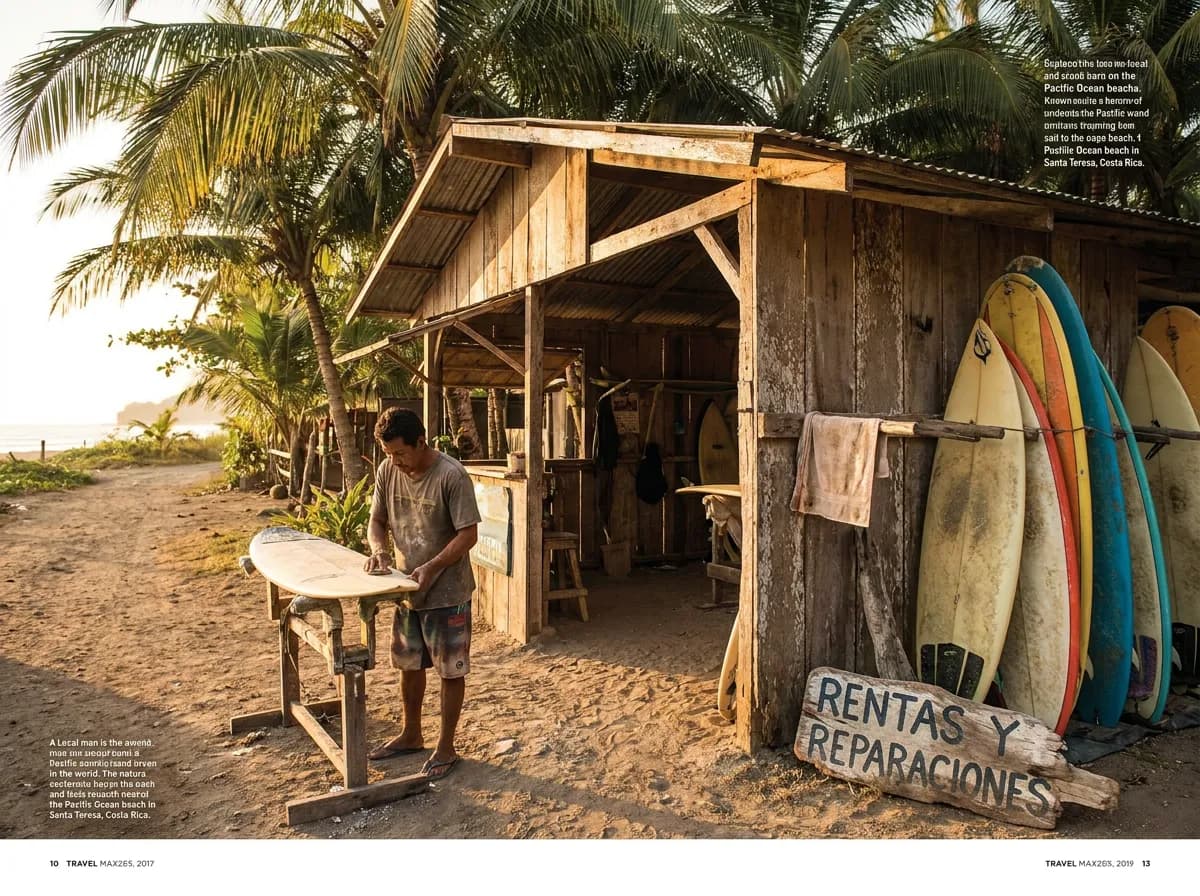
For all three of these spots, you want a board that can handle some punch. A fish or a mid-length will not serve you well at Sunset Reef on a solid day. Shortboarders will want something with enough volume to paddle into fast-moving, steep waves. If you need to sort a board before paddling out, the /guides/surf-board-rental-repair-santa-teresa guide covers what's available locally.
Reef booties are worth having in your bag, especially for Sunset Reef and Barrigona. Urchins are present around the reef sections throughout the area, as surftrips.co flags specifically. A leash in good condition is non-negotiable. Check it before every session.
Water temperature runs 26-29 degrees Celsius, so a rashguard or a 1mm top is plenty for most people. No wetsuit needed.
For timing your sessions, mornings are offshore most reliably from around dawn until 9-10am. After that the onshore winds build and conditions deteriorate. Get up early or don't bother. The /guides/tide-guide-santa-teresa-surfers will help you line up the tide with your target spot. Low tide at Suck Rock and Sunset Reef is a different session than high tide. Plan accordingly.
If you want someone to document a session at one of these spots, the /guides/surf-photography-santa-teresa guide has options for photographers who know these breaks and can position themselves properly.
FAQ
Is Suck Rock suitable for an advanced intermediate surfer? On smaller days at higher tide, yes, it's manageable. On a solid swell at low tide, it's expert territory. Be honest with yourself about where you sit before paddling out.
How do I know when Sunset Reef is breaking? Watch the swell forecasts closely (Surfline and Magic Seaweed both cover this area) and look for solid SW groundswell above 5ft. It breaks roughly 50 days a year, so you may need to wait. Ask locally at surf shops, as word travels fast when it's on.
Can I walk to these spots from central Santa Teresa? Suck Rock is walkable from the northern end of town. Sunset Reef requires transport to the end of the Mal Pais road. Barrigona is reachable from Playa Carmen but is a longer walk south. Having a quad or motorbike helps. See /guides/getting-around-santa-teresa-without-car for options.
What's the best month to target these breaks? May through October for all three, with June through September typically producing the most consistent SW swell. Confirm locally when you arrive.
Are there sharks or other hazards beyond the reef? Sharks are not a significant concern in this area historically. The real hazards are the ones already listed: reef, rocks, rips, and the consequences of a bad wipeout in shallow water over lava. Respect those and you'll be fine.
Browse the full /directory/surf directory to find local surf shops, schools, and board rentals across the Santa Teresa and Mal Pais area.