Beginner Surf in Santa Teresa: Best Breaks by Conditions
Playa Carmen is the clearest first-timer call, Playa Hermosa is the quieter backup, and Playa Santa Teresa only makes sense when conditions are forgiving. Use the day, not the hype, to choose the break.
Key takeaways
- Rent your board at Playa Carmen if you're a true first-timer.
- Santa Teresa works for beginners, but it's not a sheltered learning bay — the day matters more than the destination.
- The Santa Teresa zone has four breaks worth knowing, and only two are reliable beginner calls.
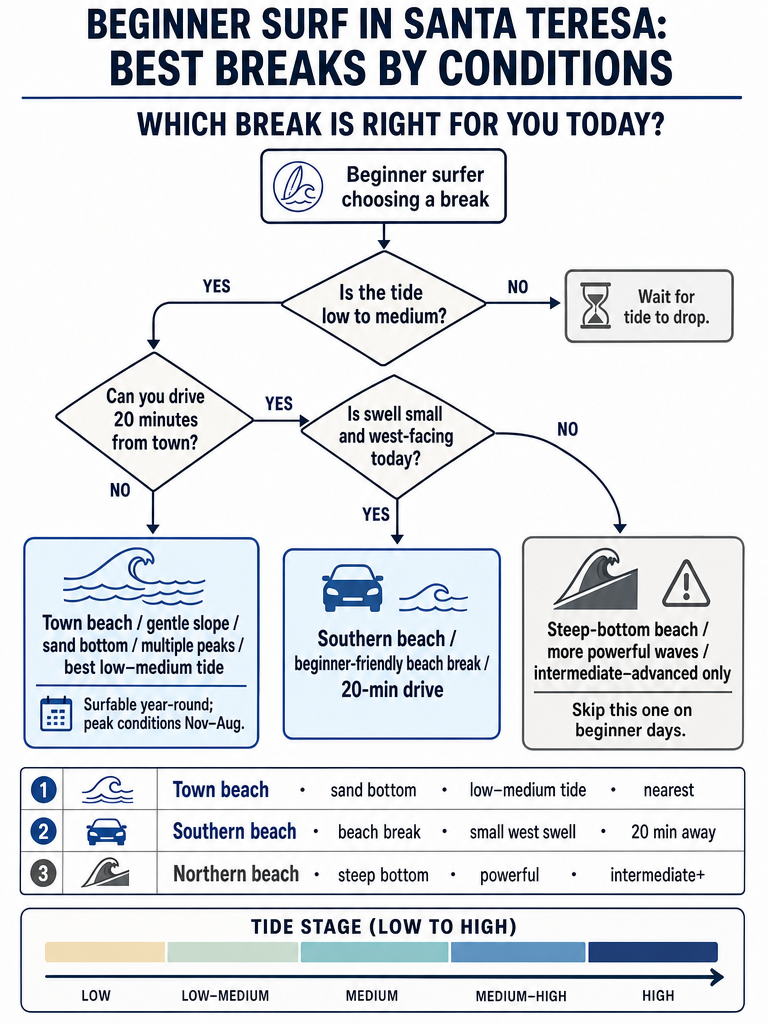
- Playa Carmen is the best beginner call from low to medium tide, when its gently sloped sand bottom and multiple peaks spread surfers out and soften the wave.
Which beach should I go to rent a board: Playa Carmen, Playa Hermosa, or Playa Santa Teresa?
Rent your board at Playa Carmen if you're a true first-timer. It's the town default and the clearest beginner call in the sources: Pura Vida Adventures describes a gently sloped sand bottom and multiple peaks, best for beginners from low to medium tide. If you can already ride 2-3 ft unbroken waves and want easier, less crowded conditions, drive to Playa Hermosa — about 20 minutes from Playa Carmen, and classified beginner-friendly.
Playa Santa Teresa, the specific break, is not a first-timer default. Pura Vida Adventures calls it steeper and more powerful, better for intermediates. Treat it as a beginner-plus call on the right day, not your opening session.
The short version for renting a board:
- Playa Carmen — walk to it from town, first day on a board, low to medium tide.
- Playa Hermosa — worth the drive when you want mellower waves and fewer people.
- Playa Santa Teresa — only once you're comfortable, and only in forgiving conditions.
Is Santa Teresa good for beginner surfers, or only on the right day?
Santa Teresa works for beginners, but it's not a sheltered learning bay — the day matters more than the destination. Blue Mystic Surf School and Best Surf Destinations both call it good for learning, yet Best Surf Destinations is blunt that this is not a calm, protected cove: conditions shift, and some days turn faster and punchier. Lapoint notes surfable waves every month, with warm water year-round between 26°C and 30°C.
That's the honest frame. The coast has real beginner options and consistent swell, but it also has beach breaks that pick up power fast. Pura Vida Adventures lists peak conditions from November to August, which is a wide window that says nothing about whether today is mellow.
Beginner surf in Santa Teresa is a break-by-break decision, and the wrong break in the wrong conditions punishes mistakes. Pick the break to match the day, not the destination hype. For the full timing breakdown, see our guide on the best time to surf Santa Teresa by swell, wind, and tide.
What are the main surf breaks in Santa Teresa Costa Rica?
The Santa Teresa zone has four breaks worth knowing, and only two are reliable beginner calls. Pura Vida Adventures and Real Surf Travel map them by drive time, swell, and consistency — the numbers below come from those two sources. The key distinction most content misses: "Santa Teresa" the zone is not the same as Playa Santa Teresa the break.
| Break | Beginner suitability | Best swell | Consistency | Drive from Playa Carmen |
|---|---|---|---|---|
| Playa Carmen | Beginner-friendly | 2-3ft West | 80% | Town default |
| Playa Hermosa | Beginner-friendly | 2-3ft West | 60% | ~20 min |
| Playa Santa Teresa | Beginner-plus / intermediate | 2-3ft West | 80% | ~10 min |
| Punta Barigona | Advanced only | 6-8ft West | 20% | — |
Playa Carmen and Playa Santa Teresa share the highest consistency at 80%, but they don't share the same wave. Playa Hermosa trades consistency (60%) for gentler shape. Punta Barigona sits at 20% consistency and needs a 6-8ft West swell — not a beginner option under any reading of the sources.
When is Playa Carmen the best beginner surf call?
Playa Carmen is the best beginner call from low to medium tide, when its gently sloped sand bottom and multiple peaks spread surfers out and soften the wave. Pura Vida Adventures identifies it as beginner-friendly and says it works across tides but favors low to medium for learners. Real Surf Travel lists its best swell at 2-3ft West with 80% consistency, so it's the peak that most reliably shows up.
The catch is crowd pressure and a hazard at one end. Real Surf Travel flags Playa Carmen as crowded and notes inside rocks at its northern end. On a busy dry-season morning, the peaks fill fast, and a beginner drifting north can end up over rock instead of sand.
Stay clear of the northern end of Playa Carmen — Real Surf Travel notes inside rocks there. Keep to the sandy peaks and check where you're drifting between sets.
For a first session, that means arriving early, picking a peak away from the crowd and the rocks, and surfing the lower tide window.
When is Playa Hermosa worth the 20 minute drive from Playa Carmen?
Playa Hermosa is worth the drive when you'd rather have mellower, less crowded waves than convenience. Pura Vida Adventures classifies it as beginner-friendly and puts it about 20 minutes from Playa Carmen. Real Surf Travel calls it fantastic for beginners, with the same 2-3ft West best swell as Playa Carmen — but rates it at 60% consistency versus Playa Carmen's 80%.
That consistency gap is the real tradeoff. Playa Hermosa is the more forgiving beach when it's working, but it's working less often, so you can drive 20 minutes and find it flat or off. It rewards checking conditions before you commit rather than showing up on faith.
Drive to Playa Hermosa when the forecast is decent and you want space to practice without dodging Playa Carmen's crowds. Stay in town and surf Playa Carmen when the swell is marginal — the higher hit rate matters more than the gentler shape. If you don't have wheels, factor that in: a Playa Hermosa run may mean a taxi or ATV, which our guide on getting around Santa Teresa covers.
Get the local read before you plan a session. Get the Nicoya dispatch.
Is Playa Santa Teresa a real beginner break?
Playa Santa Teresa is a beginner-plus break at best, and the sources openly disagree. Pura Vida Adventures says it's not beginner-friendly, describing a steeper sandy ocean bottom that produces more powerful waves better suited to intermediate and advanced surfers. Real Surf Travel takes the softer view, saying it can work for beginners at higher tides. Both list its best swell at 2-3ft West and consistency at 80%.
Here's how to reconcile that. On a small, clean, higher-tide day, Playa Santa Teresa can be surfable for a beginner who already stands up and rides unbroken waves. On a punchier day — bigger swell, lower tide, more push — the same beach turns into an intermediate wave that breaks harder and faster than Playa Carmen. The steeper bottom is why.
First-timers should learn at Playa Carmen and earn their way onto Playa Santa Teresa once they can already ride unbroken waves. The name overlap causes bad advice: people read "Santa Teresa is great for beginners," assume that means the specific break called Playa Santa Teresa, and paddle into more power than they can handle. Test it at a higher tide once you're comfortable.
What are the best tides for surfing in Santa Teresa Costa Rica?
For beginners, Playa Carmen is best from low to medium tide — that's the one clear tide call the sources support. Pura Vida Adventures says Playa Carmen works across tides but favors low to medium for learners over its gently sloped sand bottom. Playa Santa Teresa is the opposite story: Pura Vida Adventures ties its steeper, more powerful shape to intermediate surfers, while Real Surf Travel says it can work for beginners at higher tides.
That conflict is the real answer. There's no single "best tide for Santa Teresa" because the two main breaks reward opposite tide stages for a beginner.
| Break | Beginner tide guidance | Source |
|---|---|---|
| Playa Carmen | Low to medium tide | Pura Vida Adventures |
| Playa Santa Teresa | Higher tide (beginner-plus only) | Real Surf Travel |
Match the tide to the break, not the whole zone. A low tide that's ideal at Playa Carmen is the wrong window to test Playa Santa Teresa's steeper wave.
Our guide on how to read the Santa Teresa surf report like a local walks through combining tide with swell and wind.
Keep reading
- Best Time to Surf Santa Teresa by Swell, Wind, and Tide
- Nosara or Santa Teresa? The Better Fit Depends on This
- Santa Teresa Surf Lessons: When to Book a School vs a Coach
- Santa Teresa vs Mal Pais for Surf Stays: What Changes
- Santa Teresa Rainy Season: What Still Works, What Doesn't
- Where to Stay in Santa Teresa by Beach, Road, and Noise
What is the ideal tide height for surfing in Santa Teresa?
There is no verified ideal tide height for each Santa Teresa break in the available sources — anyone quoting a precise foot-measurement threshold is guessing. The sources speak in tide stage, not height: Pura Vida Adventures says Playa Carmen favors low to medium tide for beginners, and Real Surf Travel says Playa Santa Teresa can work for beginners at higher tides. Neither gives an exact number.
That's the honest position, and it's more useful than false precision. Tide height at any given break shifts with the swell, the sandbar, and the day. Chasing a fixed "X-foot" rule sets beginners up to trust a number over what the ocean is actually doing.
Decide on four things instead: tide stage (low, medium, high), swell size, break choice, and a live local reading before you leave. Pull the tide stage and swell from a live source, then match it to the break — low-to-medium for Playa Carmen, higher and only when you're ready for Playa Santa Teresa. The reliable read comes from the stage and the water on the day, not a fixed tide-height number.
Dry season vs wet season: when do beginner conditions get easier?
Dry season is the easier beginner window, but the sources define its edges differently. Lapoint calls the dry season November to May, describing calm, glassy conditions with gentle, consistent swells ideal for beginners and intermediates — and the wet season, June to October, as bigger and more powerful. Best Surf Destinations narrows the easiest learning window to December to April.
| Framing | Season / window | Beginner conditions | Source |
|---|---|---|---|
| Dry season | November to May | Calm, glassy, gentle swells | Lapoint |
| Wet season | June to October | Bigger, more powerful | Lapoint |
| Easiest learning window | December to April | Best for learners | Best Surf Destinations |
The overlap is December through April — the months both sources treat as favorable. The disagreement lives at the edges: Lapoint includes November and May in the calm window; Best Surf Destinations doesn't. The sources don't cover how May specifically behaves for beginners, so treat late dry season as a check-conditions period rather than a guarantee.
Pick December to April for the safest overlap, and confirm the day rather than trusting the calendar. Our rainy season guide covers what still works June through October.
Which Santa Teresa surf breaks should beginners skip?
Beginners should skip Punta Barigona outright and skip Playa Santa Teresa when it's punchy or crowded. Real Surf Travel rates Punta Barigona at just 20% consistency and says it only works on the largest swells — a 6-8ft West best swell that has no place in a beginner session. That's an advanced wave by every reading of the sources.
Playa Santa Teresa is the harder call. It's surfable for beginner-plus surfers at higher tides, per Real Surf Travel, but Pura Vida Adventures classifies its steeper, more powerful wave as intermediate-to-advanced. Skip it on a bigger swell, a lower tide, or a crowded day — the conditions that turn it fast and unforgiving.
Even Playa Carmen has a section to avoid: Real Surf Travel notes inside rocks at the northern end, so beginners should stay on the sandy peaks and watch their drift.
- Skip always: Punta Barigona (20% consistency, 6-8ft swell).
- Skip conditionally: Playa Santa Teresa when punchy, low-tide, or crowded.
- Avoid the section: northern end of Playa Carmen (inside rocks).
Do I need a lesson or local coach before paddling out in Santa Teresa?
Book a lesson before your first paddle-out if you've never surfed a beach break — it's the fastest way to avoid learning bad habits over Playa Carmen's crowds and rocks. The sources support instruction in general: Blue Mystic Surf School and Pura Vida Adventures both position Santa Teresa as a learning destination with surf schools along the main road, and Blue Mystic notes lesson formats including group, private, and kids' lessons.
What the available sources don't provide is a verified, independent ranking of beginner-safe surf schools in Santa Teresa — so this piece won't hand you one. Public detail on which specific schools are safest is limited as of this writing.
The practical rule: take a lesson if you can't yet read where a wave will break, pick a safe peak, or paddle out through whitewater without drifting into hazards. If you already ride 2-3 ft unbroken waves, a local coach for a session or two is often enough to dial in the specific breaks.
Our guide on when to book a school versus a coach breaks down formats and fit.
How should beginners check today's tide, swell, and wind before leaving for the beach?
Run a five-point check before you commit to a break: swell size, tide stage, wind, crowd pressure, and your honest level. This sequence matches the source guidance — low-to-medium tide for Playa Carmen (Pura Vida Adventures), higher tide only for beginner-plus days at Playa Santa Teresa (Real Surf Travel), and a 2-3ft West swell as the working range for the beginner breaks (Real Surf Travel).
Work through it in order:
- Swell — is it near the 2-3ft West window, or bigger and more powerful? Bigger favors sitting out or going mellow.
- Tide — low to medium points you at Playa Carmen; higher tide is the only time to consider Playa Santa Teresa.
- Wind — clean, light wind is what makes dry-season mornings glassy per Lapoint; onshore chop makes any break harder.
- Crowd — Playa Carmen fills fast, so a packed lineup pushes you toward Playa Hermosa or a later window.
- Your level — first-timer to Playa Carmen, comfortable 2-3ft rider to Playa Hermosa, beginner-plus only to Playa Santa Teresa.
If the swell is up, the tide is wrong for your break, and the wind is onshore, the right call is often to sit out. For live readings, Onda Teresa's surf report updates every 30 minutes; pair it with how to read the Santa Teresa surf report like a local.
Stay ahead of the conditions with the peninsula's field notes. Get the Nicoya dispatch.
Sources
- Santa Teresa's 5 Best Places To Surf In Costa Ricapuravidaadventures.com
- surf in santa teresa : r/costarica - Redditlushpalm.com
- Surfing Santa Teresa / Our Surf Trip to the Nicoya Peninsulawww.facebook.com
- Best surf spots for beginners in Santa Teresa or Esterillos, Costa Ricawww.bluemysticsurf.com
- Why Santa Teresa is Perfect for Learning to Surf in 2026www.lapointcamps.com
- The Ultimate Santa Teresa Surf Guide - Costa Rica's Top Surf Spotrealsurftravel.com
- Surfing Santa Teresa (Costa Rica) || The Ultimate Guide - Real Surf Travelbestsurfdestinations.com
FAQ
What are the main surf breaks in Santa Teresa Costa Rica?
Four breaks define the Santa Teresa zone: Playa Carmen (80% consistency, beginner-friendly, best at low-to-medium tide), Playa Santa Teresa (80% consistency, beginner-plus at higher tides only), Playa Hermosa (60% consistency, mellower and less crowded, ~20 minutes from town), and Punta Barigona (20% consistency, advanced only, needs a 6-8ft West swell). All four work best on a 2-3ft West swell.
When is the best tide to surf Santa Teresa Costa Rica?
It depends on the break. Playa Carmen is best at low to medium tide, when its gently sloped sand bottom spreads peaks out and softens the wave. Playa Santa Teresa flips that: its steeper bottom makes it more manageable for beginner-plus surfers only at higher tides. There's no single best tide for the whole zone — match the tide stage to whichever break you're paddling out at.
Is Santa Teresa good for beginner surfers?
Yes, with conditions attached. Playa Carmen is the clearest beginner call — consistent, sandy-bottomed, walkable from town. But Santa Teresa isn't a sheltered bay: beach breaks here pick up power fast, and the wrong break on the wrong day punishes mistakes. Dry season (December through April) gives the calmest, most forgiving window. The destination works for beginners; the daily conditions still need checking.
Which surf break in Santa Teresa is best for a true first-timer?
Playa Carmen is the default first-timer call. It has a gently sloped sand bottom, multiple peaks that spread the crowd out, and 80% consistency on a 2-3ft West swell. Avoid the northern end — there are inside rocks there. Arrive early, pick a sandy peak away from the rocks, and surf the low-to-medium tide window for the most forgiving conditions.
What time of year has the easiest beginner surf conditions in Santa Teresa?
December through April is the safest overlap window. Lapoint describes the dry season (November to May) as calm and glassy with gentle, consistent swells ideal for learners; Best Surf Destinations narrows the easiest learning window to December to April. Both agree on that core stretch. The wet season (June to October) brings bigger, more powerful swells that raise the skill floor at every break.
Which Santa Teresa surf report updates most often?
Onda Teresa's surf report updates every 30 minutes using a physics-based model, making it the most frequently refreshed local option for the Nicoya Peninsula. Most general surf forecast tools update once or twice daily. For beginner planning — where the difference between a 2ft and 4ft swell or a tide stage shift matters — a 30-minute refresh cycle gives a meaningfully more current read before you leave for the beach.
Santa Teresa eSIM and SIM Cards on Arrival
For most Santa Teresa trips, an eSIM is the cleanest answer: install it before you fly, keep your home number active, and arrive already connected. Buy a physical Costa Rican SIM only when you need a local number for calls, drivers, or a longer stay.
Read →Santa Teresa Pharmacies and Clinics: Where to Go
Public, verifiable pharmacy and clinic details for Santa Teresa are thin, and search results often mix in Wichita listings. This guide shows what to ignore and how to confirm care locally on the day.
Read →Santa Teresa Grocery Stores and Markets: What to Expect
Santa Teresa works best for daily top-ups, while Cóbano is the smarter larger shop. Mini markets cover water, eggs, bread, coffee, beer, and fruit.
Read →