Sea turtle nesting near Santa Teresa and Montezuma in 2026: the ASVO hatchery on Montezuma beach, the Caletas-Ario refuge near Manzanillo, species and months, how volunteering works and costs, and honest rules for watching hatchlings.
The sea turtle projects near Santa Teresa are volunteer programmes, not tourist attractions. The two established projects are the ASVO and ACI hatchery on Montezuma beach and the Caletas-Ario refuge near Manzanillo, 45 minutes from Santa Teresa. Olive ridleys are the common nesting turtle, from about July to December with a peak in September and October. Santa Teresa itself has no scheduled public hatchling release.
The short version
If you hoped to book a hatchling release the way you book a surf lesson, that does not exist here in any form I know of. What you can do is volunteer for at least a week, or two at Montezuma, with a conservation project, or walk a nesting beach at night with a licensed guide if one is running. If you are only here for a few days and want to see turtles, the honest options are a lucky chance on a Tortuga Island boat day, snorkelling at Cabo Blanco, or a trip to a beach with a public programme in another region.
If you are staying in Montezuma in the nesting season, ask the project at the beach station whether visitors can attend an evening release. One travel blog reports a small conservation centre releasing babies at 4pm every day during nesting season, which it saw twice in February. That is unconfirmed, so treat it as something to ask about, not to plan around.
Which turtles nest here
Four species are named by the projects I found.
- Olive ridley: the most common nester on this coast, according to the Montezuma volunteer project. At Caletas, nesting peaks in September and October.
- Green (black) turtle: seen more often in December, according to the Montezuma project description.
- Hawksbill: the species GoEco names for its Montezuma programme, and a travel guide says hawksbills nest on Playa Montezuma and the next beach.
- Leatherback: very rare at Montezuma, and nesting at Caletas peaks in December and January.
An olive ridley female lays between 80 and 120 eggs, and incubation takes 45 to 50 days depending on sand temperature, according to the administrator of the Playa Hermosa Punta Mala refuge in Garabito. That is the central Pacific, but the biology is the same. A nest laid in September hatches in November.
One note on dates. Nesting on this stretch of the peninsula runs from about July to December with a September and October peak, which matches the wildlife guide. Plan around that window.
Montezuma: ASVO and ACI Costa Rica
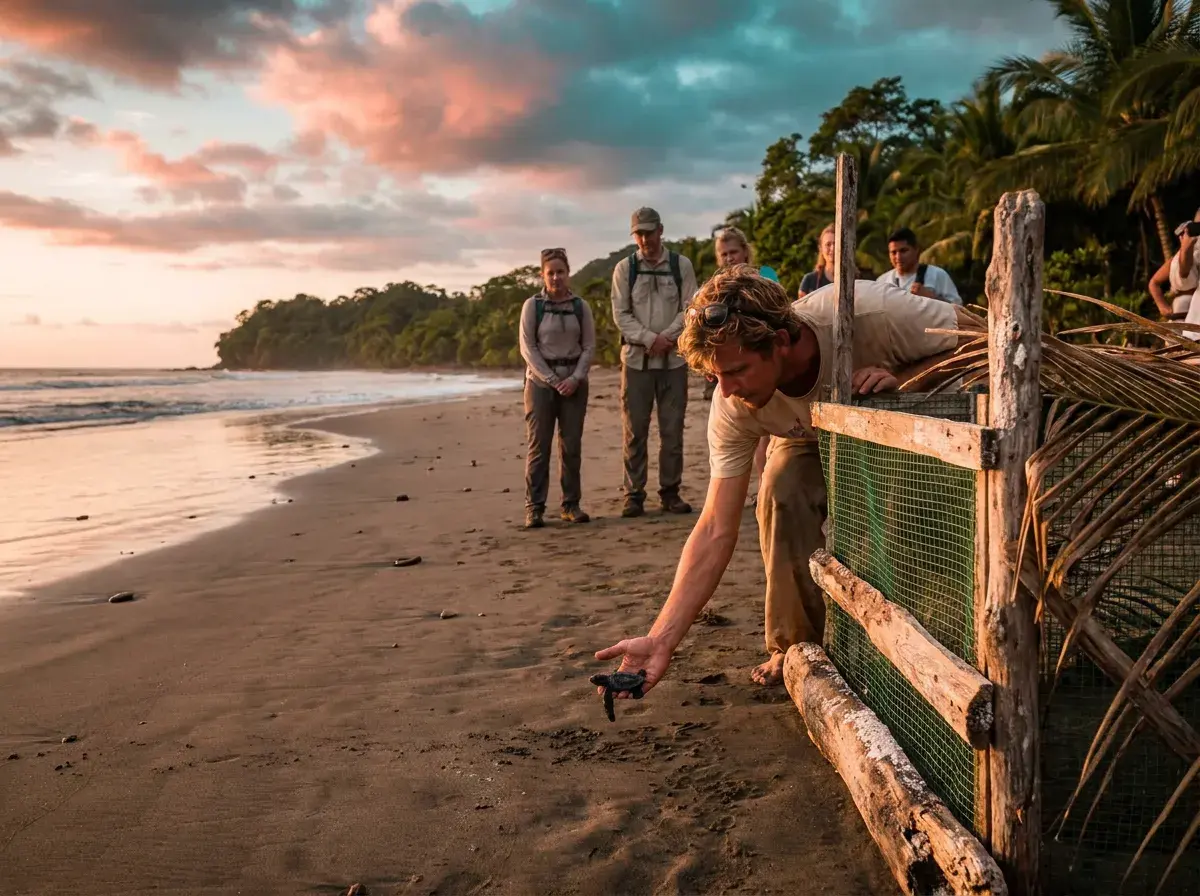
The Montezuma project is a volunteer station on the beach, run as part of ASVO's sea turtle stations with ACI Costa Rica and its Eco Camps programme. ASVO has a listing in the directory, ASVO, in Montezuma. The tasks described across volunteer listings are night patrols to protect nesting turtles and eggs from poachers, moving eggs to a protected hatchery, building and repairing the hatchery, counting and caring for hatchlings, collecting data, weekly beach cleanups and community education. Patrols run about six nights a week for three to six hours, and the project describes a maximum of 30 volunteers. Hatchlings are released in the evening, after about 4pm, at the high tide line, according to GoEco's description.
Costs from the listings I could read: the IVS Great Britain listing shows an extra fee of $800 for two weeks, covering an airport transfer, two nights in a San Jose hostel with breakfast, an orientation day with lunch, and accommodation and meals at the project. GoEco's programme lasts two to twelve weeks and its own page shows no price. The minimum is two weeks. ASVO's own site names Montezuma as a station with sea turtle protection among its tasks, links a registration form, and lists a general contact of +506 8843-2322 or info@asvo.org. It does not describe release events for the public or say what a visitor donation pays for.
Who it suits: students and long stayers who can give two weeks or more. It is not a drop-in activity and it is not a day tour.
Caletas-Ario, near Manzanillo
The Caletas-Ario National Wildlife Refuge covers 313 hectares on land and a 19,846 hectare marine protected area that extends 12 miles offshore, declared in 2006 after about three years of advocacy led by PRETOMA, according to the Sea Turtle Restoration Project. It is mainly an olive ridley nesting beach with a notable number of eastern Pacific leatherbacks, and PRETOMA has monitored it since 2001, according to a Wandering Educators write-up that reports more than 100,000 hatchlings protected and released, with predation falling from about 90% to 20%. The beach is remote and uninhabited, the volunteer-run programme lives in basic conditions, and staff are usually the only people there.
A volunteer travel company, Volunteering Journeys, sells a placement at Playa Ario in the refuge, near Manzanillo and about 45 minutes from Santa Teresa. It does not name the nonprofit that runs the work, so I cannot say it is PRETOMA's. The page lists the work as 3 km night or early morning patrols, marking nests, caring for the hatchery, moving eggs, measuring shells and counting eggs, plus beach cleanups. The season is June to February, with weekly starts in 2026 and 2027. Fees per person are $1,090 for one week, $1,520 for two, $1,990 for three and $2,390 for four, with airport transfers (about $300 each way), flights and insurance extra.
Caletas has no public visiting policy, so do not drive there expecting a tour. Go through a volunteer programme or contact PRETOMA first.
Playa Hermosa, careful
Several search results for "Playa Hermosa turtles" are about Playa Hermosa in Garabito on the central Pacific, where the Punta Mala wildlife refuge protects olive ridley nests from July to December and moves eggs to a hatchery. That is a different Hermosa from the Playa Hermosa de Cobano near Santa Teresa, which we cover in the best beaches guide. There is no hatchery or public release programme on Hermosa de Cobano, though turtles may nest on any quiet beach on this coast.
Seeing turtles without a programme
A chance encounter is likely only underwater. Sea turtles show up on the Isla Tortuga reef trips, which our Isla Tortuga guide prices at $85 to $140, and in the Cabo Blanco waters covered by the snorkelling and diving guide. If you spot a nesting female on a beach at night, which can happen on any quiet beach during the season, keep back and stay quiet, and read the rules below.
Rules for visitors
These match what the wildlife guide on this site and the conservation projects teach, and they are good practice anywhere.
- Do not touch a nesting female, her eggs or a hatchling.
- No flash, no torches and no phone lights near a turtle. Lights draw hatchlings away from the sea.
- Stay behind the turtle, and keep dogs away.
- Do not drive on the beach. Costa Rica bans vehicles on beaches.
- Do not pick up hatchlings and carry them to the water. Let them crawl, since the crawl helps them orient.
- Taking turtle eggs is illegal, and authorities seize them. In central Pacific Playa Hermosa, authorities took close to a thousand eggs in two days. If you see egg poaching, call 911.
- Ask any operator that offers a night turtle tour about group size, flash policy and who gets in front of the turtle. If they cannot answer, do not go.
Planning
The best months are September to November for olive ridley hatchlings and nesting. Rain falls on most days in those months, so plan around the weather using the rainy season guide. If you want to combine turtles with other nature stops, our things to do beyond surfing guide lists the options, and the tours hub compares what is bookable.
Browse every tour and outdoor operator in one place at the /directory/activities hub.
FAQ
Can you see baby sea turtles hatch in Santa Teresa?
There is no scheduled public hatchling release in Santa Teresa. The established projects are volunteer programmes in Montezuma and at the Caletas-Ario refuge. One blog reports daily 4pm releases at Montezuma during the season; that is unconfirmed, so ask the project directly.
When is sea turtle nesting season near Santa Teresa?
Projects on this part of the peninsula describe July or August through November or December, with olive ridley nesting peaking in September and October at Caletas. Leatherbacks nest in December and January.
How can I volunteer with sea turtles near Santa Teresa?
Apply to the ASVO station in Montezuma, which has a two week minimum and an $800 fee shown on one listing, or to the programme at Playa Ario near Manzanillo, which a volunteer company prices at $1,090 for a week. ASVO's general contact is info@asvo.org.
Is it okay to touch sea turtle hatchlings?
No. Do not touch or carry hatchlings, and do not use lights or flash. Let them crawl to the sea on their own.
How much does a sea turtle release cost?
No public release near Santa Teresa publishes a fee. Volunteer programmes cost $800 to $1,090 and up, which funds food, lodging and the project.
Are there sea turtle tours in Santa Teresa?
No operator I know of runs one. Ask any operator about group size, flash policy and their protocol before you book, and avoid anyone who lets you stand in front of a nesting turtle.