Howler monkeys, white-faced capuchins, sea turtles, scarlet macaws, the wildlife you'll encounter and where to find it.
Wildlife here doesn't wait for you to go looking. Howler monkeys rattle the trees outside your room at 5am, scarlet macaws bank over the road while you're grabbing coffee, and if you sit still long enough on any jungle trail, something will move. This guide covers what you'll actually see, where to find it, and how not to waste a morning staring at empty canopy.
The Monkeys: Three Species, Very Different Personalities
You're likely to encounter two species regularly around Santa Teresa and Mal Pais, with a third requiring a bit more effort.
Howler monkeys are the ones that sound like the apocalypse. The territorial vocalization of a male howler is a deep, resonant roar that carries for miles and sounds nothing like what you'd expect from a medium-sized primate. Dawn and dusk are peak howling hours. They move slowly through the upper canopy, which actually makes them easier to observe once you spot them. Look for dark, hunched shapes near fruiting trees along the road between Santa Teresa and Mal Pais, especially early morning.
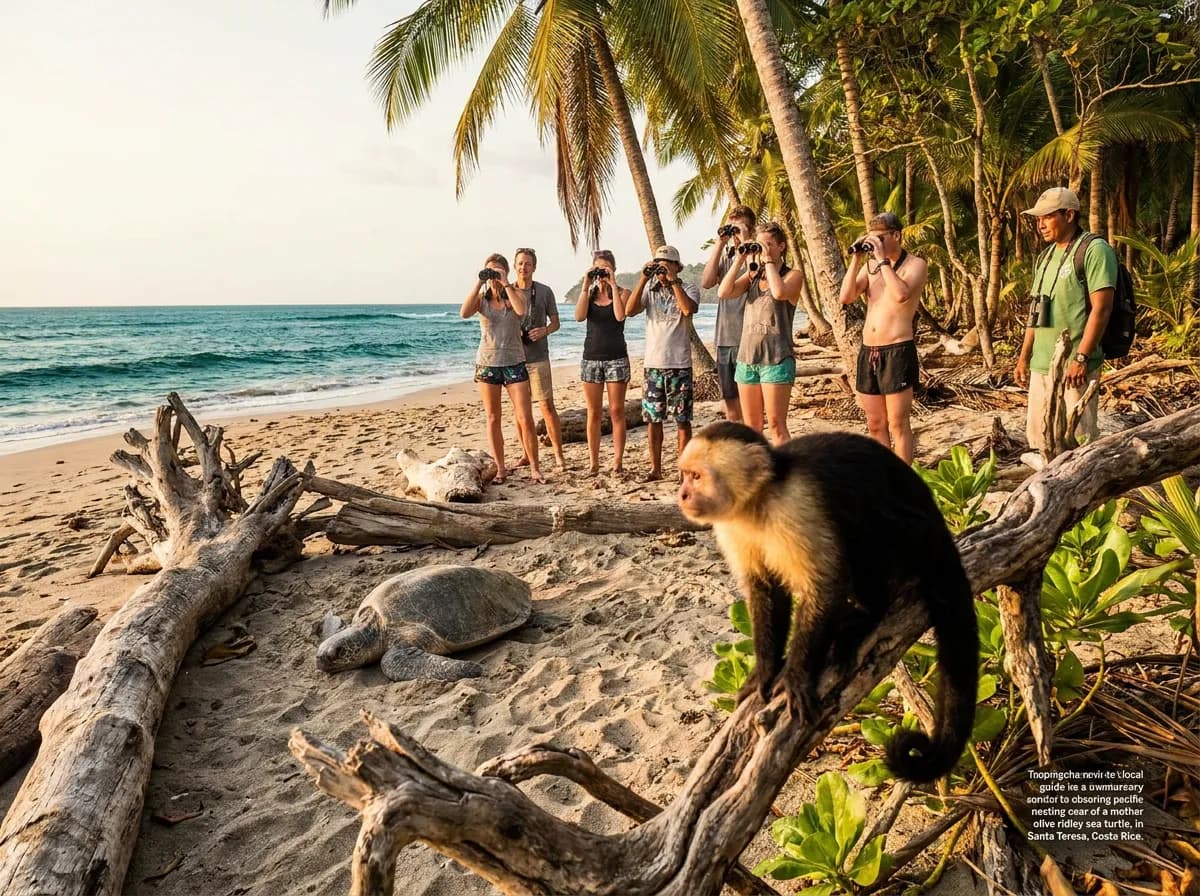
White-faced capuchins are the comedians. They travel in troops of 4-20 individuals, making mischief, raiding gardens, and playing in trees. They're curious about humans but generally maintain distance. You might encounter them on jungle trails, in hotel gardens, or working their way through the canopy above the beach path. They move fast, communicate constantly with chirps and barks, and have absolutely no fear of humans. Don't leave fruit on your terrace.
Spider monkeys are the rarest of the three and genuinely worth seeking out. They swing through the highest canopy levels and are best spotted during guided hikes in protected areas. Cabo Blanco is your best bet. See the section below.
For a broader look at what else keeps you busy out here, check the /guides/things-to-do-santa-teresa-beyond-surfing guide.
Scarlet Macaws and the Birds Worth Stopping For
Parrots and parakeets move in noisy groups overhead, especially early and late. Toucans are often spotted in fruiting trees or heard before you see them. Hummingbirds appear like quick sparks around flowering plants, and raptors are common above open areas when the day warms.
Scarlet macaws are the showstopper. A scarlet macaw pair will bank low over your coffee on the terrace if you're staying anywhere near the forest edge. They're most reliably seen around Cabo Blanco and along the road toward Cabuya in the early morning.
The landscape here is a patchwork: coastal scrub, fruiting trees in gardens, pockets of secondary forest, riparian corridors near Río Negro, and deeper, greener hills as you head inland. That variety is why the birding is genuinely good even without entering a reserve. Head toward Río Negro and you'll find exactly what many birds love: water nearby, taller trees, and quieter roads than the beach strip.
If you want to go deeper, a local guide becomes worth it if you're short on time, want help with identification by call, or are hoping to see specific groups like raptors or forest species. Ask at your accommodation or check the /directory/activities hub for operators running birding-focused outings.
Cabo Blanco: The Reserve That Earns the Trip
This is the anchor for serious wildlife days on the peninsula. Established as Costa Rica's first protected area in 1963, this 1,270-hectare refuge sits 20-30 minutes from Santa Teresa town. Hours are Wednesday through Sunday, 8am-4pm (closed Monday and Tuesday). Entrance fee is $12 USD plus 13% tax.
Best wildlife activity is between 7-9am or 3-4pm when animals are most active. Plan to arrive right at opening.
The Sendero Sueco (Swedish Trail) is 10km round-trip, about 2 hours each way. The main trail descends to a pristine beach and tide pools. You'll spot howler monkeys, birds, and possibly jaguarundis or ocelots. It's rated moderate difficulty, meaning it's doable in trail runners but you'll be sweaty. Over 100 bird species inhabit the reserve, including macaws, trogons, and parrots.
Bring water, sturdy shoes, and binoculars. The reserve does not have a shop inside. We have a full breakdown at /guides/hiking-cabo-blanco.
Curú Wildlife Refuge: Quieter, Closer, Underrated
Curú Wildlife Refuge offers some of the best wildlife viewing in the area without the crowds. Well-maintained trails loop through coastal forest and along the shore. Sloths, howler monkeys, toucans, and parrots are all common, and a slow, attentive pace will be rewarded.
It's a solid half-day option if you want wildlife without committing to the full Cabo Blanco hike. It also pairs well with the Paquera ferry route if you're arriving or leaving that way. See /guides/paquera-vs-tambor-ferry for logistics.
Sloths: How to Actually Find One
Three-toed sloths are around. They're just invisible until they aren't. A three-toed sloth will be suspended in the same cecropia tree for three consecutive days before you even notice it. Cecropia trees, the tall ones with large pale-green leaves, are where you look first. Scan slowly from the base up. Once you find one, you'll suddenly see why you missed it.
Two-toed sloths are nocturnal and harder. If you're doing a night walk with a guide, that's your best shot.
Sea Turtle Nesting: Seasonal and Worth Planning Around
The beaches of Santa Teresa host marine turtles, primarily olive ridleys and occasionally other sea turtle species, especially during nesting season from April through September. This overlaps heavily with rainy season, which is also when the peninsula is quieter and cheaper. See /guides/rainy-season-santa-teresa for the full picture on timing.
Conservation-minded tours can be arranged through your accommodation. Never touch nesting females or eggs. Any operator who lets you get in front of a nesting turtle or use a flash is not running a responsible tour. Ask specifically about their protocol before you book.
The Rest of the Wildlife Checklist
You won't see everything on every trip, but here's what's genuinely present in the Santa Teresa and Mal Pais area:
- Coatis (the raccoon-like animals with the long curved snout), common on trails and occasionally bold near restaurants
- Iguanas, everywhere, especially on sunny rocks and fence posts along the main road
- Anteaters, rare but real, usually spotted at dusk on forest-edge trails
- White-tailed deer, occasionally seen in the hills above town toward Mal Pais
- Margays, ocelots, and jaguarundis are present but rare wild cats. Sightings happen, mostly on longer forest trails at dawn or dusk.
The single best thing you can do for wildlife viewing anywhere here is slow down. Move slowly and quietly. Many creatures are shy. Hire a guide for deeper insight into animal behavior and ecology. Early morning hikes between 7-8am offer the best activity windows.
For getting out to these spots without a car, check /guides/getting-around-santa-teresa-without-car. For day trips that combine wildlife with waterfalls and other peninsula highlights, see /guides/day-trips-from-santa-teresa.
FAQ
When is the best time of year to see wildlife in Santa Teresa? Year-round, honestly. Dry season (December-April) means easier trail conditions and more predictable mornings. Rainy season (May-November) brings lush forest, turtle nesting, and fewer people on the trails. Either works. Early morning is always better than midday regardless of season.
Do I need a guide to see monkeys and birds around town? No. Howler monkeys and capuchins show up without any effort near most accommodations along the forest edge. For Cabo Blanco or serious birding, a guide adds real value, especially for identifying species by call and knowing where to look inside the reserve.
Is Cabo Blanco open every day? No. It's open Wednesday through Sunday, 8am-4pm, and closed on Mondays and Tuesdays. Plan around this, especially if you're on a short trip.
Are the sea turtle tours ethical? Some are, some aren't. Ask your tour operator directly: do they limit group size, prohibit flash photography, and keep visitors behind the turtle during nesting? If they can't answer clearly, find someone else. Your accommodation can usually point you to reputable operators.
Can I see wildlife without leaving the main Santa Teresa strip? Yes. Scarlet macaws, capuchins, howler monkeys, iguanas, and coatis all pass through the town corridor regularly. You don't need to go anywhere special. You just need to look up occasionally.
Browse all local activity operators and guided tour options at /directory/activities.